
Why Are Some Sri Lankan Apparel Factories Struggling While the Industry Still Exports Billions?
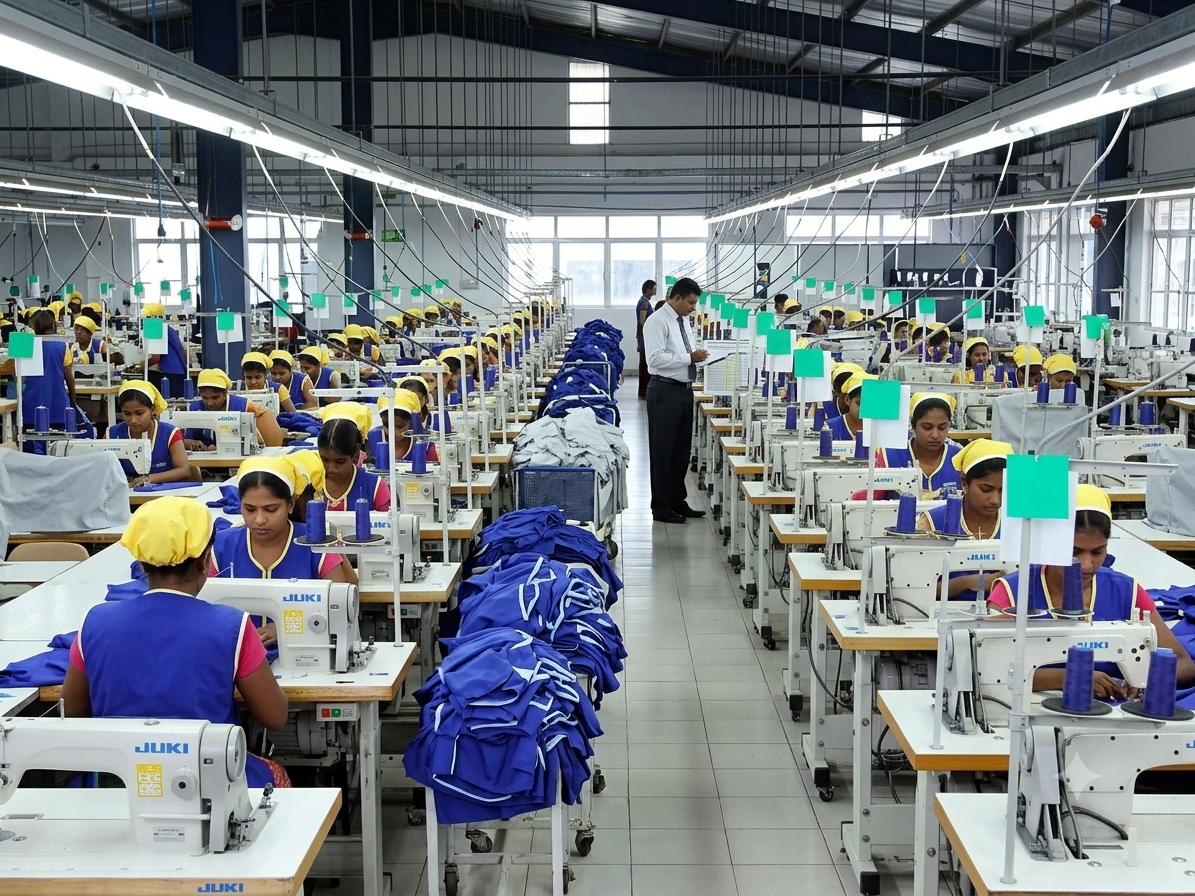
A Strategic Analysis of the Challenges, Opportunities, and the Road Ahead
Sri Lanka’s apparel industry is not dying—but it is changing.
Every few weeks, another headline appears claiming that a garment factory has reduced production, merged operations, or ceased manufacturing. This naturally raises an important question:
Is Sri Lanka’s apparel industry declining?
My answer is no—but parts of the industry are under immense pressure.
There is an important difference between an industry that is declining and one that is transforming.
Sri Lanka’s apparel industry remains the country’s largest merchandise export sector. In 2025, apparel exports exceeded US$5 billion, demonstrating remarkable resilience despite geopolitical uncertainty, inflation, changing consumer behaviour, and slowing demand in major international markets. However, the industry entered 2026 facing renewed headwinds, with exports declining in several early months as demand softened in the United States and Europe. (Sri Lanka Apparel)
This tells us one thing:
The industry is surviving—but not every factory is.
That distinction is critical.
The Economic Importance of Sri Lanka’s Apparel Industry
For more than four decades, apparel manufacturing has been one of Sri Lanka’s greatest economic success stories.
Today, the industry:
- Generates over US$5 billion in annual export earnings.
- Accounts for a significant share of Sri Lanka’s merchandise exports.
- Provides direct employment to approximately 350,000 people, with many more supported indirectly through logistics, packaging, transport, and services.
- Supplies many of the world’s leading international fashion brands.
- Is internationally recognised for ethical manufacturing, compliance, quality, and sustainable production. (Sri Lanka Business)
Unlike many low-cost manufacturing countries, Sri Lanka has built its reputation on quality rather than quantity.
That reputation remains one of the industry’s greatest strengths.
Then Why Are Some Factories Closing?
This is where the discussion becomes more nuanced.
Factories rarely close because of a single issue.
Instead, closures usually result from multiple pressures occurring simultaneously.
In my opinion, the challenges can be grouped into four major categories:
- Global market changes
- Domestic cost pressures
- Structural weaknesses
- Strategic management decisions
Let’s examine each.
1. Global Demand Has Changed
The global fashion industry is undergoing one of its biggest transformations in decades.
Consumers are spending more cautiously.
Retailers are carrying lower inventories.
Brands are placing smaller orders.
Delivery expectations have become much faster.
Instead of ordering six months in advance, many international buyers now expect manufacturers to deliver within weeks.
Factories that cannot respond quickly lose competitiveness.
Although Sri Lanka continues to attract premium buyers, overall order volumes have become less predictable than they were before the pandemic. Industry data showed export growth through much of 2025, but renewed volatility emerged in early 2026 as demand weakened in key markets. (Daily Mirror)
2. Competition Is No Longer Based Only on Labour Costs
Many people assume Bangladesh wins simply because wages are lower.
That explanation is incomplete.
Bangladesh benefits from:
- Massive production capacity
- Integrated textile manufacturing
- Strong economies of scale
- Competitive energy costs
- Large industrial zones
- Favourable trade access into key markets
Vietnam competes differently.
Its strength comes from:
- Free Trade Agreements
- High productivity
- Advanced manufacturing technology
- Strong logistics infrastructure
- Efficient ports
India benefits from its enormous domestic textile ecosystem, while Cambodia continues to compete in labour-intensive production.
Sri Lanka therefore competes in a far more demanding environment than it did twenty years ago.
3. Rising Production Costs
Every manufacturer understands a simple principle:
Profit depends not only on sales—but also on cost.
Over recent years, manufacturers have faced increases in:
- Electricity costs
- Fuel prices
- Logistics expenses
- Shipping costs
- Financing costs
- Wage expectations
- Compliance investments
- Technology upgrades
Individually, these increases appear manageable.
Combined, they significantly reduce operating margins.
Factories producing standard, price-sensitive garments feel this pressure most acutely.
4. Labour Has Become a Strategic Challenge
One of the industry’s biggest long-term concerns is labour availability.
Young Sri Lankans increasingly aspire to careers in:
- Information Technology
- Banking
- Hospitality
- Overseas employment
- Entrepreneurship
Factory employment is no longer viewed as an attractive long-term career by many school leavers.
As experienced workers retire, replacing them becomes increasingly difficult.
Consequently, labour shortages have become a structural issue rather than a temporary problem.
5. Productivity Matters More Than Ever
Higher wages do not automatically reduce competitiveness.
Lower productivity does.
Two factories may pay identical salaries.
Yet one factory can remain profitable while the other struggles.
Why?
Because productivity differs.
Successful manufacturers invest heavily in:
- Lean manufacturing
- Automation
- Artificial Intelligence
- Digital production planning
- Employee training
- Waste reduction
In today’s apparel industry, efficiency is often a greater competitive advantage than low wages.
6. The ESG Revolution
Environmental, Social and Governance (ESG) standards are no longer optional.
Major international brands increasingly evaluate suppliers based on:
- Carbon emissions
- Renewable energy
- Water management
- Waste reduction
- Worker welfare
- Supply chain transparency
Sri Lanka has traditionally enjoyed an excellent reputation for ethical manufacturing.
However, maintaining that leadership now requires continuous investment.
Factories unable to meet evolving sustainability expectations risk losing future contracts—not because of quality, but because of compliance.
Understanding Why Some Manufacturers Survive While Others Struggle
One of the most important lessons from the global apparel industry is this:
The future belongs not to the cheapest manufacturer, but to the most adaptable manufacturer.
Around the world, successful apparel companies are not competing only through low-cost labour. They are competing through:
- Innovation
- Speed
- Technology
- Sustainability
- Brand partnerships
- Supply chain excellence
- Specialised products
Sri Lanka has many world-class apparel companies. However, smaller manufacturers and companies focused mainly on basic production face increasing pressure because their competitive advantage is limited.
The difference between survival and closure is often not the industry itself.
It is the business model.
Case Study 1: Sri Lanka’s Premium Apparel Model – Competing Through Value, Not Volume
Sri Lanka has built a reputation as a high-quality apparel manufacturing destination.
Several leading Sri Lankan apparel groups have successfully positioned themselves as strategic partners rather than simple suppliers.
Their success has come from:
- Long-term relationships with global brands
- Ethical manufacturing reputation
- Innovation centres
- Sustainability investments
- High-quality production standards
The lesson is clear:
Sri Lanka cannot win a race to the bottom. It must win a race to the top.
A factory producing basic garments with only price as its competitive advantage will always face pressure from lower-cost destinations.
However, a manufacturer producing specialised, technical, sustainable, and premium products can command better margins.
Case Study 2: The Bangladesh Transformation – Scale Creates Power
Bangladesh is one of the most important lessons for Sri Lanka.
Over the past three decades, Bangladesh transformed itself into one of the world’s largest apparel exporters.
The reasons include:
1. Massive production capacity
Bangladesh created thousands of factories capable of fulfilling very large orders.
2. Industry ecosystem
The country developed strong supporting industries:
- Textile mills
- Fabric suppliers
- Accessories manufacturers
- Logistics providers
3. Cost competitiveness
Large-scale production created efficiency advantages.
Lesson for Sri Lanka:
Sri Lanka cannot copy Bangladesh.
The country does not have the same population size or labour availability.
Instead, Sri Lanka must develop a different competitive identity:
Premium + Sustainable + Innovative Apparel Manufacturing.
Case Study 3: Vietnam – The Power of Trade Strategy
Vietnam provides another valuable lesson.
Vietnam successfully attracted global apparel investment through:
- Free Trade Agreements
- Foreign investment policies
- Infrastructure development
- Manufacturing efficiency
Many global brands expanded sourcing from Vietnam because the country offered both competitive production and easier market access.
Lesson for Sri Lanka:
A competitive apparel industry requires more than factories.
It requires:
- Trade diplomacy
- Export strategies
- Investment policies
- Infrastructure planning
Manufacturing competitiveness is created at national level.
Case Study 4: COVID-19 Impact – The Weakest Business Models Were Exposed
The COVID-19 pandemic changed the apparel industry permanently.
During the pandemic:
- Retail stores closed
- Fashion demand collapsed
- International orders were cancelled or delayed
- Cash flow became a major challenge
Companies with:
- Strong balance sheets
- Diversified customers
- Better technology
- Efficient management
survived better.
However, companies depending on:
- A few buyers
- Low-margin products
- High debt
- Limited working capital
experienced severe pressure.
The lesson:
A crisis does not always create weakness. Often, it reveals existing weaknesses.
Case Study 5: The Rise of Fast Fashion – A New Global Challenge
The growth of ultra-fast fashion platforms has changed consumer behaviour.
Customers increasingly expect:
- Lower prices
- More choices
- Faster delivery
- Frequent new designs
This creates pressure on traditional apparel supply chains.
A manufacturer producing large quantities of standard products faces a difficult environment.
The future opportunity is not necessarily mass production.
It is:
- Smaller production runs
- Faster response
- Personalisation
- Sustainable fashion
- Higher-value products
Case Study 6: Automation and Technology – The Factory of the Future
The apparel factory of the future will not look like the factory of the past.
Technology will transform:
- Cutting
- Quality inspection
- Inventory management
- Production planning
- Customer forecasting
Artificial Intelligence can help manufacturers predict:
- Consumer trends
- Demand patterns
- Material requirements
- Production efficiency
However, technology is not replacing people completely.
The future model is:
Human creativity + digital intelligence + efficient manufacturing.
Factories that ignore technology will gradually lose competitiveness.
Case Study 7: Sri Lankan SMEs – The Hidden Challenge
Large apparel groups often have:
- Strong international relationships
- Access to finance
- Professional management
- Technology investment
Small and medium manufacturers face different realities.
Many SMEs struggle with:
- Limited access to capital
- High operational costs
- Lack of automation
- Dependency on agents
- Limited international marketing capability
The solution is not simply government assistance.
SMEs need strategic transformation.
They must move from:
“We manufacture what buyers give us”
towards:
“We create solutions that buyers need.”
What Should Sri Lanka Do to Protect the Future of Apparel?
1. Move From Volume to Value
Sri Lanka should not compete with countries that have cheaper labour.
Instead, Sri Lanka should become recognised for:
- Luxury apparel
- Technical garments
- Sustainable fashion
- Healthcare textiles
- Smart clothing
- Performance wear
2. Build an Apparel Innovation Ecosystem
The industry needs stronger collaboration between:
- Universities
- Research institutions
- Manufacturers
- Technology companies
Future competitiveness will depend on innovation.
3. Develop Skilled Human Capital
The industry must change its image.
Apparel manufacturing should not be presented as only factory employment.
It should be promoted as a professional career involving:
- Fashion technology
- Engineering
- Digital manufacturing
- International business
- Supply chain management
4. Encourage Automation Without Losing Employment
Automation should not be viewed only as a threat.
It can help factories:
- Increase productivity
- Improve quality
- Reduce waste
- Create higher-skilled jobs
5. Strengthen International Market Access
Sri Lanka must continue working on:
- Trade agreements
- Export promotion
- Brand Sri Lanka positioning
- International investment attraction
A small country must be strategically connected to the global economy.
The Future: From Garment Factory to Global Fashion Partner
The biggest mistake Sri Lanka can make is believing that the apparel industry is only about sewing garments.
The future is much bigger.
The opportunity is to create a complete ecosystem:
- Design
- Research
- Innovation
- Sustainability
- Technology
- Manufacturing
- Branding
Sri Lanka has already proven that it can compete globally.
The next challenge is moving from being a supplier to becoming a strategic partner.
Final Thought
The question is not:
“Will Sri Lanka’s apparel industry survive?”
The better question is:
“Which companies will adapt, innovate, and lead the next generation of Sri Lankan apparel?”
Industries do not disappear because challenges exist.
Industries disappear when they stop adapting.
Sri Lanka’s apparel industry still has enormous potential—but the next decade will belong to those who embrace transformation.
The Road Ahead: Can Sri Lanka Build the Next Generation of Apparel Excellence?
The future of Sri Lanka’s apparel industry will not be decided by the challenges we face today.
It will be decided by how we respond to them.
Every successful industry in the world has gone through periods of disruption.
The automobile industry changed through automation.
The banking industry changed through digital transformation.
The tourism industry changed through experience-based travel.
The apparel industry is also changing.
The question is whether Sri Lanka will be a follower or a leader in this transformation.
My Strategic Vision for Sri Lanka Apparel 2030
In my view, Sri Lanka’s apparel sector should focus on five strategic pillars.
1. From Low-Cost Manufacturing to High-Value Manufacturing
Sri Lanka should not attempt to compete only on price.
A country with a relatively small workforce cannot win against countries with millions of manufacturing workers.
Instead, Sri Lanka should strengthen its position as:
- A premium apparel destination
- A sustainable manufacturing hub
- An innovation-driven supplier
- A trusted partner for global brands
The future opportunity lies in products such as:
- Performance wear
- Medical textiles
- Sustainable clothing
- Luxury apparel
- Smart textiles
- Specialised industrial garments
2. From Factory Workers to Industry Professionals
The apparel industry must change the perception of employment.
The future apparel workforce will require professionals in:
- Fashion technology
- Data analytics
- Supply chain management
- Artificial Intelligence
- Robotics
- Sustainability management
A modern apparel factory is no longer simply a production floor.
It is a technology-enabled business environment.
3. Stronger Collaboration Between Industry and Education
Sri Lanka has many talented young people.
However, the gap between education and industry requirements remains a challenge.
Universities, vocational institutions, and apparel companies should work together to develop:
- Industry-focused courses
- Apprenticeship programmes
- Research projects
- Innovation centres
Countries that win in manufacturing are usually countries that successfully connect knowledge with industry.
4. Embracing Digital Transformation
The next generation of apparel companies will use technology to improve:
- Production efficiency
- Quality control
- Demand forecasting
- Inventory management
- Customer relationships
Artificial Intelligence should not be viewed as a threat.
It should be viewed as a tool that allows Sri Lankan companies to compete globally.
5. Creating a Stronger “Made in Sri Lanka” Identity
Sri Lanka has successfully built a reputation for:
- Ethical manufacturing
- Quality products
- Responsible business practices
This reputation should become a stronger global brand.
The country should communicate:
“Made in Sri Lanka means quality, responsibility and innovation.”
A strong national brand creates value for every exporter.
Final Reflection: Transformation Is the Only Sustainable Strategy
The decline of some apparel factories should not be viewed only as a crisis.
It should also be viewed as a signal.
A signal that the industry must evolve.
Companies that depend only on low prices will face increasing pressure.
Companies that invest in:
- Innovation
- People
- Technology
- Sustainability
- Strategic partnerships
will continue to grow.
Sri Lanka’s apparel industry has survived wars, economic crises, pandemics, and global market disruptions.
Its greatest strength has always been adaptability.
The next chapter will not belong to the biggest factory.
It will belong to the smartest factory.
The future of Sri Lankan apparel is not about producing more garments.
It is about creating more value.
Disclaimer
This article has been authored and published by Dr. Dharshana Weerakoon, DBA (USA), in good faith for educational, professional, and public awareness purposes.
The analysis is based on publicly available industry information, international market observations, professional experience, and general economic and business research relating to Sri Lanka’s apparel and manufacturing sectors.
The views expressed are personal analytical opinions intended to encourage constructive discussion on industry transformation, competitiveness, and sustainable economic development.
This article does not represent legal, financial, investment, or commercial advice. Readers should conduct their own independent research and professional consultation before making business decisions.
The article does not intend to criticise, defame, or negatively portray any individual organisation, company, institution, or industry stakeholder. Any references to industry challenges are made from a general strategic perspective.
The author accepts no responsibility for any interpretation, adaptation, or use of this content beyond its intended educational purpose.
© Dr. Dharshana Weerakoon, DBA (USA). All rights reserved.
Further Reading: https://dharshanaweerakoon.com/comfortable-public-transport-in-sri-lanka/
Further Reading: https://www.linkedin.com/newsletters/outside-of-education-7046073343568977920/