Unlocking Sri Lanka: The Strategic Opportunity Indian SMEs Should Not Ignore
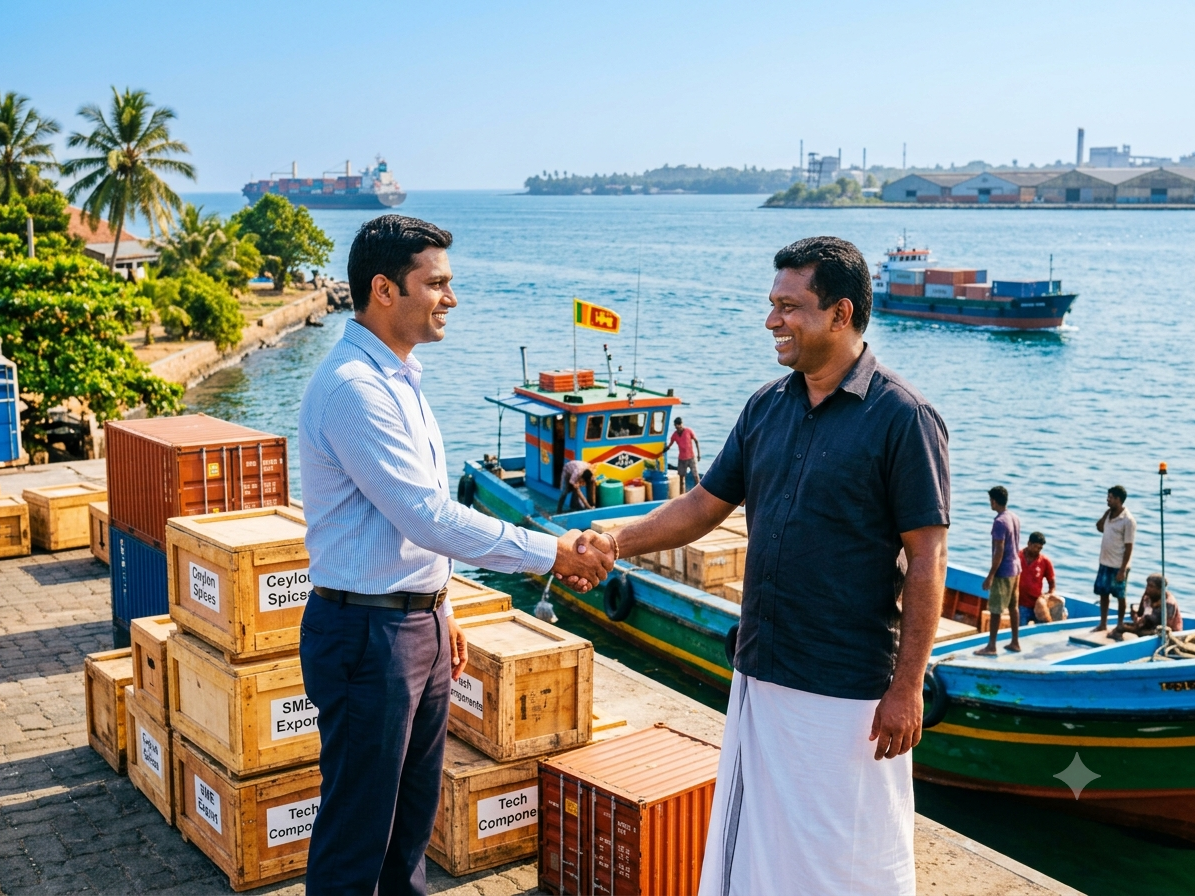
Why Indian entrepreneurs should look beyond tourism and explore the next India–Sri Lanka business corridor
Sri Lanka is often viewed by Indian entrepreneurs through three familiar lenses: tourism, trade and proximity.
I believe the opportunity is much bigger.
For Indian SMEs, Sri Lanka can become a strategic operating base, partnership market, tourism platform, service hub and gateway to new regional opportunities.
The question is no longer whether India and Sri Lanka are economically connected.
The real question is:
How can Indian SMEs convert that connection into sustainable business?
The numbers are already telling us something
Sri Lanka’s economy grew by approximately 5% in 2025, according to the Department of Census and Statistics and the Central Bank of Sri Lanka.
More importantly, India–Sri Lanka commercial relations continue to deepen.
Merchandise trade between the two countries reached approximately US$7.1–7.2 billion in FY2025/26, according to Indian official data.
Sri Lanka’s exports to India have also increased substantially over recent years.
India’s cumulative investment in Sri Lanka had reached approximately US$2.94 billion by 2025, according to figures cited by the High Commission of India from Central Bank data.
Then there is tourism.
Sri Lanka recorded 531,511 Indian tourist arrivals in 2025, an increase of approximately 27.5% over 2024.
These are not simply tourism statistics.
They are indicators of a much larger commercial relationship.
Why Indian SMEs should pay attention
Large corporations can enter markets with large capital, extensive teams and long investment horizons.
SMEs operate differently.
They look for:
- manageable investment;
- faster market entry;
- reliable partners;
- access to customers;
- regional connectivity;
- opportunities to export services;
- scalable business models;
- and the ability to test a market before committing substantial capital.
Sri Lanka can potentially offer these advantages when the investment is properly structured and locally compliant.
However, I would not recommend that every Indian SME simply “open a company in Sri Lanka”.
Market entry should begin with a business model, not a registration certificate.
That distinction is extremely important.
1. Tourism and Hospitality
This is perhaps the most visible opportunity.
India was Sri Lanka’s largest tourist source market in 2025, with more than half a million arrivals.
But the bigger opportunity is not simply bringing more Indian tourists.
It is creating specialised tourism products for different Indian customer segments.
For example:
Case Study 1 — Indian Wedding Tourism
Sri Lanka has the natural environment, hotels, beaches, heritage locations and air connectivity required for destination weddings.
An Indian SME specialising in wedding planning, photography, event management, luxury transport, décor, entertainment or travel management could establish a local partnership model rather than building a large physical operation.
The business can earn from the entire ecosystem:
Accommodation + events + transport + food + entertainment + excursions + shopping.
The opportunity is therefore much larger than selling a hotel room.
2. Wellness, Ayurveda and Medical Tourism
India has enormous expertise in healthcare, Ayurveda, wellness, pharmaceuticals and medical services.
Sri Lanka has a complementary advantage: a tourism environment where wellness can be integrated with leisure.
This creates an interesting cross-border opportunity.
Case Study 2 — Indian Wellness Brand + Sri Lankan Destination
Imagine an Indian wellness company partnering with a Sri Lankan hotel or landowner.
The Indian SME provides:
- professional expertise;
- treatment protocols;
- wellness programmes;
- training;
- marketing;
- technology;
- and customer acquisition.
The Sri Lankan partner provides:
- location;
- hospitality infrastructure;
- local operations;
- tourism licences where required;
- and destination management.
Instead of one company trying to do everything, both sides contribute what they are best at.
That is the partnership model I believe Sri Lanka needs more of.
3. Food Processing and Agribusiness
Sri Lanka imports a significant range of food and agricultural products.
At the same time, the country has a strong agricultural base and a growing tourism and hospitality industry.
This creates opportunities for Indian SMEs in:
- food processing;
- spices;
- ready-to-eat products;
- dairy-related businesses;
- cold-chain solutions;
- food technology;
- packaging;
- agricultural machinery;
- aquaculture;
- and hospitality food supply.
Case Study 3 — From Supplier to Local Producer
An Indian SME supplying hotels with processed food could initially export to Sri Lanka.
After understanding the market, it could move to a second stage:
import → distribute → locally manufacture → export.
This reduces the risk of making a large investment before understanding customer behaviour.
The lesson is simple:
Enter gradually. Learn locally. Scale intelligently.
4. IT, AI and Digital Services
This is one of the most underestimated opportunities.
Sri Lanka has a relatively strong technology and services ecosystem, while Indian SMEs have enormous capabilities in software development, AI, cybersecurity, fintech, ERP, digital marketing and business-process services.
Case Study 4 — Indian Technology SME + Sri Lankan Talent
An Indian technology company does not necessarily need to relocate its entire operation.
Instead, it could establish a Sri Lankan delivery or regional support centre.
The model could combine:
Indian technology + Sri Lankan professionals + international customers.
Such a model can potentially create employment in Sri Lanka while giving the Indian company access to another talent pool and operating location.
This is particularly relevant to SMEs because service businesses can often scale without the capital intensity associated with factories or large property developments.
5. Renewable Energy and Green Businesses
Sri Lanka’s energy transition creates another important opportunity.
Solar, wind, energy efficiency, battery storage, smart-energy solutions and related engineering services are increasingly important areas of economic development.
India has developed significant capabilities in renewable-energy manufacturing, engineering, project development and financing.
Case Study 5 — Solar SME Partnership
An Indian solar SME could work with Sri Lankan businesses, hotels, factories, hospitals or commercial properties to develop:
- rooftop solar;
- energy-management systems;
- battery solutions;
- energy audits;
- maintenance services;
- and efficiency programmes.
The strongest opportunity may not always be selling equipment.
It can be selling energy savings as a business solution.
6. Logistics, Warehousing and Regional Distribution
Sri Lanka’s location is strategically important.
The country sits close to major Indian Ocean shipping routes and has ambitions to strengthen its role in logistics, transshipment and regional connectivity.
For Indian SMEs, this creates opportunities in:
- warehousing;
- freight forwarding;
- cold-chain logistics;
- maritime services;
- e-commerce fulfilment;
- supply-chain technology;
- packaging;
- and specialised distribution.
Case Study 6 — Indian SME Using Sri Lanka as a Regional Platform
A specialised Indian manufacturer could establish a Sri Lankan distribution operation serving the local market while exploring opportunities in other Indian Ocean markets.
The objective should not be:
“How much can I sell in Sri Lanka?”
The better question is:
“What can Sri Lanka help me reach?”
That change in thinking can completely alter an investment strategy.
7. Education, Skills and Professional Services
Another opportunity is sitting in plain sight.
India has an enormous education, vocational-training, technology and professional-services ecosystem.
Sri Lanka needs continuous development of skills across tourism, hospitality, healthcare, technology, logistics, construction and other sectors.
Case Study 7 — Skills Without Building a University
An Indian SME specialising in professional education could partner with Sri Lankan universities, institutes, hotels, companies or industry associations.
The model could include:
- professional certifications;
- hospitality training;
- digital skills;
- AI training;
- management education;
- technical training;
- executive development;
- and industry-specific programmes.
The investment can therefore be relatively asset-light while still creating measurable economic value.
The opportunity is not only about India selling to Sri Lanka
This is where I believe many discussions go wrong.
A successful India–Sri Lanka SME relationship should not be:
India sells → Sri Lanka buys.
It should increasingly become:
India + Sri Lanka → create → operate → export → grow.
That is a completely different economic model.
Sri Lankan companies bring local knowledge, relationships, destination expertise, labour and market understanding.
Indian SMEs bring scale, technology, capital, manufacturing capabilities, management expertise and access to the enormous Indian market.
When those strengths are combined properly, both sides can benefit.
UPI is another small signal with a big meaning
Digital connectivity is becoming an important part of the relationship.
UPI-based payments have already been connected with Sri Lanka’s LankaQR ecosystem, making it easier for Indian travellers to make payments in Sri Lanka.
For SMEs, this is more significant than it may initially appear.
Think about the thousands of small businesses interacting with Indian tourists:
restaurants, shops, guides, transport providers, wellness centres, attractions, retailers and small hotels.
Reducing payment friction can increase convenience and potentially encourage more formal digital transactions.
The future Indian visitor to Sri Lanka will increasingly expect the same digital convenience experienced at home.
Businesses that understand this early may have an advantage.
What Indian SMEs must NOT do
Opportunity does not mean guaranteed success.
Sri Lanka is still an emerging market with regulatory, currency, taxation, political, economic and operational risks.
Therefore, Indian entrepreneurs should avoid:
1. Entering without local due diligence
A local partner is not automatically a good partner.
2. Investing because a property looks cheap
A cheap asset can become an expensive mistake.
3. Assuming Indian business practices will work identically in Sri Lanka
Cultural and regulatory differences matter.
4. Ignoring foreign-exchange exposure
Revenue, costs, financing and repatriation structures must be assessed professionally.
5. Treating government approvals as a formality
Sector-specific licences and approvals may apply.
6. Entering only because someone promises high returns
Investment decisions should be based on independently verified numbers, not promises.
7. Ignoring ESG and community considerations
The next generation of investment will increasingly be judged not only by financial returns but also by its impact on people, communities and the environment.
What I would recommend to an Indian SME
I would use a 5-stage Sri Lanka entry model.
Stage 1 — Understand
Study the market, regulations, competitors, customer segments and costs.
Stage 2 — Partner
Identify credible Sri Lankan companies, professionals and institutions.
Stage 3 — Pilot
Start with a manageable project.
Stage 4 — Prove
Measure revenue, customer response, operating costs and scalability.
Stage 5 — Scale
Only after the model works should the company commit larger capital.
This approach is particularly suitable for SMEs.
Sri Lanka should also change the way it attracts Indian SMEs
Sri Lanka should not compete only by saying:
“Come and invest.”
That message is too broad.
Instead, Sri Lanka should present clearly structured opportunities:
Here is the sector.
Here is the market.
Here is the project.
Here is the required investment.
Here are the regulations.
Here are the local partners.
Here is the potential customer base.
Here are the risks.
Here is the expected development timeline.
Serious entrepreneurs appreciate transparency.
They do not need exaggerated promises.
They need clarity.
The next India–Sri Lanka opportunity may belong to SMEs
The India–Sri Lanka relationship is entering a different phase.
The traditional relationship was largely based on:
trade + government cooperation + large infrastructure projects.
The next phase can increasingly become:
SMEs + technology + tourism + services + manufacturing + logistics + entrepreneurship.
And that is where I see significant potential.
Sri Lanka has approximately 22 million people.
India has more than 1.4 billion.
Geographically, the two countries are extremely close.
Culturally, there are centuries of connections.
Commercially, bilateral merchandise trade is already measured in billions of US dollars.
Tourism is growing strongly.
Digital connectivity is improving.
Indian investment is already substantial.
Therefore, the foundation exists.
What is needed now is better execution.
My message to Indian entrepreneurs
If you are an Indian SME owner thinking about Sri Lanka, I would not ask you:
“How much money do you want to invest?”
I would first ask:
“What problem can your company solve in Sri Lanka?”
Then I would ask:
“What can Sri Lanka give your company that you cannot easily achieve elsewhere?”
If those two answers make commercial sense, then the investment discussion becomes much more meaningful.
Sri Lanka does not need investors who come only to extract value.
Sri Lanka needs long-term partners who create value.
And Indian SMEs have an opportunity to become exactly that.
My Vision
I believe the future should not be about India investing in Sri Lanka alone.
It should be about:
India and Sri Lanka building businesses together.
Businesses that create employment.
Businesses that transfer knowledge.
Businesses that bring technology.
Businesses that develop tourism.
Businesses that increase exports.
Businesses that strengthen communities.
Businesses that respect the environment.
And businesses that remain commercially viable.
That is how a bilateral relationship becomes a business ecosystem.
And that, in my view, is the real opportunity.
Sri Lanka is not merely a destination to visit.
It can become a destination to build.
About the Author
Dr. Dharshana Weerakoon, DBA (USA) is a Global Tourism & Hospitality Strategist, entrepreneur, Chairman of Global Cooperation Private Limited and Managing Director of International Hospitality Ventures Private Limited.
His professional interests include tourism strategy, hospitality, destination development, international business partnerships, investment strategy and emerging tourism models.
Disclaimer
This article has been prepared and published in good faith by Dr. Dharshana Weerakoon, DBA (USA), drawing upon publicly available information from national and international institutions, including Sri Lankan and Indian government agencies, tourism authorities, central-bank publications, investment agencies and international economic and tourism data, together with the author’s professional experience and independent industry analysis.
The figures and developments referred to in this article reflect information available at the time of writing and may change as policies, markets, regulations and economic conditions evolve.
This article is intended solely for educational, professional, analytical and public-awareness purposes. It is not legal, tax, financial, investment, immigration or regulatory advice, and it should not be relied upon as a substitute for professional due diligence.
Any reference to an investment opportunity, sector or business model is intended to stimulate discussion and does not constitute a representation, guarantee or solicitation of investment returns.
Potential investors should obtain independent legal, tax, financial, regulatory and commercial advice before making any investment or business decision and should independently verify all applicable licences, approvals, ownership structures, foreign-exchange requirements, taxation obligations and other regulatory requirements under Sri Lankan and Indian law.
The author does not endorse or guarantee any particular company, project, investment, partner, product or financial outcome mentioned or contemplated in this article.
The views expressed are the author’s own professional and analytical views and should not be interpreted as representing any government, institution, company, investment agency or other organisation.
The article is intended to promote responsible cross-border entrepreneurship, sustainable economic cooperation, ethical business practices and mutually beneficial India–Sri Lanka partnerships.
© Dr. Dharshana Weerakoon, DBA (USA). All rights reserved.
Further Reading: https://www.linkedin.com/newsletters/outside-of-education-7046073343568977920/
Further Reading: https://dharshanaweerakoon.com/responsibilities-of-accountants-and-external-auditors/