
Beyond Internships: Why Strategic University–Industry Partnerships Are Shaping the Future Workforce and Entrepreneurship Ecosystem
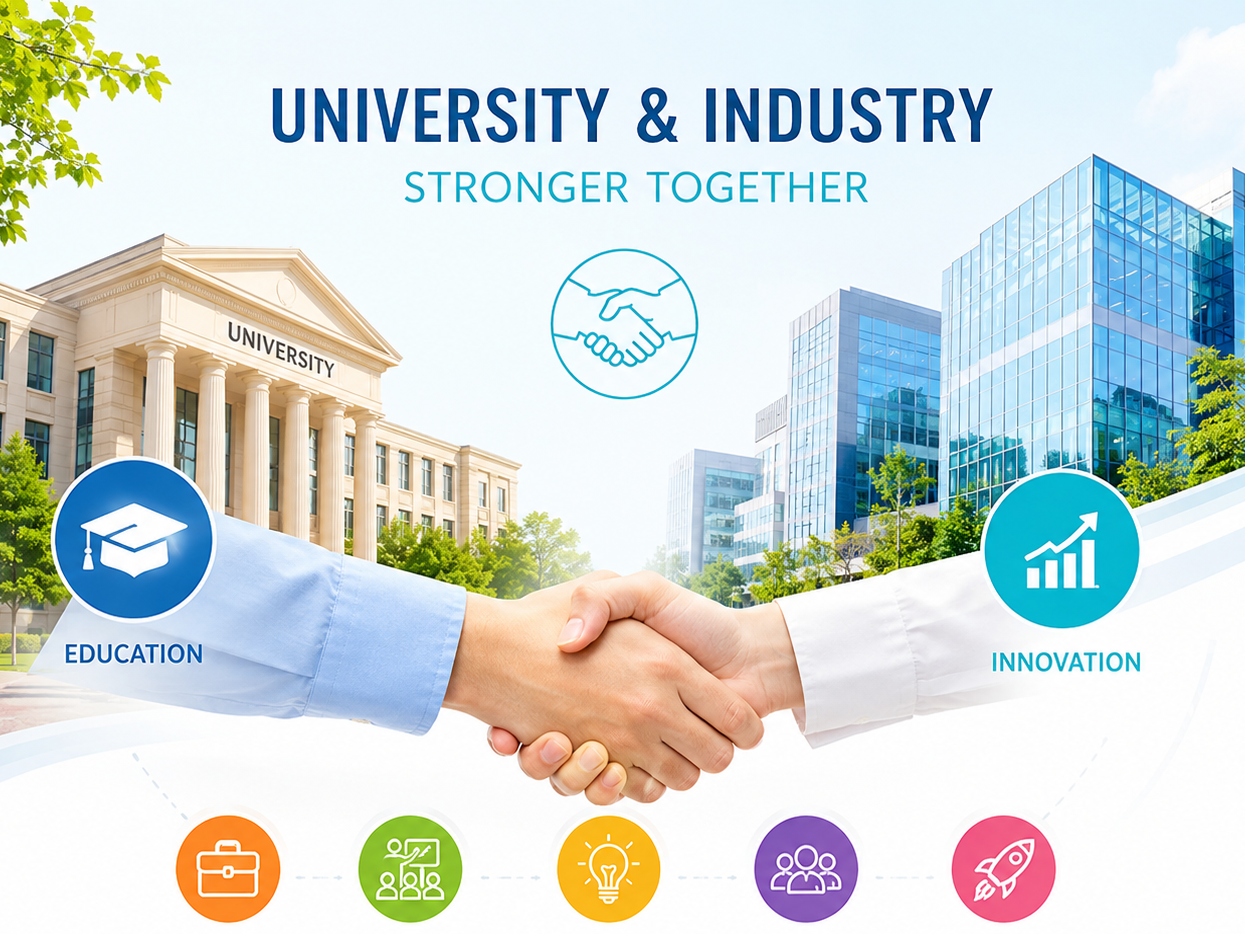
Introduction
The future of higher education is no longer confined to lecture halls, academic journals, and examinations. Across the world, universities are increasingly expected to produce graduates who are not only academically qualified but also industry-ready, innovative, entrepreneurial, and capable of adapting to rapidly changing economic realities.
At the same time, businesses are facing unprecedented challenges in attracting skilled talent, developing future leaders, and remaining competitive in a knowledge-driven global economy. Consequently, a strong partnership between universities and industry has become a strategic necessity rather than a desirable option.
One of the most effective mechanisms to institutionalize such partnerships is through Memoranda of Understanding (MoUs) signed between universities and private sector organizations. While many perceive these agreements merely as frameworks for student internships, their true value extends far beyond internship placements.
A well-designed university-industry partnership creates a sustainable ecosystem where students, lecturers, researchers, entrepreneurs, businesses, and society collectively benefit. Such collaborations help bridge the long-standing gap between theory and practice while creating pathways for innovation, employability, and economic growth.
As Chairman of Global Cooperation (Private) Limited, I have had the privilege of engaging with several higher education institutions to explore mutually beneficial partnerships focused on internships, industry exposure, guest lecturing, research collaboration, entrepreneurship development, and career-oriented educational initiatives.
Based on my observations and professional experience, I firmly believe that Sri Lanka and many developing nations stand at a critical juncture where stronger industry-academic collaboration can significantly influence national competitiveness and workforce development.
The Global Shift Towards University–Industry Collaboration
The traditional education model was largely designed for an industrial-era economy where graduates entered relatively stable professions and remained within a specific career path for decades.
However, the Fourth Industrial Revolution has transformed this landscape.
According to international labour market studies, approximately 50% of employees worldwide will require significant reskilling or upskilling during their careers due to technological advancements and changing workplace requirements.
Furthermore:
- More than 80% of employers globally report difficulties in finding job-ready graduates.
- Nearly 70% of employers prioritize practical skills and workplace readiness alongside academic qualifications.
- Organizations increasingly seek graduates with communication skills, leadership qualities, adaptability, problem-solving abilities, and digital competencies.
These developments demonstrate that academic excellence alone is no longer sufficient.
Universities must therefore integrate practical industry experiences into their educational frameworks, while businesses must actively participate in talent development initiatives.
Why MoUs Between Universities and Companies Matter
A Memorandum of Understanding serves as a strategic platform that enables structured collaboration between academic institutions and industry partners.
Such agreements can facilitate:
- Student internships
- Industry training opportunities
- Guest lectures
- Visiting faculty programs
- Joint research initiatives
- Entrepreneurship development
- Curriculum enhancement
- Industry projects
- Career guidance programs
- Innovation and incubation initiatives
- Employment pathways
When properly implemented, these partnerships become long-term investments in human capital development.
The benefits extend well beyond individual organizations and contribute directly to national economic growth.
Benefit No. 1: Transforming Students into Industry-Ready Professionals
One of the most significant advantages of university-industry collaboration is the development of employable graduates.
Many students graduate with strong theoretical knowledge but limited understanding of workplace realities.
Internship programs help bridge this gap by exposing students to:
- Corporate culture
- Business communication
- Professional ethics
- Teamwork
- Decision-making processes
- Customer engagement
- Technology applications
- Project management
Research consistently shows that graduates who complete structured internships are more likely to secure employment within the first year after graduation compared to those without practical exposure.
More importantly, internships help students identify their strengths, career interests, and areas requiring further development.
Benefit No. 2: Developing Future Entrepreneurs
Entrepreneurship is increasingly recognized as a critical driver of economic growth.
However, entrepreneurial thinking cannot be developed solely through textbooks.
Students require exposure to:
- Real business challenges
- Market dynamics
- Financial management
- Risk assessment
- Innovation processes
- Leadership practices
Industry partnerships create opportunities for aspiring entrepreneurs to learn directly from business leaders, founders, and executives.
Through mentorship programs, business case studies, innovation workshops, and entrepreneurship forums, students gain practical insights that encourage enterprise creation.
Countries with strong university-business ecosystems consistently demonstrate higher rates of startup formation and innovation-driven growth.
Therefore, university-industry collaboration should be viewed as an investment in the next generation of entrepreneurs.
Benefit No. 3: Enhancing Academic Knowledge Through Industry Exposure
Collaboration is not a one-way process.
While students gain industry experience, academic staff also benefit significantly.
Many lecturers possess exceptional academic expertise but may have limited exposure to current industry practices.
Regular interaction with businesses enables academics to:
- Understand emerging industry trends
- Update teaching methodologies
- Align course content with market requirements
- Develop applied research initiatives
- Strengthen professional networks
As industries evolve rapidly, curriculum relevance becomes increasingly important.
Continuous engagement with industry ensures that educational programs remain current and responsive to changing market demands.
Benefit No. 4: Building Industry-Relevant Curricula
One of the recurring concerns raised by employers is the mismatch between graduate competencies and industry expectations.
Through formal partnerships, companies can provide valuable feedback regarding:
- Skills shortages
- Emerging technologies
- Market requirements
- Professional standards
- Future workforce needs
This information allows universities to design curricula that better align with employment opportunities.
As a result:
- Graduate employability improves.
- Employer satisfaction increases.
- Recruitment costs decrease.
- Economic productivity rises.
This creates a win-win situation for all stakeholders.
Benefit No. 5: Expanding Professional Networks
Professional networking is often underestimated within higher education.
Many career opportunities emerge through relationships, mentorship, and professional engagement.
University-industry partnerships enable students to connect with:
- Corporate executives
- Industry experts
- Entrepreneurs
- Researchers
- Policymakers
These interactions help students develop confidence, communication skills, and professional awareness.
For businesses, networking initiatives create opportunities to identify future talent and strengthen corporate reputation among emerging professionals.
Benefit No. 6: Supporting Research and Innovation
Universities remain important centres of knowledge creation.
However, research achieves maximum impact when it addresses real-world challenges.
Industry collaboration can facilitate:
- Joint research projects
- Innovation initiatives
- Product development
- Technology transfer
- Commercialization opportunities
Many globally successful innovations originated from partnerships between academic researchers and industry practitioners.
By combining theoretical expertise with practical market knowledge, organizations can accelerate innovation and improve competitiveness.
Seven Case Studies Demonstrating Successful University–Industry Collaboration
Case Study 1 – Germany’s Dual Education System
Germany’s renowned dual education model integrates classroom learning with structured workplace training.
Students divide their time between academic study and practical employment, resulting in exceptionally high workforce readiness and strong employer confidence.
This model is often cited as a global benchmark for vocational and professional education.
Case Study 2 – Massachusetts Institute of Technology (MIT)
MIT maintains extensive partnerships with global corporations.
These collaborations support research, innovation, startup development, and commercialization activities.
The university’s entrepreneurial ecosystem has contributed to thousands of businesses and significant economic value creation.
Case Study 3 – Stanford University and Silicon Valley
The close relationship between Stanford University and Silicon Valley demonstrates the transformative power of university-industry partnerships.
Many successful technology companies emerged from this ecosystem, benefiting from academic expertise, mentorship, funding, and industry engagement.
Case Study 4 – National University of Singapore
Singapore’s universities actively collaborate with industry to ensure graduates possess skills aligned with national economic priorities.
These partnerships support innovation, employability, and entrepreneurship development.
Case Study 5 – Australian Industry Placement Programs
Australian universities increasingly incorporate industry placements into degree programs.
Students gain workplace experience while employers identify future talent.
This approach contributes to improved graduate outcomes and employer satisfaction.
Case Study 6 – United Kingdom Knowledge Transfer Partnerships
The UK’s Knowledge Transfer Partnership model connects universities with businesses to solve practical challenges through collaborative projects.
The initiative has generated substantial economic returns and enhanced innovation capacity.
Case Study 7 – Emerging Sri Lankan University Partnerships
Sri Lankan universities are increasingly partnering with private sector organizations to facilitate internships, research collaboration, guest lectures, and industry engagement.
These initiatives represent positive steps toward strengthening graduate employability and fostering innovation within the country’s higher education system.
The Role of Guest Lecturing and Visiting Faculty Programs
Guest lectures provide students with exposure to current industry realities.
Unlike theoretical classroom discussions, industry professionals share:
- Practical experiences
- Success stories
- Challenges
- Leadership lessons
- Market insights
Such interactions help students understand how academic concepts apply within real business environments.
Similarly, visiting faculty arrangements enable professionals to contribute directly to educational programs while strengthening ties between academia and industry.
The Importance of Job-Oriented Educational Programs
The modern labour market increasingly values practical competencies.
Therefore, universities should integrate:
- Industry certifications
- Professional workshops
- Leadership training
- Communication skills development
- Digital literacy programs
- Project-based learning
These initiatives complement traditional academic learning and improve employment outcomes.
Challenges That Must Be Addressed
Despite the benefits, university-industry partnerships may face challenges, including:
- Resource limitations
- Administrative delays
- Misaligned expectations
- Limited industry participation
- Inadequate monitoring mechanisms
To maximize effectiveness, partnerships should include:
- Clear objectives
- Defined responsibilities
- Performance indicators
- Regular evaluations
- Continuous communication
Successful collaboration requires commitment from both academia and industry.
A Vision for Sri Lanka
Sri Lanka possesses immense human capital potential.
However, unlocking this potential requires stronger integration between education and industry.
Universities should become active partners in national development, while businesses should recognize their responsibility in shaping future talent.
By strengthening internship opportunities, promoting entrepreneurship, encouraging industry participation in education, and fostering collaborative innovation, Sri Lanka can create a workforce that is globally competitive, resilient, and future-ready.
The goal should not simply be producing graduates.
The goal should be producing leaders, innovators, entrepreneurs, and responsible citizens capable of contributing meaningfully to society and economic development.
Conclusion
University-industry collaboration is no longer optional.
It is a strategic imperative for institutions, businesses, students, and nations seeking sustainable growth in a competitive global economy.
MoUs between universities and companies should not be viewed as ceremonial documents.
They should serve as living frameworks that drive meaningful action, measurable outcomes, and long-term partnerships.
When students gain practical experience, lecturers enhance industry knowledge, businesses access future talent, and entrepreneurs receive guidance and mentorship, everyone benefits.
Most importantly, society benefits.
The future belongs to nations that successfully connect education with industry, knowledge with application, and ambition with opportunity.
The time to strengthen these partnerships is now.
Disclaimer
This article has been authored and published in good faith by Dr. Dharshana Weerakoon, DBA (USA), based on publicly available educational, labour market, economic development, and higher education information, professional observations, industry engagement, and practical experience accumulated through academic, corporate, entrepreneurial, and leadership roles.
The article is intended solely for educational, professional, informational, and public discussion purposes relating to university-industry collaboration, internship development, entrepreneurship promotion, workforce readiness, and higher education advancement.
The views expressed are personal, analytical, and professional in nature and should not be construed as legal, regulatory, employment, investment, financial, educational accreditation, or policy advice. Readers are encouraged to seek independent professional guidance where appropriate.
Every effort has been made to present information fairly, accurately, ethically, and responsibly. The author accepts no responsibility for any interpretation, application, reliance upon, or misuse of the contents of this article.
This article is written with respect for applicable laws, academic integrity principles, professional ethics, intellectual property rights, equal opportunity principles, privacy considerations, and responsible public discourse standards.
© Dr. Dharshana Weerakoon, DBA (USA). All rights reserved.
Further Reading: https://www.linkedin.com/newsletters/outside-of-education-7046073343568977920/
Further Reading: https://dharshanaweerakoon.com/fairness-in-education/