Beyond the Casino Floor: Can Colombo Become South Asia’s Next Luxury and Family Wealth Gateway?
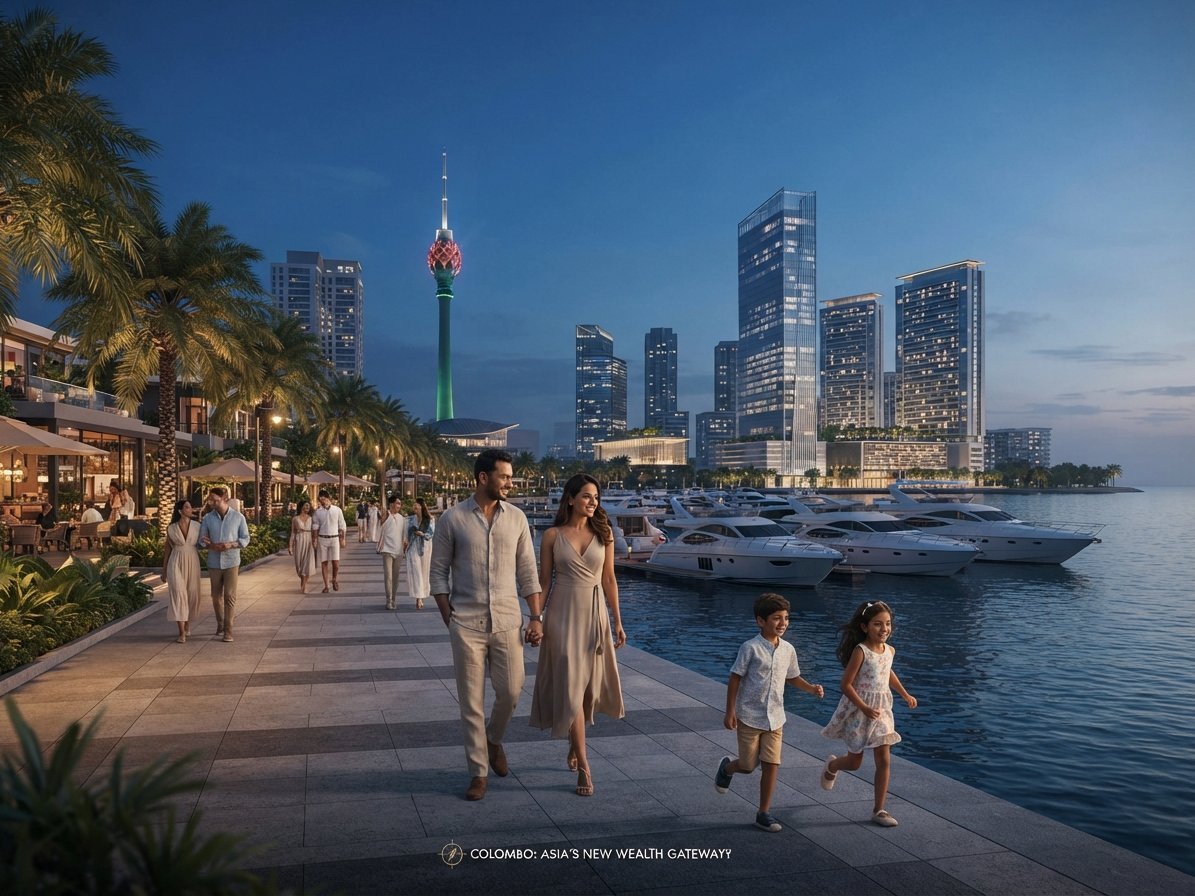
The opportunity is bigger than gaming
When we discuss Colombo’s emerging integrated resort industry, the conversation often centres on casinos, hotel rooms, foreign investment and whether Sri Lanka can become another Macau.
In my view, that is only part of the story.
The more interesting question is this: Can Colombo attract the wider ecosystem of spending associated with internationally mobile entrepreneurs, wealthy families, family offices and luxury travellers?
Consider the activities surrounding a wealthy family travelling internationally. Beyond accommodation, the family may require private aviation, premium dining, wellness programmes, cultural experiences, executive meetings, legal consultations and professional services. Family members may also explore legitimate business partnerships and investment opportunities through appropriately licensed advisers.
These activities create opportunities for tourism, hospitality, retail, transport, professional services and local enterprises.
This is where Colombo integrated resorts could become more strategically important to Sri Lanka’s economic future.
The objective should not be to imitate another destination. Instead, it should be to develop a distinctive proposition that connects Sri Lanka’s hospitality strengths with the needs of international business travellers and affluent families.
The numbers tell an important story
Sri Lanka welcomed 2,362,521 international tourist arrivals in 2025, an increase of approximately 15.1% over 2024, according to published tourism statistics.
India accounted for 531,511 arrivals, making it Sri Lanka’s largest source market that year.
These figures demonstrate the importance of regional connectivity. However, arrival numbers alone do not reveal how much value each visitor creates, how widely spending is distributed or how many business relationships emerge from a visit.
That distinction matters.
Colombo integrated resorts should therefore be assessed not only by occupancy, visitor volumes or gaming-related revenue, but also by their capacity to stimulate additional international spending across the wider economy.
The relevant questions include:
- How much additional non-gaming expenditure can be attracted?
- How many international conferences, executive retreats and private business gatherings can be hosted?
- How much new business can flow to local hotels, restaurants, transport operators and experience providers?
- Can visitors be encouraged to extend their stays and explore other parts of Sri Lanka?
These are more meaningful questions for a country seeking sustainable tourism growth.
Seven international lessons for Colombo
1. Singapore: Build an ecosystem, not just a resort
Singapore’s Marina Bay Sands and Resorts World Sentosa demonstrate how integrated resorts can combine accommodation, entertainment, conventions, dining, shopping and attractions.
In 2019, Singapore announced approximately S$9 billion in committed expansion investments across its two integrated resorts, including new tourism and business-event facilities.
The strategic lesson is that a resort becomes more valuable when it strengthens the wider destination.
For Colombo integrated resorts, this means building stronger connections with the city’s restaurants, cultural attractions, premium retail, conference venues and established hospitality businesses.
The resort should be a gateway to Colombo, not an isolated destination.
2. Dubai: Connect hospitality with family wealth services
Dubai provides an important example of how a destination can combine luxury accommodation, international connectivity, professional services and a sophisticated business environment.
The Dubai International Financial Centre has developed an ecosystem serving wealth managers, family businesses, legal professionals and family offices.
Its 2025 reporting highlighted more than 1,200 family-related entities within its ecosystem.
The lesson for Colombo is not to promise an equivalent financial centre overnight. Rather, it is to recognise that wealthy families often value access to trusted professionals, efficient business arrangements and high-quality hospitality within the same destination.
Any financial or legal services offered in Sri Lanka would, of course, need to operate within the relevant regulatory framework.
3. Macau: Visitor numbers are not the whole measure of success
Macau recorded approximately 34.9 million visitor arrivals in 2024, according to its official statistics.
Yet the structure of visitation is equally instructive. Same-day visitors represented a substantial share of arrivals, while average visitor spending outside gaming varied considerably by visitor category.
For Colombo, the implication is straightforward: headline arrival numbers do not automatically translate into higher local economic value.
Colombo integrated resorts should encourage overnight stays, premium experiences, business events and additional spending beyond the resort itself.
The objective should be to increase the value created per visitor while distributing the benefits more widely.
4. The Maldives: Sell experiences, not merely accommodation
The Maldives has established a strong international identity around premium island hospitality, privacy, wellness and personalised experiences.
Its relevance to Colombo lies in complementarity rather than direct imitation.
Colombo can serve as an urban gateway for business meetings, premium dining, shopping and cultural experiences, while the wider island offers beaches, Ayurveda, wildlife, heritage and nature-based travel.
A visitor could combine executive meetings in Colombo with a wellness retreat, a southern coastal stay or a cultural journey inland.
For international tour operators, that creates a more compelling multi-experience itinerary than a city-only visit.
5. London: Make professional services part of the visitor economy
London demonstrates how an international city can bring together luxury hospitality, cultural institutions, professional services, global business events and high-end retail.
For Colombo, the lesson is to develop stronger connections between hospitality providers and appropriately qualified legal, accounting, consulting and corporate-service professionals.
An entrepreneur attending a conference might also arrange meetings with advisers, explore commercial partnerships or attend a family-business forum.
However, such services should be promoted accurately and delivered only by appropriately authorised professionals. A resort should not be presented as a substitute for a regulated financial or legal institution.
6. Monaco: Understand the economics of a premium destination
Monaco illustrates how a relatively small destination can build an international identity around premium hospitality, events, dining and lifestyle experiences.
Colombo does not need to replicate Monaco’s geography, market structure or visitor profile.
Instead, it can learn from the importance of service quality, event programming, destination reputation and the coordination of premium experiences.
For Colombo integrated resorts, the opportunity is to develop a recognisable service standard that encourages visitors to return for reasons beyond gaming.
7. Colombo Port City: Connect tourism with a wider business proposition
Colombo Port City introduces another dimension to the discussion: the potential relationship between tourism, business services and a developing international commercial environment.
Its legal and regulatory framework includes specific provisions for authorised businesses and designated activities.
Nevertheless, the existence of a special economic zone does not mean that every financial activity is automatically permitted, nor does it make the resort industry a financial-services hub by itself.
The opportunity lies in creating lawful connections between business events, hospitality, professional services and international investment dialogue.
For Colombo integrated resorts, this could support executive retreats, family-business conferences and cross-border entrepreneurship forums, subject to applicable approvals and market demand.
What should Colombo do differently?
International examples offer useful lessons, but success will depend on how Sri Lanka translates them into local conditions.
I would prioritise five areas.
First, develop a family-office hospitality proposition. Create discreet, high-quality arrangements for international families attending business events, including accommodation, transport, meeting facilities, dining and cultural experiences. Regulated professional advice should remain the responsibility of qualified providers.
Second, expand non-gaming revenue. Conference facilities, culinary experiences, entertainment, wellness, premium retail and private events can diversify revenue streams and broaden the resort’s appeal.
Third, connect Colombo with the rest of Sri Lanka. Integrated resorts should collaborate with destination management companies, boutique hotels, Ayurveda providers, wildlife operators and cultural attractions. Longer itineraries can spread visitor expenditure beyond the capital.
Fourth, strengthen trust and governance. Clear licensing, transparent business practices, anti-money-laundering controls, responsible gambling safeguards and data protection are essential. International credibility is built through dependable standards, not marketing alone.
Fifth, measure economic impact properly. Track non-gaming expenditure, local procurement, employment quality, business-event participation, visitor length of stay and the proportion of spending reaching Sri Lankan enterprises.
These indicators would provide a more balanced picture of the sector’s contribution.
The arbitrage opportunity: Value creation, not regulatory shortcuts
The term arbitrage deserves careful explanation.
In this context, I use it to describe the lawful advantages created when a destination connects markets, services, experiences and business opportunities more efficiently.
It is not a call for tax evasion, regulatory avoidance, opaque financial arrangements or the exploitation of legal differences.
Colombo’s potential advantage could come from combining regional accessibility with premium hospitality, Sri Lankan culture, wellness experiences, competitive service delivery and opportunities for legitimate business engagement.
Whether this proposition becomes commercially successful will depend on execution, regulation, connectivity, investor confidence and international demand.
It should be treated as a strategic opportunity to develop, not a guaranteed outcome.
My perspective: Colombo needs a broader ambition
Having worked across tourism and hospitality markets in several countries, I believe destinations become more resilient when they understand what visitors need beyond the room they book or the attraction they visit.
A luxury traveller may come for a resort. A business leader may come for a conference. A family may come for a holiday. Yet each may also spend on restaurants, transport, wellness, cultural experiences and local businesses.
The challenge is to connect those activities into a coherent destination experience.
For Sri Lanka, Colombo integrated resorts could contribute to that ambition if they operate as part of a wider tourism and business ecosystem.
The opportunity is not simply to attract wealth into a building. It is to create the conditions under which international visitors spend more time in Sri Lanka, engage with its businesses and experience more of what the country offers.
That requires collaboration among resort operators, tourism authorities, professional-service providers, destination management companies, airlines, hotels and local entrepreneurs.
Ultimately, Colombo’s competitive advantage should not rest on gaming alone. It should rest on trust, connectivity, service quality, distinctive experiences and the ability to bring people and opportunities together.
The question is no longer simply whether Colombo can compete with Macau. It is whether Colombo can develop a proposition that is distinctly Sri Lankan, commercially credible and relevant to the next generation of global travellers and international business families.
That is a far more valuable ambition to pursue.
About the author
Dr. Dharshana Weerakoon, DBA (USA), is a Global Tourism & Hospitality Strategist, entrepreneur and hospitality professional with more than three decades of international experience. He is Chairman of Global Cooperation Private Limited and Managing Director of International Hospitality Ventures Private Limited (IHV).
His professional interests include destination strategy, international tourism partnerships, hospitality investment, luxury travel and sustainable tourism development.
Disclaimer
This article has been prepared and published in good faith by Dr. Dharshana Weerakoon, DBA (USA), for educational, professional commentary and public discussion. It draws on publicly available tourism statistics, published information concerning international destinations and integrated resorts, and the author’s professional experience and industry analysis.
The article presents personal opinions and strategic possibilities, not verified forecasts or guarantees of commercial outcomes. References to international destinations are intended as comparative case studies and do not imply endorsement, affiliation or equivalence between their regulatory systems and Sri Lanka’s.
The article does not constitute legal, financial, tax, investment or regulatory advice. Any proposed business, financial or tourism activity must be independently assessed and conducted in accordance with applicable Sri Lankan laws, licensing requirements, anti-money-laundering obligations, data-protection requirements and responsible-gambling standards, where relevant. Readers should seek advice from appropriately qualified professionals before making decisions.
The author accepts no responsibility for decisions made solely on the basis of this commentary. The views expressed are entirely personal and do not necessarily represent the position of any company or organisation with which the author is associated.
© Dr. Dharshana Weerakoon, DBA (USA). All rights reserved.
Join the conversation
Can Colombo build a globally competitive luxury and business tourism ecosystem that generates value beyond gaming? Which international model offers the most useful lessons for Sri Lanka?
I welcome informed perspectives from tourism professionals, hospitality leaders, investors, policymakers and international business communities.
Further Reding: https://dharshanaweerakoon.com/spiritual-tourism-in-sri-lanka/
Further Reading: https://www.linkedin.com/newsletters/outside-of-education-7046073343568977920/