The Soundscape Economy: Can Sri Lanka Turn Natural Quiet into a Premium Tourism Product?
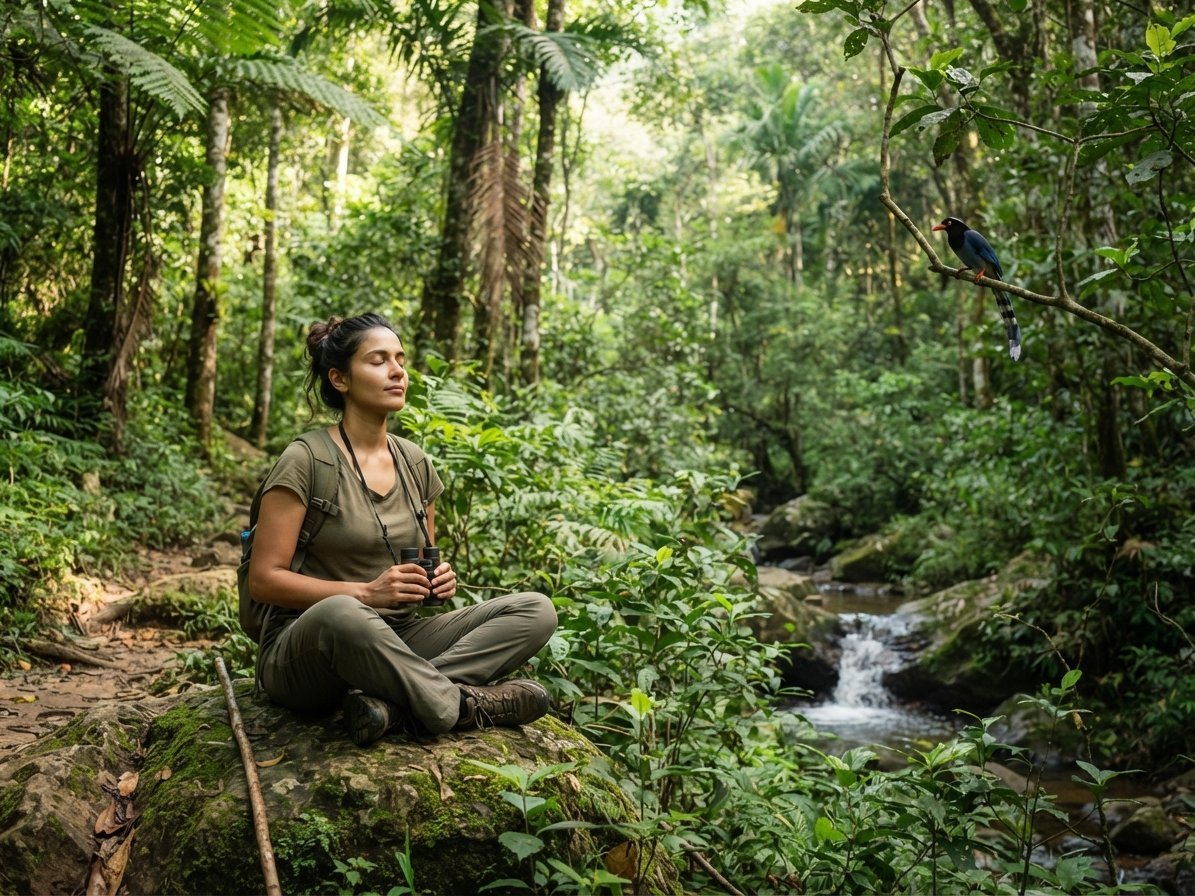
Can Sri Lanka turn silence, birdsong and the natural rhythm of the forest into a new premium tourism economy?
For decades, tourism has largely been sold through what travellers can see.
Mountains.
Beaches.
Wildlife.
Temples.
Hotels.
Landscapes.
But there is another tourism asset that remains largely invisible.
Sound.
More precisely, the absence of intrusive human-made sound.
I believe Sri Lanka has an opportunity to develop a new niche around this idea: Auditory Detox Tourism — carefully designed journeys where visitors temporarily exchange traffic, notifications, machinery, meetings and urban noise for the natural acoustic environment of a protected landscape.
This is not about selling “silence” as a medical treatment.
It is about recognising natural quiet as a tourism experience and a conservation asset.
And Sri Lanka has some extraordinary places in which to explore the concept.
1. The world is becoming louder
Modern travellers may spend their working lives surrounded by phones, traffic, aircraft, construction, meetings, alarms, entertainment systems and constant digital notifications.
The World Health Organization has documented associations between excessive environmental noise and outcomes including annoyance, sleep disturbance, cardiovascular effects and cognitive impacts.
At the same time, research into forest environments has reported physiological changes associated with forest exposure, including reductions in cortisol, pulse rate and sympathetic nervous activity.
This creates an interesting tourism question:
If noise has an economic cost, can natural quiet have economic value?
I believe the answer deserves serious investigation.
Not because every quiet forest should become a luxury resort.
Quite the opposite.
The value may come from protecting the forest from tourism’s own noise.
2. Sri Lanka already possesses the raw material
Consider the scale of the opportunity.
Sri Lanka recorded 2,362,521 tourist arrivals in 2025. During January–August 2026, the country recorded more than 1.34 million arrivals, according to Sri Lanka Tourism Development Authority statistics.
The challenge is therefore no longer simply attracting people to Sri Lanka.
It is increasingly about developing different reasons for high-value visitors to stay longer, spend responsibly and travel beyond conventional tourism corridors.
The Central Highlands World Heritage property includes the Knuckles Conservation Forest, covering approximately 31,305 hectares.
Sinharaja Forest Reserve covers approximately 8,864 hectares and is recognised by UNESCO as Sri Lanka’s last extensive patch of primary lowland tropical rainforest.
These are not merely scenic locations.
They are complex living ecosystems.
And their natural acoustic environments are part of that experience.
A visitor does not only see a rainforest.
They hear water.
Wind.
Insects.
Frogs.
Bird calls.
Leaves.
Distant wildlife.
Sometimes, perhaps most importantly, they hear almost nothing produced by human machinery.
That is an economic proposition worth examining.
3. But “decibel-zero” is not the objective
I deliberately use the phrase “decibel-zero value” as a provocative economic metaphor.
Scientifically, a rainforest is not a zero-decibel environment.
Nor should we attempt to make it one.
Nature has its own orchestra.
The objective should therefore not be absolute silence.
It should be low anthropogenic noise and high-quality natural soundscapes.
That distinction is extremely important.
The product is not silence.
The product is the experience of natural sound.
This changes the entire tourism model.
4. Seven international lessons
Case Study 1 — Yosemite, United States
Yosemite National Park has treated natural sound as a resource requiring management.
Its soundscape programme monitors natural and human-made sounds and examines how aircraft, vehicles and other noise affect wilderness experiences.
The lesson for Sri Lanka is simple:
A protected landscape can have an acoustic management strategy, not merely a visual conservation strategy.
Case Study 2 — Muir Woods, United States
Muir Woods National Monument introduced a Quiet Zone in Cathedral Grove.
Visitors were encouraged to switch off mobile phones, speak quietly and walk with greater awareness.
One reported noise-reduction experiment produced a 3 dBA reduction without excluding visitors from the area.
That is particularly interesting.
The solution was not necessarily expensive infrastructure.
It was visitor behaviour.
Case Study 3 — Japan’s Forest Therapy
Japan provides perhaps the strongest conceptual parallel.
The country’s Shinrin-yoku, or forest bathing, movement developed into a structured field of research and tourism.
Research involving forests across Japan has examined physiological responses including cortisol, blood pressure, pulse rate and autonomic nervous activity.
A more recent study of stressed participants also reported a reduction in salivary cortisol following forest exposure.
Sri Lanka already possesses the forests.
The opportunity is to develop the experience architecture around them.
Case Study 4 — Poland’s “Silent Route”
Poland has experimented with the idea of a dedicated quiet tourism trail.
Measurements along the Wdecki Landscape Park’s “Silent Route” recorded average equivalent sound levels ranging approximately from 30.05 to 47.9 dB, depending on conditions.
The concept is important because it demonstrates that quiet can become a designed visitor experience, rather than simply an accidental characteristic of a remote location.
Case Study 5 — Bhutan
Bhutan demonstrates another relevant principle: tourism does not always have to maximise visitor volume.
Its long-standing high-value, low-volume philosophy sought to connect tourism revenue with environmental and cultural protection.
Sri Lanka should not copy Bhutan.
But Sri Lanka can learn from the underlying principle:
A scarce environmental experience can be managed through value rather than volume.
Case Study 6 — European Quiet Areas
European environmental research increasingly treats quiet natural areas as resources connected with wellbeing and environmental quality.
The emerging methodologies combine objective acoustic measurements with human perceptions of quietness.
This suggests an important opportunity for Sri Lanka:
Instead of saying, “This forest feels quiet,” we could eventually say:
“This trail has a measured acoustic profile.”
That creates the possibility of scientific tourism products.
Case Study 7 — Soundscape and Tourism Experience Research
Tourism research has also examined the relationship between soundscape and landscape.
Research involving Mount Emei and the Leshan Giant Buddha in China found that soundscape perception contributes to tourism experience and that soundscape should receive greater attention in tourism planning.
This is important because tourism is fundamentally multisensory.
We have spent decades designing what visitors see.
The next generation of tourism may increasingly design what visitors hear, smell, touch and feel.
5. What could Sri Lanka actually sell?
I would not create a mass-market “silence tour”.
I would create a premium, controlled and measurable experience.
Imagine a product called:
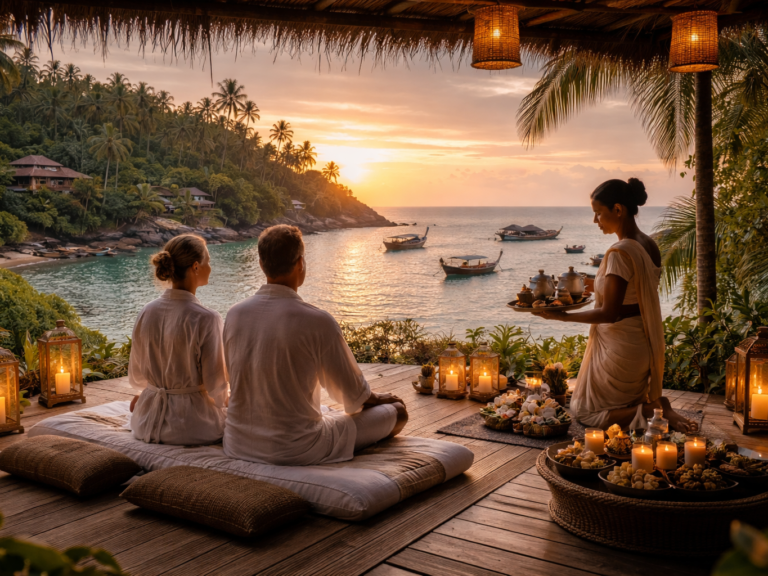
“Sri Lanka Auditory Detox — 72 Hours Without the City”
A visitor arrives.
Their smartphone remains available for emergencies but is placed into a controlled digital-minimalism mode.
The journey moves towards the Knuckles region or an appropriate forest-edge location.
No loud entertainment.
No unnecessary vehicle movement.
No amplified music.
No unnecessary generators.
No mass groups.
No party atmosphere.
Instead:
Guided dawn listening.
Bird identification by sound.
Forest sound mapping.
Mindful walking.
Water acoustics.
Night sound observation where permitted.
Traditional ecological knowledge.
Local food.
Sleep.
Reading.
Writing.
Photography.
Reflection.
And perhaps the most valuable activity of all:
doing nothing.
6. From “tour package” to “soundscape economy”
The commercial model could involve several layers.
Premium accommodation
Small-scale, low-density accommodation located outside or adjacent to sensitive conservation zones.
Acoustic guiding
Trained guides who understand birds, insects, weather, water and forest acoustics.
Sound recording
Visitors could receive professionally recorded natural soundscapes as a digital souvenir.
Not artificial meditation music.
The real sound of Sri Lanka.
Corporate retreats
This could become particularly interesting.
Instead of another hotel ballroom with PowerPoint presentations, imagine a 48-hour executive reset combining nature, strategic reflection, walking and controlled digital disconnection.
The proposition is not “medical treatment”.
It is wellbeing-oriented experiential tourism.
Research tourism
Universities, acoustic researchers, conservation organisations and environmental scientists could use selected locations for long-term soundscape monitoring.
Conservation contribution
A defined percentage of tourism revenue could support forest protection, community programmes, monitoring and visitor management.
7. The real product may be scarcity
There is an important paradox here.
If we successfully market a quiet forest and suddenly send 500 visitors there every day, we destroy the product we were selling.
Therefore:
The more successful the product becomes, the more carefully it must be controlled.
This is where premium tourism economics becomes relevant.
Suppose a carefully managed experience allowed only 10 visitors per departure.
Ten visitors spending significantly more can potentially create greater local economic value than hundreds of visitors consuming the same ecosystem at high intensity.
The exact pricing model would require market testing.
But the strategic principle is clear:
Monetise access without commodifying the ecosystem itself.
8. Imagine a “Sri Lanka Natural Sound Index”
This is where I see an opportunity beyond tourism marketing.
Sri Lanka could develop a research-based Natural Sound Index for selected tourism and conservation landscapes.
Measurements could include:
- Average sound pressure levels
- Anthropogenic noise events
- Traffic intrusion
- Aircraft events
- Natural sound diversity
- Bird-call diversity
- Time-of-day variation
- Seasonal variation
- Visitor perception
- Ecological sensitivity
Instead of simply rating a destination by stars, hotels or scenery, we could eventually describe certain experiences through an acoustic profile.
That could become a new form of destination intelligence.
9. Knuckles and Sinharaja should not become playgrounds
This is perhaps the most important warning.
I am not proposing hotels inside protected forests.
I am not proposing unrestricted visitor access.
I am not proposing loud wellness festivals.
I am not proposing artificial “silence zones” that interfere with ecological processes.
And I am certainly not suggesting that forests should be commercially exploited simply because quiet has a market value.
The opposite should happen.
The commercial value should strengthen the conservation argument.
The forest remains the primary asset.
Tourism becomes one mechanism through which society recognises its value.
10. Local communities must be part of the model
There is another economic dimension.
A soundscape tourism model should not become an externally controlled luxury product where local communities receive only low-paid employment.
Local people can participate as:
nature interpreters, guides, hosts, food suppliers, transport providers, researchers, cultural storytellers and conservation partners.
The economic chain should remain as local as possible.
Otherwise, we simply create another tourism product with high leakage.
11. Sri Lanka’s competitive advantage may be what we have not yet packaged
Sri Lanka has spent years marketing beaches, wildlife, culture, Ayurveda, tea, adventure and hospitality.
These remain important.
But global tourism is becoming increasingly experiential.
The next competitive advantage may not always be another attraction.
Sometimes it may be an absence.
An absence of traffic.
An absence of notifications.
An absence of engines.
An absence of crowds.
An absence of constant conversation.
And then, suddenly:
A bird calls.
Water moves over stone.
Leaves respond to the wind.
A frog answers from somewhere in the darkness.
The visitor realises that the forest was never silent.
We were simply too noisy to hear it.
12. My proposal: Sri Lanka should test the concept before scaling it
I would start with a small pilot.
Not a national campaign.
Not a large infrastructure project.
A controlled Soundscape Tourism Pilot involving suitable locations around the Knuckles landscape and the Sinharaja region, subject to the requirements and permissions of the relevant conservation authorities.
The pilot could measure:
- Visitor willingness to pay
- Visitor satisfaction
- Acoustic conditions
- Biodiversity considerations
- Community income
- Visitor carrying capacity
- Noise sources
- Conservation contributions
- Repeat demand
- International market interest
Only after collecting evidence should the model be expanded.
That is how an interesting tourism idea becomes a credible tourism strategy.
The bigger question
Sri Lanka has millions of reasons for people to visit.
But perhaps we should begin asking a different question:
What can a visitor experience here that becomes more valuable precisely because we protect it from ourselves?
Natural quiet could become one answer.
The future of tourism will not necessarily belong only to destinations that build more.
It may also belong to destinations that understand what must remain unbuilt, unheard and undisturbed.
For Sri Lanka, the Knuckles and Sinharaja landscapes offer an extraordinary starting point for that conversation.
The opportunity is not to sell silence.
It is to create economic value around protecting the sounds of a living ecosystem.
That, in my view, is the beginning of a Soundscape Economy.
A note on terminology
“Auditory Detox” is used in this article as a tourism and experiential concept, not as a medical diagnosis, treatment or clinically validated therapy. Likewise, “decibel-zero” is a conceptual expression of scarcity and quietness, not a claim that natural forests reach 0 dB.
Author’s disclaimer
This article has been authored and published in good faith by Dr. Dharshana Weerakoon, DBA (USA), drawing on publicly available information from recognised national and international sources, conservation institutions, tourism authorities, scientific literature and the author’s professional experience across tourism, hospitality, business and international markets.
The article is intended solely for educational, professional, journalistic and public-awareness purposes, and to stimulate discussion about sustainable tourism, conservation and emerging tourism-economy models. The proposed “Soundscape Economy” and “Auditory Detox Tourism” concepts are presented as strategic ideas for discussion and would require appropriate scientific validation, stakeholder consultation, environmental assessment, regulatory approval and commercial feasibility analysis before implementation.
Nothing in this article should be interpreted as medical, legal, financial, investment or environmental-regulatory advice, nor as an assertion that exposure to natural sound constitutes medical treatment or produces a guaranteed health outcome.
The author accepts no responsibility for any interpretation, adaptation or implementation of the ideas presented without appropriate professional, scientific and regulatory review. Any future development involving protected forests, biodiversity, visitor access, local communities, intellectual property, data collection or commercial activity should comply with applicable Sri Lankan law, conservation regulations, ethical standards, privacy requirements and the rights of local and indigenous communities where applicable.
The views expressed are entirely personal and analytical and do not represent the official position of any government authority, conservation organisation, university, tourism institution or commercial partner unless expressly stated.
© Dr. Dharshana Weerakoon, DBA (USA). All rights reserved
Further Reading: https://dharshanaweerakoon.com/sri-lanka-bank-call-centre-outsourcing/
Further Reading: https://www.linkedin.com/newsletters/outside-of-education-7046073343568977920/