Why Accessibility Matters More Than Distance: How Bandaranaike International Airport Influences Hotel Occupancy Across Sri Lanka
Introduction
Every year, millions of international visitors arrive in Sri Lanka through Bandaranaike International Airport (BIA) in Katunayake. Much of the tourism industry’s attention is focused on increasing arrival numbers, launching new marketing campaigns, and promoting the country’s diverse attractions. While these are undoubtedly important, a fundamental question often receives far less attention:
Does the location of Sri Lanka’s primary international airport influence where tourists travel, how long they stay, and ultimately how hotels perform?
Having worked extensively across the global hospitality and tourism sectors, I have frequently observed that destination success depends not only on the quality of attractions but also on the ease with which visitors can reach them. Beautiful beaches, heritage sites, wildlife parks, and luxury resorts alone cannot guarantee sustainable hotel occupancy if access remains inconvenient or time-consuming.
This raises an important strategic discussion for Sri Lanka.
Perhaps the issue is not geographical distance itself. Rather, it is accessibility, travel time, transport reliability, and visitor convenience that increasingly shape tourist behaviour.
A destination located 350 kilometres from an international airport may perform exceptionally well if visitors can reach it comfortably within three hours via high-quality highways. Conversely, another destination located only 180 kilometres away may struggle if the journey requires five to six hours on congested roads.
For tourism planners, hotel investors, destination marketers, and policymakers, understanding this distinction has significant implications for future tourism development.
Distance Does Not Equal Accessibility
One of the biggest misconceptions in tourism planning is assuming that shorter geographical distance automatically translates into better accessibility.
International travellers rarely evaluate destinations based on kilometres. Instead, they consider practical questions such as:
- How long will it take to reach the destination?
- Will the journey be comfortable after a long international flight?
- Is transportation reliable?
- Can the destination be reached safely during daylight?
- Does the journey require multiple transfers?
In hospitality, the visitor experience begins the moment the aircraft lands—not when the guest checks into the hotel.
Long transfers immediately after international flights often create physical fatigue, reducing the perceived attractiveness of destinations that are otherwise world-class.
This phenomenon is well documented in tourism geography, where accessibility is recognised as one of the strongest determinants of destination competitiveness.
The Airport Effect
Nearly all international leisure travellers entering Sri Lanka begin their journey at Bandaranaike International Airport.
This effectively creates a national tourism gateway.
Every destination across the country competes not only on its attractions but also on its relative accessibility from this gateway.
This creates what can be described as the “Airport Effect.”
The Airport Effect influences:
- Hotel occupancy
- Average length of stay
- Regional tourism investment
- Tour operator itinerary design
- Excursion patterns
- Repeat visitation
- Destination competitiveness
Many visitors, particularly those travelling on seven to ten-day itineraries, prefer destinations that minimise transfer time while maximising leisure experiences.
Consequently, accessibility becomes an important competitive advantage.
Southern Sri Lanka: A Practical Example of Improved Accessibility
The Southern Expressway fundamentally changed tourism dynamics along Sri Lanka’s southern coastline.
Before the expressway, reaching destinations such as Galle, Hikkaduwa, Tangalle, and Hambantota required considerably longer travel times.
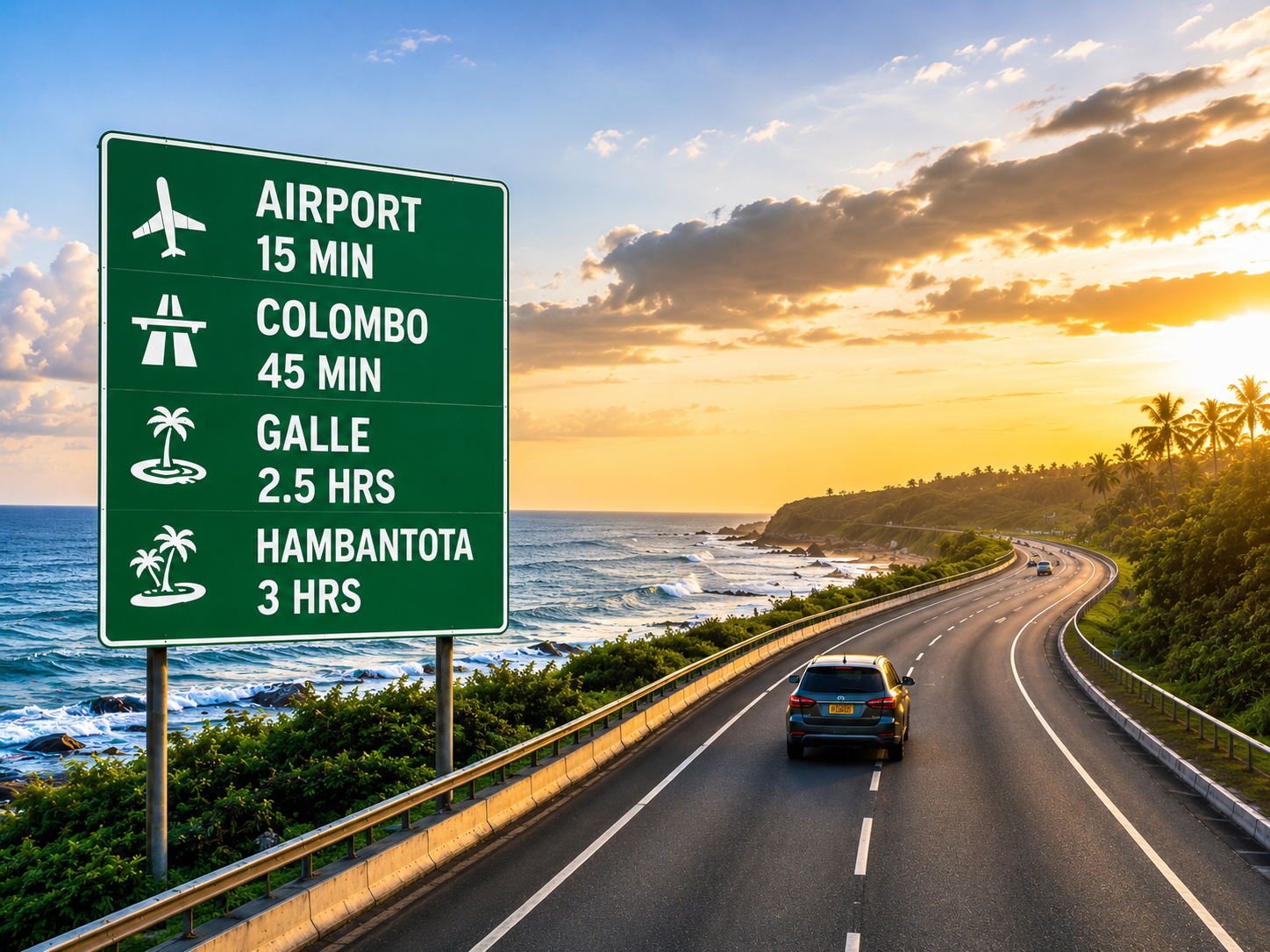
Today, international visitors can comfortably travel from Bandaranaike International Airport to many southern destinations within approximately three hours.
This improvement has produced several notable outcomes.
Hotel developers have shown increasing confidence in investing in southern coastal properties.
International tour operators are able to design shorter itineraries without sacrificing guest comfort.
Luxury travellers can enjoy extended beach holidays without exhausting overland journeys.
Weekend tourism has also become increasingly attractive for domestic visitors.
The expressway demonstrates that improved transport infrastructure can significantly enhance destination competitiveness without changing the destination itself.
Why Nuwara Eliya Faces a Different Challenge
Nuwara Eliya remains one of Sri Lanka’s most iconic destinations.
Its cool climate, colonial heritage, tea plantations, waterfalls, and scenic landscapes continue to attract visitors from around the world.
Yet accessibility presents a unique challenge.
Although the geographical distance from Katunayake is considerably shorter than many eastern destinations, the winding mountain roads often require five to six hours of travel.
For many international visitors who have already completed long-haul flights, this additional journey becomes physically demanding.
As a result, many tour operators include Nuwara Eliya as part of broader round tours rather than encouraging extended standalone stays.
This does not diminish the destination’s attractiveness.
Instead, it illustrates how travel time can influence tourism behaviour independently of destination quality.
Trincomalee: A World-Class Beach Destination with Accessibility Constraints
Few beaches in Asia rival the natural beauty of Trincomalee.
Its pristine coastline, whale watching opportunities, diving experiences, and growing portfolio of international-standard resorts position the region among Sri Lanka’s strongest tourism assets.
However, accessibility remains one of its principal constraints.
For many visitors, travelling from Katunayake requires approximately five to six hours by road.
Consequently, international tourists often allocate fewer nights than the destination arguably deserves.
This affects not only hotel occupancy but also restaurant revenue, excursion participation, transport services, and local employment.
Improved domestic aviation, future expressway extensions, or direct international connectivity could significantly enhance Trincomalee’s tourism potential.
The Cultural Triangle: Rich Heritage, Longer Journeys
Sri Lanka’s Cultural Triangle—including Anuradhapura, Polonnaruwa, Sigiriya, and Dambulla—represents one of South Asia’s greatest concentrations of cultural heritage.
Visitors consistently rank these destinations among the country’s most memorable experiences.
Nevertheless, travel logistics influence visitor behaviour.
Many tourists choose fast-paced itineraries that combine multiple heritage sites over two or three days before continuing towards the southern beaches.
Long road journeys often discourage repeat visits or extended stays.
Improved transport connectivity has the potential to encourage deeper exploration rather than rapid sightseeing.
Such changes would directly benefit hotels, guides, restaurants, transport operators, and surrounding communities.
Lessons from International Tourism Destinations
The relationship between airport accessibility and hotel performance is not unique to Sri Lanka.
Several successful tourism destinations have invested heavily in transport infrastructure as a means of strengthening competitiveness.
In the Maldives, international visitors arrive at a central international airport before seamlessly transferring via speedboats or seaplanes to island resorts. Although many resorts are geographically remote, efficient transfer systems minimise perceived travel inconvenience.
Thailand has adopted a different strategy by developing multiple international gateways serving Bangkok, Phuket, Chiang Mai, Krabi, and other tourism regions. This decentralised approach reduces pressure on a single airport while distributing visitors more evenly across the country.
Similarly, Bali benefits from an international airport located close to major tourism zones, enabling visitors to reach many hotels within a relatively short period after arrival.
These international examples demonstrate that accessibility—not simply distance—is often the decisive factor influencing tourism demand and hotel occupancy.
The Economics of Travel Time
Travel time carries an economic cost.
Every additional hour spent in transit represents time that visitors cannot spend enjoying attractions, dining in restaurants, participating in excursions, shopping, or relaxing at hotels.
From the hospitality industry’s perspective, reducing travel friction enhances the overall guest experience while simultaneously increasing opportunities for local tourism expenditure.
For hotel operators, easier accessibility often translates into:
- Higher occupancy rates.
- Increased average length of stay.
- Greater visitor satisfaction.
- Improved online reviews.
- Stronger repeat visitation.
- Higher average daily spending.
- Increased investor confidence.
Consequently, investments in transport infrastructure should not be viewed solely as road development projects.
They are also strategic investments in tourism competitiveness and national economic growth.
Case Study: Southern Expressway – Infrastructure as a Tourism Catalyst
The Southern Expressway represents one of the clearest examples of how transport infrastructure can reshape tourism demand. Before its development, destinations such as Bentota, Hikkaduwa, Galle, Mirissa, Tangalle, and Hambantota were perceived as relatively distant due to lengthy travel times. Today, significantly improved road connectivity has enhanced visitor convenience and strengthened investor confidence.
International tour operators can now include southern beach destinations within shorter itineraries without compromising guest comfort. Hotels have benefited from stronger weekend demand, increased domestic tourism, and greater flexibility in package design. Although occupancy is influenced by many factors—including seasonality, airline capacity, pricing, destination marketing, and geopolitical conditions—improved accessibility has undoubtedly enhanced the competitiveness of Sri Lanka’s southern tourism corridor.
The broader lesson is clear: transport infrastructure should be viewed not merely as a public works investment but as a strategic tourism asset capable of stimulating regional economic development.
Case Study: Trincomalee – Unlocking Greater Potential
Trincomalee possesses many of the ingredients required for sustained international tourism growth. Its beaches, marine biodiversity, whale and dolphin watching, diving opportunities, cultural heritage, and expanding portfolio of quality accommodation position it among Sri Lanka’s premier coastal destinations.
Yet accessibility continues to influence visitor behaviour.
Many travellers arriving after long international flights must undertake an additional five to six-hour road journey. Consequently, some visitors allocate only two or three nights before continuing elsewhere, while others omit the destination entirely due to time constraints.
Future improvements such as enhanced expressway connectivity, expanded domestic aviation, or carefully planned international air services could substantially improve the region’s competitiveness. Such developments would not only support higher hotel occupancy but also create broader economic opportunities for restaurants, guides, transport providers, small businesses, and local communities.
Case Study: The Cultural Triangle – Encouraging Longer Stays
The Cultural Triangle remains one of Sri Lanka’s greatest tourism strengths. Ancient cities, archaeological treasures, religious sites, wildlife experiences, and UNESCO World Heritage attractions collectively offer an experience unlike many competing destinations.
However, visitor itineraries often remain compressed.
Rather than encouraging extended exploration, many package tours combine several heritage destinations within a limited timeframe before moving visitors towards the southern coast.
Improving accessibility between tourism regions, developing better visitor transport networks, and strengthening integrated destination planning could encourage travellers to spend additional nights within the Cultural Triangle. Longer stays would naturally increase hotel occupancy while generating greater economic benefits across local communities.
Learning from International Tourism Models
Many successful tourism destinations have recognised that accessibility is a competitive advantage.
The Maldives demonstrates that physical distance is not necessarily a disadvantage when efficient transfer systems are available. Visitors arrive through a central international gateway before transferring seamlessly by speedboat or seaplane to remote island resorts. Although the distances may be considerable, the overall travel experience remains efficient and memorable.
Thailand has diversified its tourism gateway strategy through multiple international airports serving destinations such as Bangkok, Phuket, Chiang Mai, Krabi, and Koh Samui. This decentralised model reduces pressure on a single airport while improving direct access to major tourism regions.
Similarly, Spain has invested heavily in regional airports, high-speed rail, and integrated transport systems that enable visitors to move efficiently between coastal destinations, historic cities, and island tourism markets.
These examples demonstrate that accessibility can be enhanced through multiple solutions rather than relying solely on geographical proximity.
Is It Time for a Multi-Gateway Tourism Strategy?
Sri Lanka has historically relied on Bandaranaike International Airport as its principal international gateway. While this approach has served the country for decades, growing visitor expectations suggest that a broader discussion may be warranted.
A carefully planned multi-gateway strategy could complement—not replace—Bandaranaike International Airport.
The long-term development of Mattala Rajapaksa International Airport, expanded domestic aviation, improved regional airports, and stronger multimodal transport integration could gradually improve access to destinations in the Eastern Province, the Deep South, and the Northern Province.
Such an approach would require detailed feasibility studies, airline partnerships, commercial viability assessments, and coordinated tourism planning. Nevertheless, it presents an opportunity worthy of strategic consideration as Sri Lanka plans for future tourism growth.
The Economic Value of Reducing Travel Time
Every hour that tourists spend travelling represents an hour that cannot be spent experiencing a destination.
Reducing travel time creates multiple economic benefits.
Visitors have more opportunities to dine in local restaurants, participate in excursions, shop at local businesses, visit cultural attractions, enjoy wellness experiences, and extend their hotel stays.
From the hotel industry’s perspective, improved accessibility may contribute to:
- Higher occupancy levels.
- Increased average length of stay.
- Improved guest satisfaction.
- Stronger online reviews.
- Greater repeat visitation.
- Higher visitor expenditure.
- Increased investor confidence.
While accessibility alone cannot guarantee tourism success, it remains one of the most influential enabling factors.
Strategic Recommendations for Sri Lanka
As Sri Lanka continues rebuilding and strengthening its tourism sector, accessibility should become a central component of long-term destination planning.
Several strategic priorities deserve consideration.
First, continue investing in high-quality road infrastructure linking key tourism regions while maintaining environmental sustainability.
Second, strengthen domestic air connectivity where commercially viable, particularly for destinations requiring longer road journeys.
Third, encourage integrated transport solutions combining air, road, rail, and maritime services to improve the overall visitor experience.
Fourth, promote destination clusters rather than isolated attractions. Encouraging visitors to explore multiple nearby destinations can increase average length of stay while distributing tourism benefits more evenly.
Fifth, enhance visitor facilities along major tourism corridors, including rest areas, information centres, clean public amenities, electric vehicle charging stations, and digital tourism information systems.
Finally, ensure that future tourism master plans integrate transport planning, hotel investment strategies, destination marketing, environmental sustainability, and community participation within a single national framework.
Conclusion
Sri Lanka possesses extraordinary tourism assets.
From pristine beaches and mist-covered mountains to ancient cities, wildlife reserves, and vibrant cultural traditions, the country offers remarkable diversity within a relatively compact geographical area.
Yet international competitiveness is determined not only by what visitors experience after arrival but also by how easily they can reach those experiences.
The future discussion should therefore move beyond simple measurements of geographical distance.
The more relevant question is this:
How accessible are Sri Lanka’s tourism destinations?
Improving accessibility is not solely about constructing new roads or expanding airports. It is about creating a seamless visitor journey that begins the moment an aircraft lands and continues until the traveller returns home with lasting memories.
Countries that successfully integrate transport, tourism planning, hospitality investment, and destination management consistently achieve stronger visitor satisfaction, higher occupancy, longer stays, and more balanced regional development.
Sri Lanka has already demonstrated what improved connectivity can achieve in the Southern Province. With thoughtful planning, similar success can be replicated across other tourism regions while preserving the country’s natural and cultural heritage.
As the global tourism industry becomes increasingly competitive, accessibility may well become one of Sri Lanka’s most valuable strategic advantages.
Disclaimer
This article has been authored and published in good faith by Dr. Dharshana Weerakoon, DBA (USA). The views expressed are based on professional experience in the international tourism and hospitality industry, together with analysis of publicly available tourism information, industry trends, and established tourism management principles. The article is intended solely for educational, professional, and public discussion purposes. It does not constitute legal, financial, investment, or government policy advice. Any recommendations are offered as strategic observations to encourage constructive dialogue on the future development of Sri Lanka’s tourism sector.
© Dr. Dharshana Weerakoon, DBA (USA). All rights reserved.
Further Reading: https://dharshanaweerakoon.com/petti-kade/
Further Reading: https://www.linkedin.com/newsletters/outside-of-education-7046073343568977920/