Beyond Arrivals: Designing the Ideal Tourism Model for Sri Lanka’s Next Generation
Introduction
For decades, Sri Lanka has been recognized as one of the world’s most naturally gifted tourism destinations. Blessed with ancient civilizations, pristine beaches, diverse wildlife, rich cultural heritage, tea plantations, religious landmarks, and warm hospitality, the island possesses a tourism product that many countries can only dream of creating.
Yet despite these advantages, Sri Lanka continues to struggle with a fundamental question:
What is the ideal tourism model for Sri Lanka?
Successive governments, policymakers, investors, and industry stakeholders have often measured tourism success primarily through arrival numbers. While tourist arrivals remain important, the global tourism industry has evolved significantly. The world’s most successful destinations today are no longer competing solely for visitor volume. Instead, they focus on maximizing value, sustainability, community benefits, environmental protection, visitor satisfaction, and long-term economic resilience.
Sri Lanka stands at a critical crossroads. The country can either pursue mass tourism based on volume, often associated with environmental degradation and low economic returns, or adopt a smarter, more sustainable, and more profitable tourism model designed specifically for its unique characteristics.
In my professional assessment, developed through decades of international tourism and hospitality experience across multiple continents, the ideal tourism model for Sri Lanka is neither mass tourism nor ultra-luxury tourism alone.
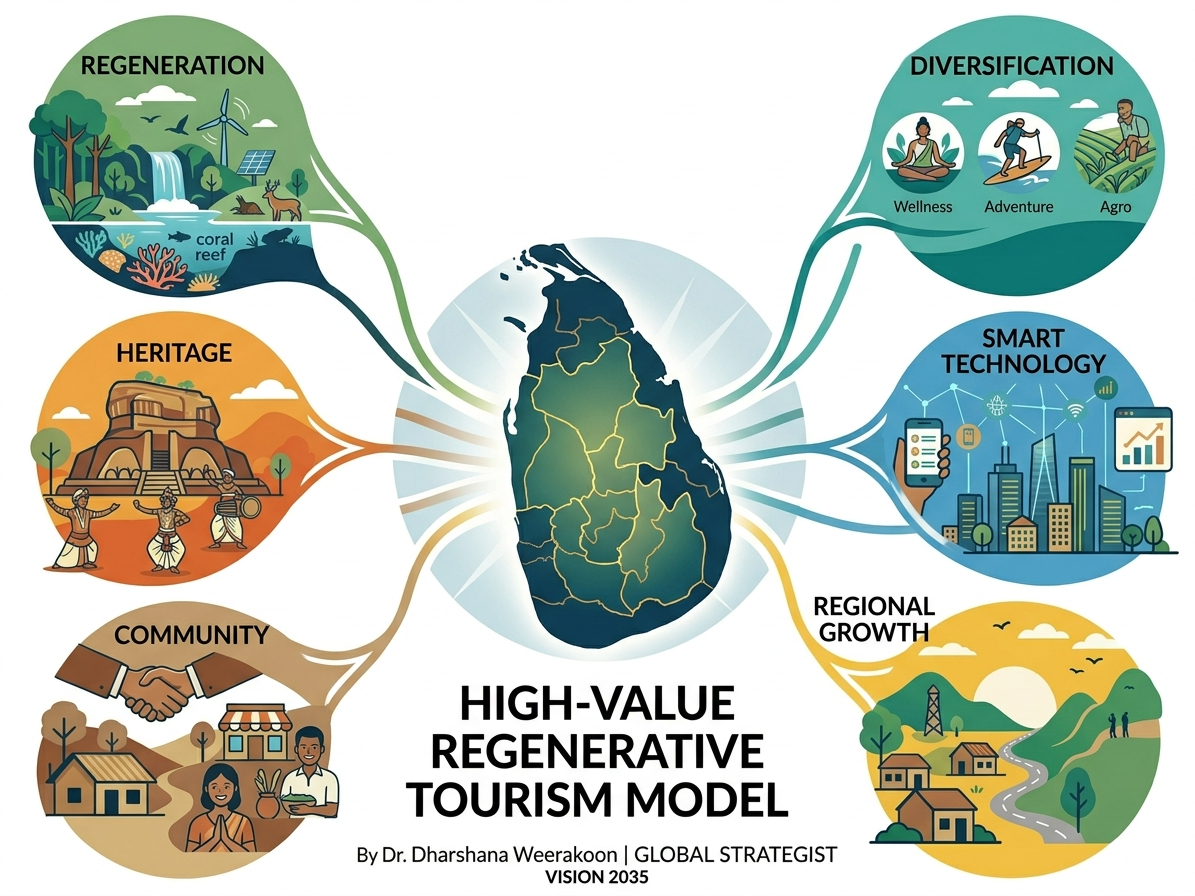
The most suitable model is a High-Value Regenerative Tourism Model, supported by community participation, environmental stewardship, cultural preservation, technology integration, and sustainable economic growth.
Understanding Sri Lanka’s Tourism Reality
Before discussing the future, it is essential to understand the present.
Tourism has consistently ranked among Sri Lanka’s most important foreign exchange earners. Prior to the Easter attacks of 2019 and the COVID-19 pandemic, Sri Lanka welcomed approximately 2.3 million international visitors annually.
Tourism directly and indirectly supports hundreds of thousands of jobs across:
- Hotels and resorts
- Restaurants
- Transportation services
- Tour operators
- Travel agencies
- Handicraft industries
- Agriculture
- Fisheries
- Entertainment sectors
However, despite growth in arrivals over the years, tourism revenue per visitor has not always increased proportionately.
This raises a critical concern:
Are we attracting the right visitors, or simply more visitors?
The future competitiveness of Sri Lankan tourism depends less on volume and more on value creation.
Why Mass Tourism Is Not the Right Model for Sri Lanka
Many destinations pursued mass tourism during the latter half of the twentieth century. While this generated significant visitor numbers, it often created long-term challenges.
Common consequences include:
- Overcrowding
- Environmental degradation
- Cultural commodification
- Pressure on infrastructure
- Increased waste generation
- Water shortages
- Reduced resident satisfaction
Destinations such as parts of Spain, Thailand, and Indonesia have experienced both the benefits and drawbacks of mass tourism.
Sri Lanka’s geographical size presents limitations.
With approximately 65,000 square kilometers of land area and sensitive ecosystems, Sri Lanka cannot sustainably accommodate unlimited tourism growth without consequences.
Uncontrolled tourism expansion risks damaging precisely the assets that attract visitors in the first place.
Why Ultra-Luxury Tourism Alone Is Also Insufficient
At the opposite end of the spectrum lies exclusive luxury tourism.
Countries such as the Maldives have successfully positioned themselves as premium destinations with high visitor spending.
However, Sri Lanka differs significantly.
Sri Lanka possesses:
- Diverse landscapes
- Multiple market segments
- Extensive cultural heritage
- Significant rural populations
- Numerous SMEs dependent on tourism
An exclusively luxury-focused strategy could limit broader economic participation and exclude local communities from tourism benefits.
Therefore, Sri Lanka requires a balanced approach.
The Ideal Model: High-Value Regenerative Tourism
The future should not be measured merely by how many tourists arrive.
Instead, success should be measured by:
- Visitor spending
- Community benefits
- Environmental improvement
- Cultural preservation
- Economic resilience
- Resident satisfaction
This philosophy forms the foundation of regenerative tourism.
Unlike sustainable tourism, which seeks to minimize damage, regenerative tourism aims to leave destinations better than before.
Visitors become contributors rather than consumers.
Communities become beneficiaries rather than spectators.
Nature becomes an asset to be restored rather than exploited.
Pillar 1: Community-Centered Tourism Development
Tourism cannot thrive long-term if local communities are excluded.
Communities should be integrated into:
- Tourism planning
- Product development
- Cultural experiences
- Supply chains
- Employment opportunities
When residents directly benefit from tourism, they become active custodians of the destination.
This creates stronger destination authenticity and improves visitor experiences.
Case Study 1: Bhutan
Bhutan operates one of the world’s most recognized high-value tourism models.
Rather than maximizing arrivals, Bhutan focuses on maximizing value while protecting culture and environment.
The country attracts fewer visitors than many competing destinations but generates strong economic returns while maintaining cultural integrity.
Key lesson for Sri Lanka:
Quality over quantity often produces better long-term outcomes.
Pillar 2: Environmental Regeneration
Sri Lanka’s natural capital represents one of its greatest competitive advantages.
Tourism planning should prioritize:
- Forest conservation
- Coral reef protection
- Coastal management
- Wildlife preservation
- Renewable energy adoption
- Sustainable construction
Future tourism projects should contribute positively to environmental outcomes.
Hotels should be encouraged to measure and reduce:
- Carbon emissions
- Water consumption
- Waste generation
The destination itself should become greener each year.
Case Study 2: Costa Rica
Costa Rica transformed itself into a global ecotourism leader.
More than a quarter of the country’s territory is protected through national parks and conservation initiatives.
The country’s tourism success demonstrates that environmental protection and economic growth can coexist.
Key lesson:
Conservation can become a powerful tourism product.
Pillar 3: Cultural Heritage Preservation
Sri Lanka possesses over 2,500 years of recorded civilization.
Few destinations can match its:
- Ancient cities
- Religious heritage
- Archaeological treasures
- Traditional arts
- Indigenous knowledge systems
Tourism development should strengthen cultural preservation rather than commercialize it excessively.
Authentic experiences increasingly attract modern travelers seeking meaningful connections.
Case Study 3: Japan
Japan successfully combines modernization with heritage preservation.
Ancient traditions coexist alongside advanced technology.
Visitors experience authentic cultural immersion while enjoying world-class infrastructure.
Key lesson:
Heritage becomes more valuable when preserved authentically.
Pillar 4: Diversification of Tourism Products
Sri Lanka must move beyond traditional beach tourism.
Future growth opportunities include:
Wellness Tourism
Growing global demand exists for:
- Ayurveda
- Holistic health
- Meditation
- Yoga retreats
Adventure Tourism
Opportunities include:
- Hiking
- Cycling
- Surfing
- Diving
- Wildlife experiences
Agro-Tourism
Tea, cinnamon, coconut, and spice industries offer unique visitor experiences.
Educational Tourism
Universities and research institutions can attract international learners.
MICE Tourism
Meetings, incentives, conferences, and exhibitions can generate year-round demand.
Case Study 4: New Zealand
New Zealand diversified its tourism products through adventure, nature, culture, and premium experiences.
This reduced dependence on a single tourism segment.
Key lesson:
Diversification improves resilience.
Pillar 5: Smart Tourism and Digital Transformation
Future tourism competitiveness will increasingly depend on technology.
Sri Lanka should embrace:
- Digital destination marketing
- Artificial intelligence
- Big data analytics
- Smart visitor management
- Contactless services
- Digital payment ecosystems
Technology should enhance visitor experiences while improving destination management.
Case Study 5: Singapore
Singapore has become a global leader in smart tourism through technology integration, efficient infrastructure, and strategic planning.
Key lesson:
Technology can significantly increase tourism efficiency and visitor satisfaction.
Pillar 6: Developing Secondary Destinations
Tourism concentration creates challenges.
Popular destinations often experience overcrowding while other regions remain underdeveloped.
Sri Lanka should encourage tourism growth in:
- Northern Province
- Eastern Province
- Uva Province
- Rural villages
- Emerging coastal areas
This would distribute economic benefits more equitably across the country.
Case Study 6: Slovenia
Slovenia successfully promoted lesser-known destinations while protecting major attractions.
The result was more balanced tourism development nationwide.
Key lesson:
Tourism dispersal improves sustainability.
Pillar 7: Measuring Success Differently
Traditional tourism indicators often focus on:
- Arrivals
- Hotel occupancy
- Foreign exchange earnings
Future tourism strategies should additionally measure:
- Visitor spending per day
- Resident satisfaction
- Environmental indicators
- Community income distribution
- Cultural preservation outcomes
- Repeat visitation rates
These indicators provide a more comprehensive understanding of destination performance.
Case Study 7: Iceland
Iceland experienced rapid tourism growth and subsequently adopted stronger destination management measures to balance economic benefits with environmental protection.
Key lesson:
Growth must be managed proactively rather than reactively.
What Could the Sri Lankan Model Look Like by 2035?
Imagine a Sri Lanka where:
- Tourism revenue exceeds previous records.
- Average visitor spending significantly increases.
- Communities receive a larger share of tourism benefits.
- Protected areas expand.
- Heritage sites receive greater investment.
- SMEs thrive.
- Digital tourism services become globally competitive.
- Sustainability becomes a core national brand attribute.
Under such a model, tourism would become not merely an industry but a catalyst for national development.
Strategic Recommendations
To implement the ideal tourism model, Sri Lanka should prioritize:
1. National Tourism Vision Beyond Politics
Tourism policy should remain consistent across political cycles.
2. High-Value Visitor Attraction
Target markets based on spending potential rather than arrivals alone.
3. Sustainability Certification
Encourage businesses to adopt measurable sustainability standards.
4. Strengthened Destination Branding
Position Sri Lanka as a premium regenerative tourism destination.
5. SME Empowerment
Increase access to finance, training, and digital capabilities.
6. Human Capital Development
Invest in tourism education and professional development.
7. Public-Private Collaboration
Strengthen partnerships across government, industry, academia, and communities.
Conclusion
The ideal tourism model for Sri Lanka is not mass tourism, nor is it tourism reserved exclusively for luxury travelers.
The future lies in a carefully balanced approach that combines economic growth, environmental regeneration, cultural preservation, technological innovation, and community prosperity.
Sri Lanka possesses all the ingredients required to become one of the world’s most admired tourism destinations.
The challenge is no longer attracting visitors.
The challenge is creating a tourism system that generates lasting value for the nation, protects future generations, and ensures that every visitor leaves Sri Lanka better informed, more inspired, and more connected to its people and heritage.
If implemented effectively, a High-Value Regenerative Tourism Model could position Sri Lanka as a global benchmark for responsible tourism development throughout the twenty-first century.
The question therefore is not whether Sri Lanka can achieve this vision.
The question is whether we are prepared to embrace it.
Disclaimer
This article has been authored and published in good faith by Dr. Dharshana Weerakoon, DBA (USA), based on publicly available tourism, economic, environmental, and destination management information; professional observations from international tourism and hospitality markets; and extensive industry experience gained across multiple regions and sectors. The article is intended solely for educational, professional discussion, public awareness, and policy dialogue purposes relating to the future development of tourism in Sri Lanka.
The analysis, opinions, recommendations, and proposed tourism framework presented herein are personal professional views of the author and should not be interpreted as legal, governmental, regulatory, financial, investment, or policy advice. While every reasonable effort has been made to ensure accuracy, completeness, fairness, and objectivity, no warranty is provided regarding future outcomes, forecasts, or implementation results.
The content is designed to support constructive discussion on sustainable, regenerative, community-centered, and economically resilient tourism development while respecting applicable Sri Lankan laws, regulations, intellectual property rights, cultural heritage protections, environmental standards, human rights principles, and accepted ethical practices. Any resemblance to specific organizations, policies, or stakeholders is purely analytical and intended in the public interest.
The author accepts no responsibility for any interpretation, adaptation, commercial use, policy application, or decision-making undertaken by third parties based on this article. Readers are encouraged to undertake independent research and obtain appropriate professional advice where necessary.
This article has been independently authored through professional expertise, academic knowledge, industry experience, and original analytical thinking.
© Dr. Dharshana Weerakoon, DBA (USA). All Rights Reserved.
Further Reading: https://dharshanaweerakoon.com/sri-lanka-export-proceeds-conversion-rule/
Further Reading: https://www.linkedin.com/newsletters/outside-of-education-7046073343568977920/