
Sri Lanka’s New Export Proceeds Conversion Rule: Strengthening the Rupee or Challenging Export Competitiveness? A Strategic Analysis
Introduction
Sri Lanka‘s export sector has long been one of the country’s most important economic pillars. Exporters generate foreign exchange, create employment, support thousands of small and medium enterprises, and contribute significantly to government revenue.
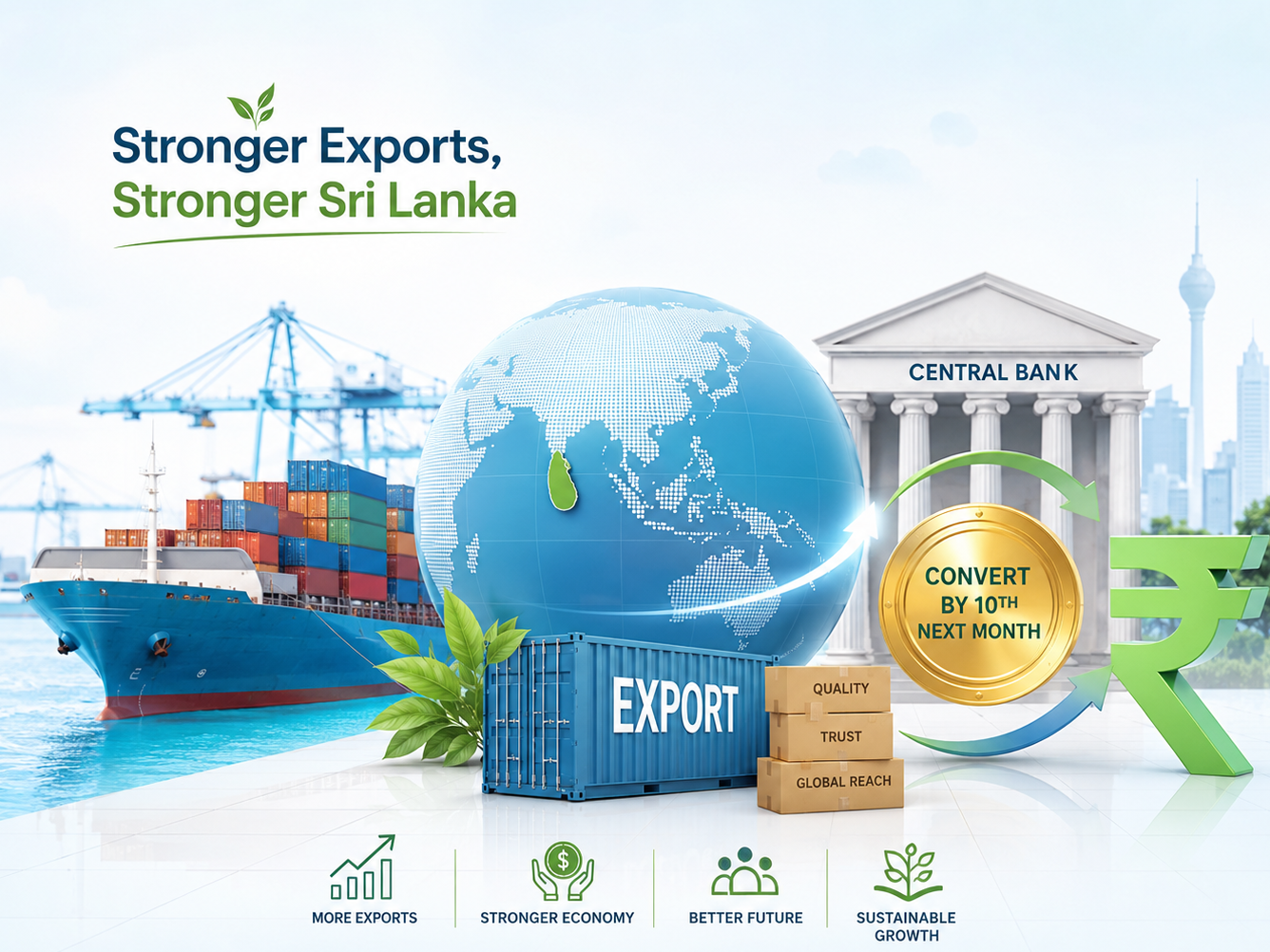
Against this backdrop, the Central Bank’s recent decision requiring exporters to convert residual export proceeds into Sri Lankan Rupees by the 10th day of the succeeding month has attracted considerable attention across the business community.
While some policymakers may view the measure as a mechanism to improve foreign exchange liquidity and support currency stability, many exporters are evaluating its implications for competitiveness, treasury management, investment planning, and long-term business confidence.
This article does not seek to criticize or endorse any policy position. Rather, it examines the potential opportunities, risks, and lessons from international experience while encouraging constructive dialogue among policymakers, exporters, financial institutions, and industry stakeholders.
Understanding the New Requirement
Under the latest regulatory framework, exporters receiving foreign currency earnings are expected to convert residual foreign exchange balances into Sri Lankan Rupees within a significantly shorter period than previously allowed.
In practical terms, this means:
- Export proceeds may still be used for approved foreign currency transactions.
- Any remaining balance must be converted into Rupees within the stipulated timeframe.
- Exporters have less flexibility to retain foreign currency balances for treasury and operational planning.
From a regulatory perspective, the objective appears straightforward: increase the supply of foreign currency entering the domestic financial system and improve visibility over foreign exchange flows.
However, the impact on businesses can be more complex.
Why Foreign Exchange Matters
Foreign exchange is not simply money sitting in a bank account.
For exporters, foreign currency often functions as:
- Working capital.
- A hedge against currency volatility.
- A reserve for importing raw materials.
- A funding source for overseas marketing.
- A mechanism for servicing foreign loans.
- A buffer against unexpected international costs.
Consequently, treasury management forms a critical part of modern export business strategy.
A company exporting software services, apparel, tea, rubber products, logistics services, tourism services, engineering solutions, or manufactured goods often plans several months ahead regarding foreign currency commitments.
Therefore, any policy affecting foreign currency retention naturally becomes an important business issue.
The Economic Logic Behind the Policy
Every central bank faces a difficult balancing act.
On one side lies macroeconomic stability.
On the other lies business flexibility.
Supporters of mandatory conversion requirements may argue that:
1. Increased Dollar Liquidity
More foreign currency entering the banking system may improve liquidity.
2. Currency Stability
A greater supply of foreign exchange can help stabilize exchange rate fluctuations.
3. Market Transparency
Regulators gain better visibility into actual export earnings.
4. Stronger Reserve Management
Formal banking channels become more active participants in currency circulation.
5. Reduced Speculative Retention
Authorities may seek to discourage excessive holding of foreign currency for speculative purposes.
These objectives are understandable from a monetary policy perspective.
However, the effectiveness of such measures often depends on broader market conditions.
The Exporter’s Perspective
Exporters typically operate in highly competitive international markets.
Unlike domestic businesses, they compete with firms from:
- India
- Vietnam
- Bangladesh
- Thailand
- Indonesia
- Malaysia
- The Philippines
These countries continuously improve efficiency, productivity, and ease of doing business.
Consequently, exporters often view flexibility as a strategic advantage.
Several concerns may emerge.
Cash Flow Planning
Businesses may need foreign currency shortly after converting it.
This can create unnecessary transaction costs.
Exchange Rate Risk
Companies may lose flexibility in managing currency movements.
Treasury Efficiency
Corporate treasury departments generally perform better when they can optimize timing.
Administrative Burden
Additional compliance requirements increase operational complexity.
Investor Perception
Foreign investors closely monitor regulatory consistency when making long-term investment decisions.
None of these concerns necessarily invalidate policy objectives.
Rather, they highlight the importance of balancing macroeconomic goals with commercial realities.
Case Study 1: Vietnam’s Export Transformation
Vietnam has become one of Asia’s most successful export economies.
The country attracted substantial foreign direct investment while maintaining a strong export-oriented strategy.
A key lesson from Vietnam is the importance of predictable policy frameworks.
Investors often prioritize stability over perfection.
When businesses understand the rules and can forecast future regulatory environments, investment confidence generally improves.
Case Study 2: Bangladesh’s Garment Industry
Bangladesh transformed itself into a global apparel powerhouse.
The country’s garment sector now generates tens of billions of dollars annually.
One contributing factor has been consistent support for export-oriented industries.
Exporters have historically benefited from policies designed to enhance competitiveness rather than increase administrative constraints.
The lesson is not that regulations should be absent.
Rather, regulations must align with export growth objectives.
Case Study 3: India’s IT Services Sector
India’s IT and business process outsourcing industries generate significant foreign exchange earnings.
Over time, regulators have gradually modernized foreign exchange management systems to support international business expansion.
The emphasis has increasingly shifted toward compliance, transparency, and digital monitoring rather than excessive operational restrictions.
Case Study 4: Singapore’s Financial Model
Singapore’s success is built largely on trust, efficiency, and predictability.
Businesses operating in Singapore value the ability to manage capital and currency efficiently.
Although Singapore’s circumstances differ significantly from Sri Lanka’s, the principle of policy predictability remains relevant.
Case Study 5: Thailand’s Tourism Foreign Exchange Strategy
Thailand earns substantial foreign exchange through tourism.
Authorities generally focus on attracting earnings while creating mechanisms that encourage funds to remain within the formal economy.
The emphasis is often on incentives rather than restrictions.
Case Study 6: South Korea’s Export-Led Growth
South Korea’s rise from a developing nation to a global industrial powerhouse depended heavily on exports.
Government policy frequently focused on empowering exporters through financing, infrastructure, technology support, and market access.
Export competitiveness remained central to economic planning.
Case Study 7: Sri Lanka’s Own Export Success Stories
Sri Lankan exporters have repeatedly demonstrated resilience.
Despite civil conflict, global recessions, pandemics, and economic crises, exporters continued generating foreign exchange.
Industries such as:
- Apparel
- Tea
- IT/BPM
- Logistics
- Rubber products
- Tourism-related exports
have shown remarkable adaptability.
This resilience should not be underestimated.
Potential Benefits of the New Rule
To maintain balance, it is important to acknowledge potential advantages.
These may include:
- Greater banking sector liquidity.
- Enhanced regulatory oversight.
- Improved foreign exchange circulation.
- Stronger monetary policy transmission.
- Reduced idle foreign currency balances.
Under certain economic conditions, these outcomes can contribute positively to macroeconomic stability.
Potential Risks
Equally, policymakers should remain attentive to possible unintended consequences.
These may include:
- Reduced exporter flexibility.
- Increased transaction costs.
- Lower attractiveness for foreign investors.
- More complex treasury management.
- Potential reduction in competitiveness.
The challenge is ensuring that the benefits outweigh the costs.
A Broader Strategic Question
The discussion extends beyond a single regulation.
The larger question is:
How can Sri Lanka maximize export earnings while maintaining currency stability?
Several complementary approaches deserve consideration.
Expanding Export Markets
Diversification reduces vulnerability.
Supporting Innovation
Technology-driven exports generally create higher value.
Encouraging Foreign Investment
Investors bring capital, expertise, and market access.
Strengthening Productivity
Higher productivity improves competitiveness regardless of exchange rate movements.
Improving Ease of Doing Business
Reducing bureaucracy can generate economic gains that exceed the benefits of many financial interventions.
What Exporters May Need to Do
Businesses may consider:
- Reviewing treasury policies.
- Improving foreign exchange forecasting.
- Enhancing cash flow planning.
- Strengthening banking relationships.
- Exploring hedging strategies where appropriate.
- Conducting scenario analysis.
Preparation is often more effective than reaction.
The Importance of Dialogue
The strongest economies typically benefit from constructive engagement between regulators and the private sector.
Neither side possesses all the answers.
Policymakers understand macroeconomic pressures.
Exporters understand operational realities.
Meaningful dialogue often produces better outcomes than polarized debate.
Conclusion
The new export proceeds conversion requirement represents a significant policy development for Sri Lanka’s export sector.
Whether it ultimately strengthens economic stability, creates operational challenges, or achieves a balance between both objectives will depend on implementation, market conditions, and ongoing engagement with stakeholders.
What remains beyond debate is the importance of exporters themselves.
Every dollar earned through exports contributes to national development.
Every exporter who secures an overseas contract strengthens Sri Lanka’s economic future.
Therefore, as discussions continue, the focus should remain on a shared objective:
A stable currency, a competitive export sector, a strong investment climate, and sustainable long-term economic growth.
The most successful nations rarely choose between macroeconomic stability and export competitiveness.
Instead, they strive to achieve both.
Disclaimer
This article has been authored and published in good faith by Dr. Dharshana Weerakoon, DBA (USA), based on publicly available economic information, professional observations, industry developments, and extensive international business experience. It is intended solely for educational, journalistic, research, and public awareness purposes and is designed to encourage constructive discussion on economic policy, export competitiveness, foreign exchange management, and national development.
The views expressed are personal, analytical, and non-partisan. They do not constitute legal, financial, tax, regulatory, investment, or professional advice. Readers are encouraged to seek independent professional guidance before making business or investment decisions.
The author makes no allegation against any individual, institution, regulator, government body, or private organization. Any references to policies, industries, countries, or economic practices are presented exclusively for comparative and analytical purposes.
This article is intended to comply fully with applicable laws, regulations, ethical standards, intellectual property protections, principles of fairness, and responsible public discourse.
© Dr. Dharshana Weerakoon, DBA (USA). All Rights Reserved.
Further Reading: https://dharshanaweerakoon.com/credit-card-trap/
Further Reading: https://www.linkedin.com/newsletters/outside-of-education-7046073343568977920/