
Why Would a Global Giant Like Pizza Hut Change Ownership?
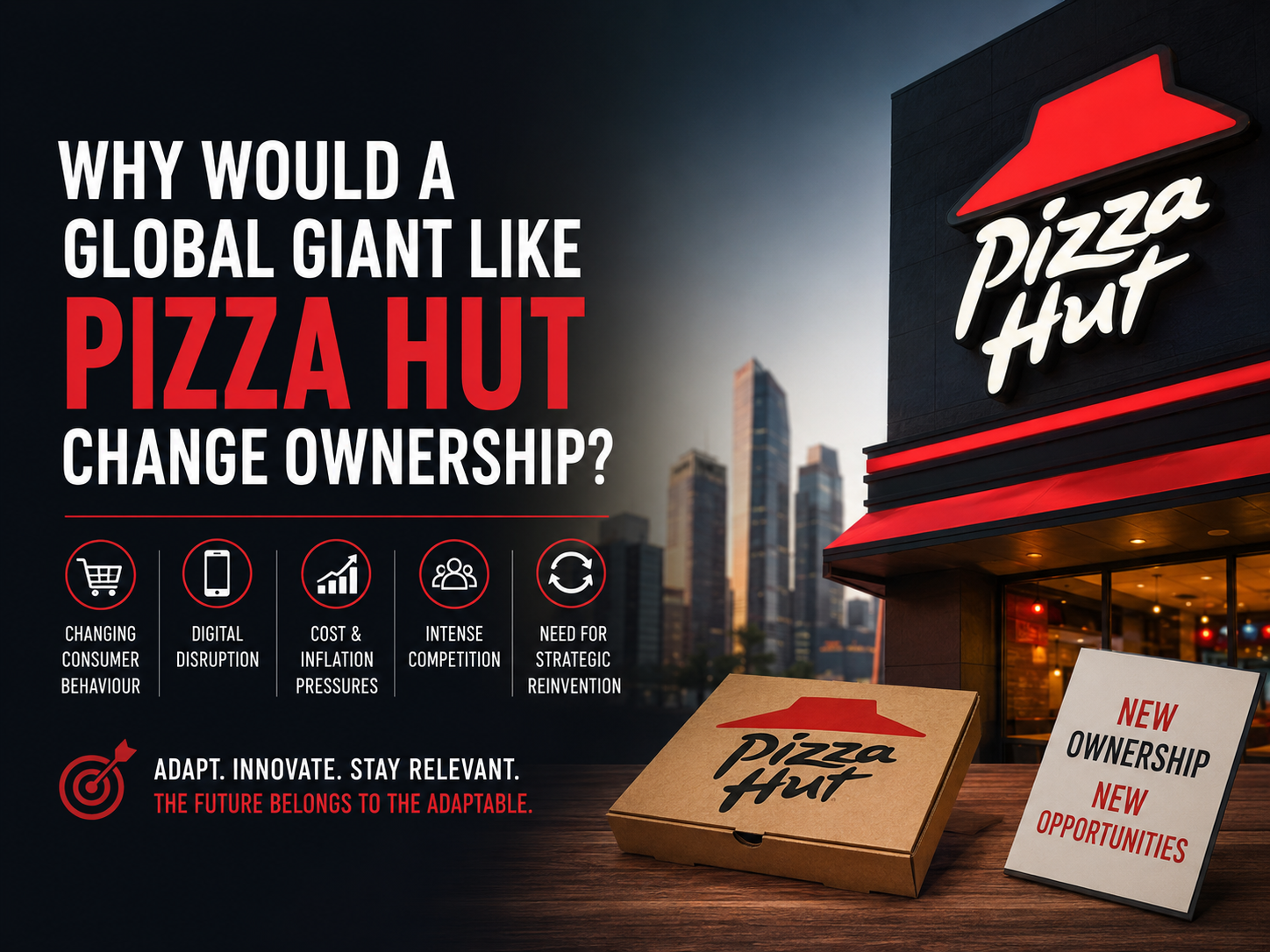
Lessons for Hospitality, Franchising, and Business Leaders
Recent reports indicate that Pizza Hut‘s parent company has agreed to sell the global Pizza Hut business (excluding Mainland China) for approximately USD 1.5 billion, while the China operation is being sold separately for approximately USD 1.2 billion, bringing the total transaction value to around USD 2.7 billion. The decision follows a strategic review after several years of operational challenges, store closures, and declining sales performance in certain markets.
This is not necessarily a story about failure.
Rather, it is a story about how even some of the world’s most recognizable brands must continuously adapt to changing consumer behavior, technology disruption, cost pressures, and evolving market expectations.
As a tourism, hospitality, and restaurant industry professional who has worked across seven countries, I believe there are important lessons every entrepreneur, franchise operator, hotelier, investor, and business leader can learn from this development.
The Bigger Question
If one of the world’s most recognized restaurant brands can face challenges significant enough to trigger a change in ownership, what does that tell us about today’s business environment?
The answer is simple.
No brand is too big to fail.
No market leader is guaranteed future success.
And no business model remains relevant forever.
The hospitality and food service industries are changing faster than ever before.
Consumers are changing.
Technology is changing.
Competition is changing.
And businesses that fail to evolve eventually lose relevance.
1. Consumer Behaviour Has Changed Dramatically
Twenty years ago, consumers selected restaurants largely based on:
- Brand reputation
- Physical location
- Traditional advertising
- Family habits
Today consumers prioritize:
- Convenience
- Mobile ordering
- Delivery speed
- Value for money
- Online reviews
- Social media visibility
- Health-conscious options
Many restaurant chains built their success around dine-in experiences.
However, the modern customer increasingly prefers delivery, take-away, drive-thru, and digital ordering.
Businesses that adapt quickly win market share.
Businesses that move slowly struggle.
2. Digital Transformation Became a Competitive Battlefield
One of the biggest shifts in the restaurant industry has been technology.
Modern restaurant success depends on:
- Mobile applications
- Loyalty programmes
- AI-driven marketing
- Customer analytics
- Delivery integration
- Digital payment systems
The challenge is not simply making pizzas.
The challenge is creating a seamless customer journey.
Many industry analysts argue that some competitors moved faster in digital transformation and customer convenience than Pizza Hut over the past decade.
In today’s world, technology is no longer a support function.
It is a core business strategy.
3. Inflation Has Changed Customer Spending Habits
Global inflation has affected nearly every industry.
Food costs increased.
Labour costs increased.
Utility costs increased.
Logistics costs increased.
Meanwhile consumers became more cautious about discretionary spending.
The restaurant industry was particularly vulnerable because dining out is often one of the first expenses households reduce during economic uncertainty.
Reports suggest inflation and weaker consumer demand were among the factors affecting Pizza Hut’s performance in several markets.
This challenge is not unique to Pizza Hut.
Hotels, restaurants, airlines, and tourism businesses worldwide face similar pressures.
4. Competition Has Never Been Stronger
The restaurant industry today is far more competitive than it was twenty years ago.
Competition now comes from:
Traditional Competitors
Other pizza brands.
Delivery Platforms
Food aggregators.
Cloud Kitchens
Virtual restaurant brands.
Independent Operators
Local businesses offering unique experiences.
Health-Focused Alternatives
Consumers seeking healthier dining choices.
The modern consumer has unlimited choices.
Brand loyalty alone is no longer enough.
5. Scale Can Become Both a Strength and a Weakness
Large global brands enjoy:
- Purchasing power
- Marketing budgets
- Established systems
- Strong brand recognition
However, large organizations can also become:
- Slower to innovate
- Less flexible
- More bureaucratic
- More costly to operate
Smaller competitors often move faster.
This creates a significant strategic challenge.
What worked in 2005 may not work in 2026.
6. Franchising Is Not a Guaranteed Formula for Success
Many people assume that owning a franchise guarantees profitability.
The reality is very different.
A franchise system succeeds only when:
- Franchisees are profitable
- Customers remain loyal
- Brand standards are maintained
- Innovation continues
- Corporate support remains strong
When any of these factors weaken, performance can decline.
This is an important lesson for hotel brands, restaurant operators, and tourism investors.
Seven Business Case Studies
Case Study 1 – Kodak
Market leader in photography.
Failed to adapt to digital transformation.
Lost relevance.
Case Study 2 – Nokia
Dominated mobile phones.
Missed the smartphone revolution.
Lost global leadership.
Case Study 3 – Blockbuster
Ignored streaming technology.
Eventually disappeared.
Case Study 4 – Toys “R” Us
Struggled with online retail disruption.
Filed for bankruptcy.
Case Study 5 – Sears
Failed to modernize retail operations.
Lost market position.
Case Study 6 – BlackBerry
Ignored changing customer expectations.
Lost dominance in mobile communications.
Case Study 7 – Pizza Hut
A globally recognized brand now entering a new ownership phase as it seeks renewed growth opportunities and strategic repositioning.
The lesson is consistent.
Success today does not guarantee success tomorrow.
What Hospitality Leaders Should Learn
As hotel owners, resort developers, tourism entrepreneurs, and restaurant operators, we should ask ourselves:
- Are we innovating fast enough?
- Are we listening to customers?
- Are we investing in technology?
- Are we monitoring changing trends?
- Are we adapting before it becomes necessary?
Waiting until a crisis emerges is often too late.
The most successful businesses reinvent themselves before they are forced to.
What This Means for Sri Lanka
Sri Lanka’s hospitality and restaurant sectors are experiencing rapid change.
Consumer expectations are rising.
Digital ordering is expanding.
Delivery services continue growing.
International brands face increasing competition from local entrepreneurs.
The businesses that will thrive over the next decade are those that combine:
- Strong branding
- Operational excellence
- Technology
- Customer experience
- Innovation
The winners will not necessarily be the largest players.
The winners will be the most adaptable players.
Final Thoughts
The Pizza Hut ownership transition is not simply a corporate transaction.
It is a reminder that every business, regardless of size, must continuously evolve.
Brands are valuable.
However, relevance is even more valuable.
History repeatedly shows that companies rarely fail because they are too small.
They fail because they stop adapting.
For business leaders, investors, hoteliers, and entrepreneurs, the message is clear:
Never assume today’s success guarantees tomorrow’s survival.
The future belongs to organizations that innovate, adapt, and remain relentlessly focused on changing customer expectations.
Disclaimer
This article has been authored and published in good faith by Dr. Dharshana Weerakoon, DBA (USA), based on publicly available information, industry reports, business publications, market observations, and over three decades of professional experience across the global hospitality, tourism, food service, and business sectors. The article is intended solely for educational, analytical, journalistic, and professional discussion purposes. Any references to organizations, brands, transactions, or business developments are based on publicly reported information available at the time of writing. The views expressed are personal, independent, and analytical, and should not be interpreted as legal, financial, investment, or commercial advice. The author accepts no responsibility for any decisions made based on this content. This article has been prepared with due regard for professional ethics, intellectual property rights, reputation management principles, and applicable laws.
© Dr. Dharshana Weerakoon, DBA (USA). All rights reserved.
Further Reading: https://dharshanaweerakoon.com/sri-lankas-university-degree-revolution/
Further Reading: https://www.linkedin.com/newsletters/outside-of-education-7046073343568977920/