When “Security” Becomes a Customer Punishment: Why Sri Lankan Banking Apps Are Losing the Digital Experience Battle in 2026
A Critical Analysis of Sri Lanka’s Banking UX Crisis, OTP Fatigue, Digital Trust, and the Urgent Need for Frictionless Fintech Transformation
A few days ago, I experienced something surprisingly simple — yet deeply revealing about the current state of Sri Lanka’s digital banking ecosystem.
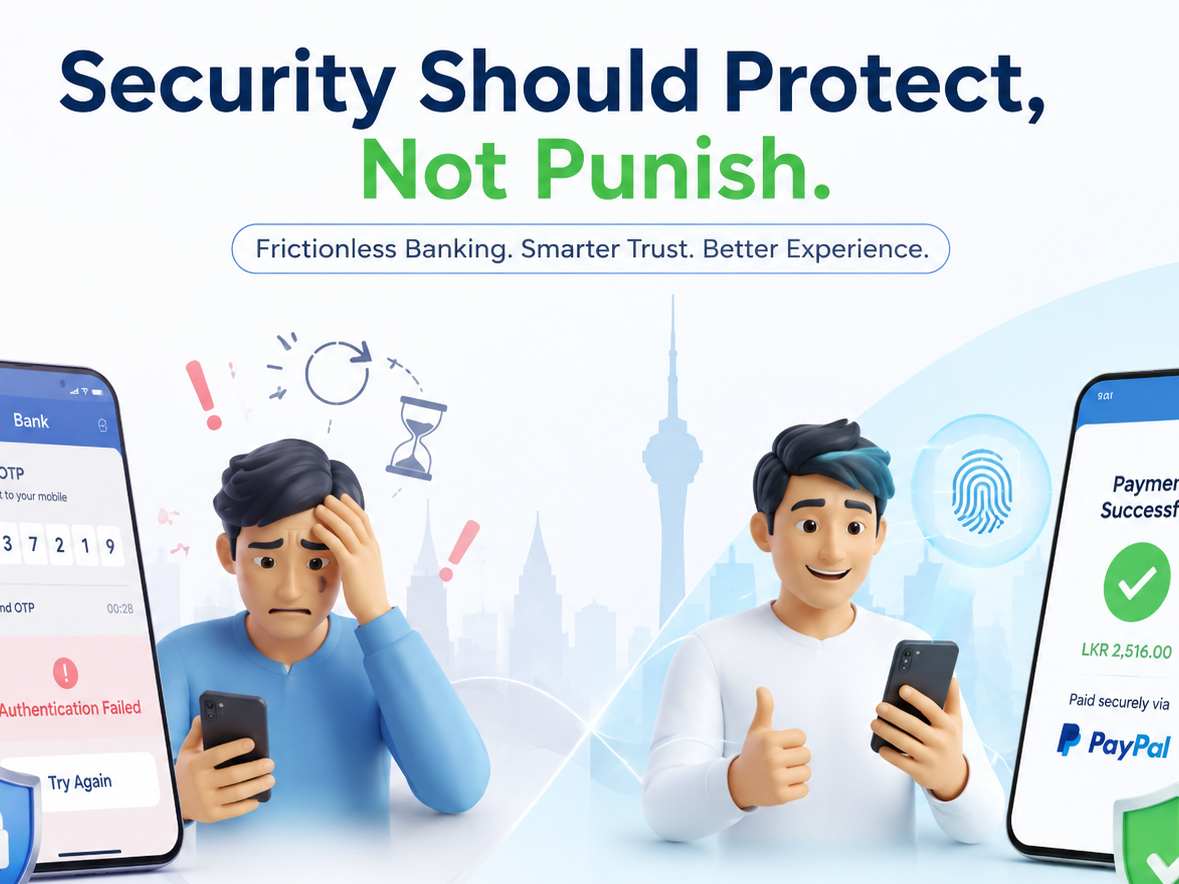
While trying to place a small online food order worth approximately LKR 2,500 through a popular food delivery platform, I used a credit card issued by one of Sri Lanka’s leading banks — a bank widely recognized for its aggressive digital marketing and “technology leadership” campaigns.
However, instead of a smooth digital transaction, I encountered repeated OTP authentication failures, endless verification loops, delayed SMS messages, session expirations, and multiple payment rejections.
Ironically, ordering a biryani became more stressful than managing a corporate procurement process.
Eventually, I switched the payment method to PayPal.
One tap.
No frustration.
No unnecessary interruptions.
No repeated password prompts.
No endless OTP loops.
The transaction was approved instantly through intelligent behavioral verification and device-based trust systems operating silently in the background.
That single experience perfectly exposed a much larger issue facing Sri Lanka’s banking and fintech industry in 2026:
Many local financial institutions still confuse “customer inconvenience” with “security.”
And that is becoming a serious strategic mistake.
The Global Digital Banking Revolution vs. Sri Lanka’s Digital Illusion
Globally, the banking and fintech industry has undergone a major transformation during the past decade.
Modern digital payment ecosystems are no longer built around fear-driven authentication systems. Instead, they are designed around:
- Behavioral intelligence
- Biometric trust
- Frictionless authentication
- AI-driven fraud detection
- Device reputation analysis
- Invisible security architecture
- Customer-centric UX design
Meanwhile, many Sri Lankan banking systems still heavily depend on:
- Repetitive SMS OTP verification
- Mandatory password changes every few months
- Outdated mobile app frameworks
- Poor session management
- Fragmented app ecosystems
- Legacy infrastructure
- High-friction customer journeys
This is not merely a technology problem.
It is a strategic mindset problem.
The Dangerous Illusion of “High Security”
One of the biggest misconceptions in Sri Lanka’s banking sector is the belief that adding more friction automatically increases security.
It does not.
In fact, global cybersecurity studies increasingly show the opposite.
According to international digital banking research, excessive authentication friction often leads to:
- Customer abandonment
- Password reuse
- Unsafe workarounds
- Reduced platform trust
- Lower digital adoption
- Increased operational support costs
Several international studies indicate that nearly 30%–40% of online payment failures globally are related to authentication friction rather than actual fraud detection.
In many cases, legitimate customers are treated like suspicious actors while real cybercriminals continue adapting faster than outdated systems.
This creates what experts now call:
“Security Theater”
A system that creates the appearance of security while damaging the customer experience.
OTP Fatigue: The New Digital Irritation
SMS OTP systems were once considered innovative.
But in 2026, many advanced digital ecosystems are gradually moving beyond OTP dependency.
Why?
Because OTP itself has major weaknesses:
- SMS delivery delays
- SIM swap attacks
- Network failures
- Roaming issues for travelers
- Poor user experience
- Human interruption
- Authentication abandonment
Today, leading global fintech platforms rely increasingly on:
- Passkeys
- FaceID
- Fingerprint authentication
- Device trust scoring
- AI-based behavioral analytics
- Risk-based adaptive authentication
In simple terms:
If the system already recognizes your trusted device, behavioral pattern, location consistency, typing speed, spending behavior, and biometric verification, there is often no need to repeatedly interrupt the customer with manual OTP requests.
This is the future.
And it is already happening globally.
The Password Obsession Problem
Another outdated practice still heavily enforced by many local banking systems is forced password rotation every few months.
Ironically, several modern cybersecurity authorities worldwide now discourage unnecessary mandatory password changes unless there is evidence of compromise.
Why?
Because humans behave predictably.
When users are forced to constantly change passwords, they often create:
- Weak password variations
- Easily guessable patterns
- Unsafe storage habits
- Reused credentials
Modern security frameworks increasingly prioritize:
- Strong initial passwords
- Multi-factor authentication
- Biometrics
- Device authentication
- Passkeys
- Behavioral risk analysis
The future of digital security is not “forcing people to remember harder passwords.”
The future is reducing human dependency altogether.
Sri Lanka’s Banking App Explosion — But Where Is Stability?
Another concerning trend in Sri Lanka’s financial sector is the rapid launch of multiple mobile applications without solving core platform stability issues.
Many banks now operate:
- One app for retail banking
- Another app for cards
- Another app for rewards
- Another app for QR payments
- Another app for business banking
- Another app for investments
Yet customers continue reporting:
- Frequent crashes
- Login failures
- OTP delays
- App freezing
- Server downtime
- Poor synchronization
- Broken UX flows
This raises an important question:
Are some institutions prioritizing “launch culture” over product maturity?
True digital transformation is not about launching more apps.
It is about building fewer, better, stable, intelligent systems that customers can trust daily.
Case Study 1 — PayPal’s Frictionless Trust Model
PayPal represents one of the strongest examples of behavioral security done correctly.
Instead of aggressively interrupting every transaction, PayPal often evaluates:
- Device familiarity
- Historical transaction patterns
- IP consistency
- Purchase behavior
- User velocity
- Risk scoring
- Behavioral trust signals
This creates what UX experts call:
“Invisible Security”
The safest systems are often the systems customers barely notice.
That is world-class UX engineering.
Case Study 2 — Apple Pay and Device-Level Security
Apple transformed digital payments by shifting security from “password dependency” to “device trust.”
Through FaceID and device encryption, users authenticate naturally without repeated manual verification loops.
The result?
- Faster transactions
- Higher customer satisfaction
- Reduced friction
- Stronger trust perception
Importantly, convenience and security coexist together.
Sri Lankan institutions must understand this principle urgently.
Case Study 3 — Singapore’s Digital Banking Transformation
Singapore aggressively modernized its fintech ecosystem through:
- Smart national digital identity systems
- Integrated payment frameworks
- Open banking initiatives
- AI-driven fraud prevention
- Unified digital infrastructure
As a result, Singapore became one of Asia’s strongest fintech ecosystems with exceptionally high digital banking adoption rates.
The lesson?
Digital transformation requires ecosystem thinking — not isolated mobile apps.
Case Study 4 — India’s UPI Revolution
India revolutionized digital payments through the Unified Payments Interface (UPI).
The platform processes billions of monthly transactions through:
- Simplified authentication
- Instant interoperability
- Mobile-first architecture
- User-centric design
India’s fintech success did not happen because of “more OTPs.”
It happened because of:
- Simplicity
- Scale
- Infrastructure modernization
- Digital trust engineering
Case Study 5 — Revolut and the Modern Fintech UX Model
Revolut became globally successful largely because it prioritized user experience alongside security.
Key strengths include:
- Real-time notifications
- One-touch card freezing
- Intelligent fraud detection
- Clean UI/UX
- Fast onboarding
- Adaptive authentication
Modern customers no longer compare local banks only with other local banks.
They compare them with global experiences.
That changes everything.
Case Study 6 — Banking App Failures During High Traffic Events
Globally, multiple traditional banks have experienced digital failures during:
- Salary days
- Shopping festivals
- Public holidays
- Flash sales
- Emergency situations
Research shows that system instability during high-demand periods severely damages long-term customer trust.
The digital economy now operates 24/7.
Customers no longer tolerate:
- Downtime
- Authentication loops
- Session failures
- Broken payment systems
Reliability itself has become part of customer experience.
Case Study 7 — The Rise of Neo-Banks
Digital-only banks worldwide are rapidly gaining younger customers because they prioritize:
- Seamless onboarding
- Fast transactions
- Transparent interfaces
- Minimal friction
- AI-powered support
- Human-centered UX
Many traditional banks underestimate how quickly customer loyalty can shift when convenience improves elsewhere.
The next generation is far less patient with outdated systems.
The Real Cost of Bad Banking UX
Poor user experience creates hidden economic damage far beyond customer frustration.
These include:
1. Reduced Digital Adoption
Customers avoid using digital channels after repeated failures.
2. Increased Operational Costs
Call centers become overloaded with password resets, OTP issues, and app complaints.
3. Brand Reputation Damage
One failed experience can spread rapidly through social media.
4. Loss of Customer Trust
Trust is extremely difficult to rebuild once broken.
5. Competitive Weakness
Global fintech competitors continue improving faster.
6. Customer Migration
Users increasingly diversify toward fintech wallets and alternative payment systems.
Sri Lanka’s Fintech Future: A Critical Crossroads
Sri Lanka possesses enormous digital potential.
The country has:
- High smartphone penetration
- Strong internet adoption growth
- Young digital consumers
- Expanding fintech awareness
- Growing e-commerce behavior
However, infrastructure modernization alone is not enough.
The industry must also modernize its philosophy.
Because true digital transformation is not about:
- More apps
- More OTPs
- More passwords
- More friction
It is about:
- Better trust systems
- Better UX
- Better infrastructure
- Better customer psychology
- Better behavioral intelligence
The Psychology of Digital Trust
Customers do not judge technology only by technical capability.
They judge it emotionally.
Every failed authentication creates:
- Irritation
- Anxiety
- Delay
- Doubt
- Fatigue
Eventually, customers stop seeing the platform as “secure.”
They start seeing it as:
“Difficult.”
And difficult systems lose users.
What Sri Lankan Banks Must Do Next
1. Move Beyond OTP Dependency
OTP should become secondary — not the primary customer experience.
2. Invest in Behavioral AI
Modern fraud prevention relies heavily on behavioral analytics.
3. Prioritize Stable Infrastructure
Reliability matters more than marketing campaigns.
4. Reduce Authentication Friction
Security should feel intelligent, not exhausting.
5. Consolidate App Ecosystems
Customers prefer unified experiences.
6. Invest in UX Professionals
Many fintech breakthroughs today come from human-centered design teams.
7. Build Trust Through Simplicity
Simple systems often create stronger adoption.
The Future Belongs to Frictionless Banking
Globally, the most successful fintech ecosystems are becoming:
- Faster
- Simpler
- Smarter
- Less visible
- More predictive
- More behavioral
- More human-centered
The winning platforms of the future will not be those with the most complicated authentication systems.
They will be the platforms customers trust instinctively because the experience feels seamless.
Final Thoughts
My small biryani order revealed something much bigger than a payment failure.
It revealed a growing disconnect between:
- What customers expect in 2026
and - What many traditional financial systems still deliver.
Customers today compare every digital experience globally.
A Sri Lankan banking app is no longer competing only with another local bank.
It is competing with:
- PayPal
- Apple Pay
- Google Pay
- Revolut
- Stripe
- Global fintech ecosystems
That is the new reality.
The future of banking is not about making customers suffer in the name of security.
It is about creating intelligent trust systems that protect users silently while allowing life to move smoothly.
Because in the digital economy:
User Experience is no longer optional. It is infrastructure.
Disclaimer
This article has been authored and published in good faith by Dr. Dharshana Weerakoon, DBA (USA), based on publicly observable consumer experiences, global fintech trends, international digital banking practices, publicly discussed industry behavior, and extensive professional observation across technology, hospitality, customer experience, and business ecosystems.
The content is intended solely for educational, analytical, journalistic, and public awareness purposes to stimulate constructive discussion regarding digital banking transformation, cybersecurity usability, customer experience design, and financial technology innovation in Sri Lanka and internationally.
No specific bank, financial institution, employee, or organization has been intentionally targeted, defamed, or accused of misconduct. Any references to systems, technologies, or operational challenges are purely analytical and industry-focused in nature.
Views expressed are entirely personal and do not constitute legal, financial, cybersecurity, investment, regulatory, or commercial advice. Readers are encouraged to conduct their own independent assessments and professional consultations where necessary.
This article has been independently authored through lived professional expertise, industry exposure, research interpretation, and human analytical insight.
Further Reading: https://dharshanaweerakoon.com/uncredentialed-tourism-experts-sri-lanka/
Further Reading: https://www.linkedin.com/newsletters/outside-of-education-7046073343568977920/