Redefining Sri Lanka’s Future: A Strategic Blueprint for High-Value Tourism, the Silver Economy, and National Transformation
Introduction: A Decade of Thinking, One Strategic Direction
Over the past several years, my professional journey—across tourism, hospitality, consulting, and international business—has led me to repeatedly confront one fundamental question:
Why does Sri Lanka, with all its natural and human advantages, continue to underperform in capturing high-value global opportunities?
Through my writings, research, and practical engagement, I have explored multiple sectors—from elderly care tourism and wellness economies to rural revitalization and digital transformation. While these may appear as independent ideas, they are not.
They are interconnected.
They form a single, strategic narrative:
👉 Sri Lanka must transition from a volume-driven economy to a value-driven, experience-led, globally competitive ecosystem.
This article is not a concept note. It is a consolidated blueprint, built from years of observation, analysis, and industry insight.
The Global Context: Why the Timing Is Critical
To understand Sri Lanka’s opportunity, we must first understand the global shift.
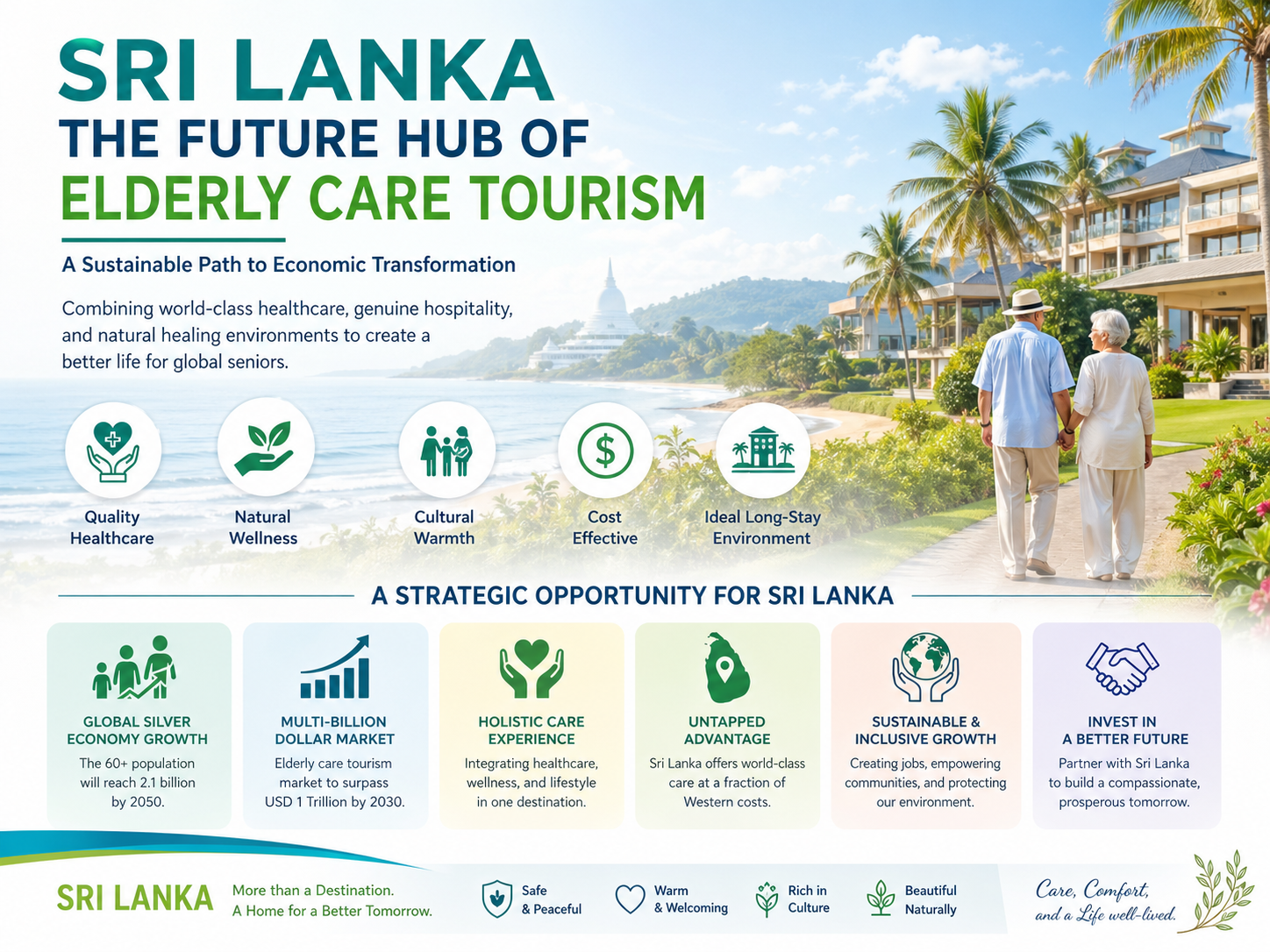
- By 2050, the global population aged 60+ will exceed 2.1 billion, nearly doubling from 2020
- The global senior living and elderly care market is projected to surpass USD 1 trillion
- The medical and wellness tourism industry is expected to exceed USD 180–200 billion
- More than 15 million retirees in Europe alone are actively exploring overseas living options
At the same time:
- Healthcare costs in developed countries are rising by 6–10% annually
- Long-term care systems in the West are under severe pressure
- There is increasing demand for affordable, high-quality, emotionally supportive care environments
This is not a temporary trend.
👉 This is a structural global shift.
Sri Lanka’s Strategic Position: Undervalued, Yet Powerful
Sri Lanka holds a rare combination of advantages that many countries cannot replicate simultaneously:
1. Cost Advantage
- Elderly care costs in Europe: USD 3,000–6,000/month
- Potential in Sri Lanka: USD 800–1,500/month
2. Healthcare Capability
Supported by institutions aligned with global benchmarks such as the World Health Organization, Sri Lanka offers:
- Life expectancy of ~77 years
- Strong public healthcare backbone
- Skilled and internationally trained professionals
3. Natural Therapeutic Assets
- Tropical climate conducive to recovery and wellness
- Coastal, hill country, and biodiversity zones
- Deep-rooted Ayurvedic traditions
4. Cultural Intelligence
Sri Lanka’s inherent respect for elders creates a human-centered care advantage that cannot be engineered artificially.
From Tourism to Transformation: A Shift in Thinking
Traditionally, Sri Lanka has relied on:
- Short-term leisure tourism
- Seasonal visitor flows
- Price-sensitive market segments
However, this model has limitations:
- Revenue volatility
- Low per-capita spending
- High environmental pressure
Over the years, my work has consistently argued for a transition toward:
👉 High-value, long-stay, experience-driven economic models
This includes:
- Elderly care tourism
- Wellness and longevity tourism
- Integrated healthcare-hospitality ecosystems
- Knowledge-based tourism
The Silver Economy: A Defining Opportunity
One of the most significant ideas I have explored is the “Silver Economy”—the economic ecosystem built around aging populations.
This is not merely about elderly care.
It is about:
- Lifestyle
- Health
- Dignity
- Community
- Long-term engagement
👉 Elderly Care Tourism in Sri Lanka can become a cornerstone of this transformation.
If structured correctly, it can:
- Generate USD 2–5 billion annually within a decade
- Create 100,000+ jobs
- Attract long-term foreign exchange
- Stimulate rural economies
Case Studies: Global Lessons with Strategic Relevance
1. Thailand – Retirement Tourism Integration
Thailand has developed structured retirement communities with healthcare integration.
Insight: Government-backed visa policies drive scale.
2. Malaysia – MM2H Programme
Malaysia’s long-term residency model has attracted thousands of retirees.
Insight: Policy clarity builds investor and consumer confidence.
3. Japan – Technology in Elderly Care
Japan uses robotics and smart monitoring systems to manage aging populations.
Insight: Efficiency through innovation is essential—but must complement human care.
4. Spain – Lifestyle-Based Retirement Migration
Spain attracts retirees through climate, healthcare, and lifestyle.
Insight: Emotional value is as important as medical quality.
5. Costa Rica – Wellness-Centric Retirement
Focuses on eco-living, sustainability, and wellness.
Insight: Sustainability enhances long-term attractiveness.
6. India – Medical Tourism Scale
India leverages affordability and specialization to attract global patients.
Insight: Scale and specialization create competitive advantage.
7. Portugal – Golden Visa Strategy
Investment-linked residency programs drive foreign inflows.
Insight: Financial incentives accelerate market entry.
A Sri Lankan Model: Integrated, Inclusive, Scalable
Based on my analysis, Sri Lanka must adopt a multi-layered strategic model:
1. Regional Development Clusters
- Kandy: Wellness and hill country living
- Galle: Coastal retirement ecosystems
- Dambulla: Cultural and eco-integrated care zones
2. Public-Private Synergy
Collaboration with institutions such as the Sri Lanka Tourism Development Authority is critical.
3. Integrated Care Resorts
Combining:
- Assisted living
- Medical care
- Wellness services
- Recreational environments
4. Workforce Transformation
Developing:
- Geriatric care professionals
- Multilingual service providers
- International-standard hospitality staff
5. Policy Innovation
- Long-term retirement visas
- Tax incentives
- Regulatory frameworks
Rural Transformation: The Hidden Multiplier
One of the most powerful outcomes of this model is rural economic revitalization.
Instead of urban concentration:
- Investments move to secondary regions
- Employment is created locally
- Infrastructure development becomes inclusive
👉 Tourism becomes a tool for balanced national growth.
Technology as an Enabler, Not a Replacement
Future-ready elderly care tourism must integrate:
- Telemedicine
- Remote health monitoring
- Smart living systems
However:
👉 Technology must enhance—not replace—human connection.
Sustainability: A Strategic Imperative
Global frameworks supported by organizations such as the United Nations World Tourism Organization emphasize:
- Environmental responsibility
- Community inclusion
- Ethical operations
Sri Lanka must embed sustainability at the core—not as an afterthought.
Challenges: A Realistic Perspective
No transformation comes without risks:
- Regulatory gaps
- Quality consistency
- Ethical considerations
- Cultural alignment
However, these are manageable—with the right strategy.
A Personal Perspective: Beyond Strategy
This body of work reflects more than professional analysis.
It reflects a belief:
👉 Sri Lanka’s greatest asset is not its geography—it is its people.
Our ability to care, connect, and create meaningful experiences is unmatched.
Conclusion: From Potential to Positioning
Sri Lanka stands at a critical juncture.
We can:
- Continue with traditional models
Or - Lead a new global movement in high-value tourism and care economies
👉 The choice is strategic. The timing is now.
Disclaimer
This article has been authored and published in good faith by Dr. Dharshana Weerakoon, DBA (USA), based on publicly available data from recognized Sri Lankan and international institutions (including tourism authorities, central banking publications, global health and tourism bodies), combined with extensive professional experience across multiple sectors and regions.
It is intended solely for educational, analytical, and public awareness purposes to stimulate informed discussion on sustainable tourism development, elderly care tourism, and economic transformation within the Sri Lankan context.
The views expressed are entirely personal, professional, and strategic in nature and do not constitute legal, financial, medical, or investment advice. While every effort has been made to ensure accuracy and relevance, the author assumes no responsibility for any interpretation, adaptation, or application of the concepts presented.
All ideas and models discussed are intended to align with the legal and regulatory framework of Sri Lanka, including intellectual property laws, human rights legislation, and applicable ethical standards governing tourism, healthcare, and data privacy.
✍ This work has been independently developed and articulated through professional expertise, industry engagement, and original thought.
Further Reading: https://dharshanaweerakoon.com/are-we-a-nation-of-steps/
Further Reading: https://www.linkedin.com/newsletters/outside-of-education-7046073343568977920/