Sri Lanka’s US$1 Billion Question: Are We Strong Enough to Protect Our Financial System?
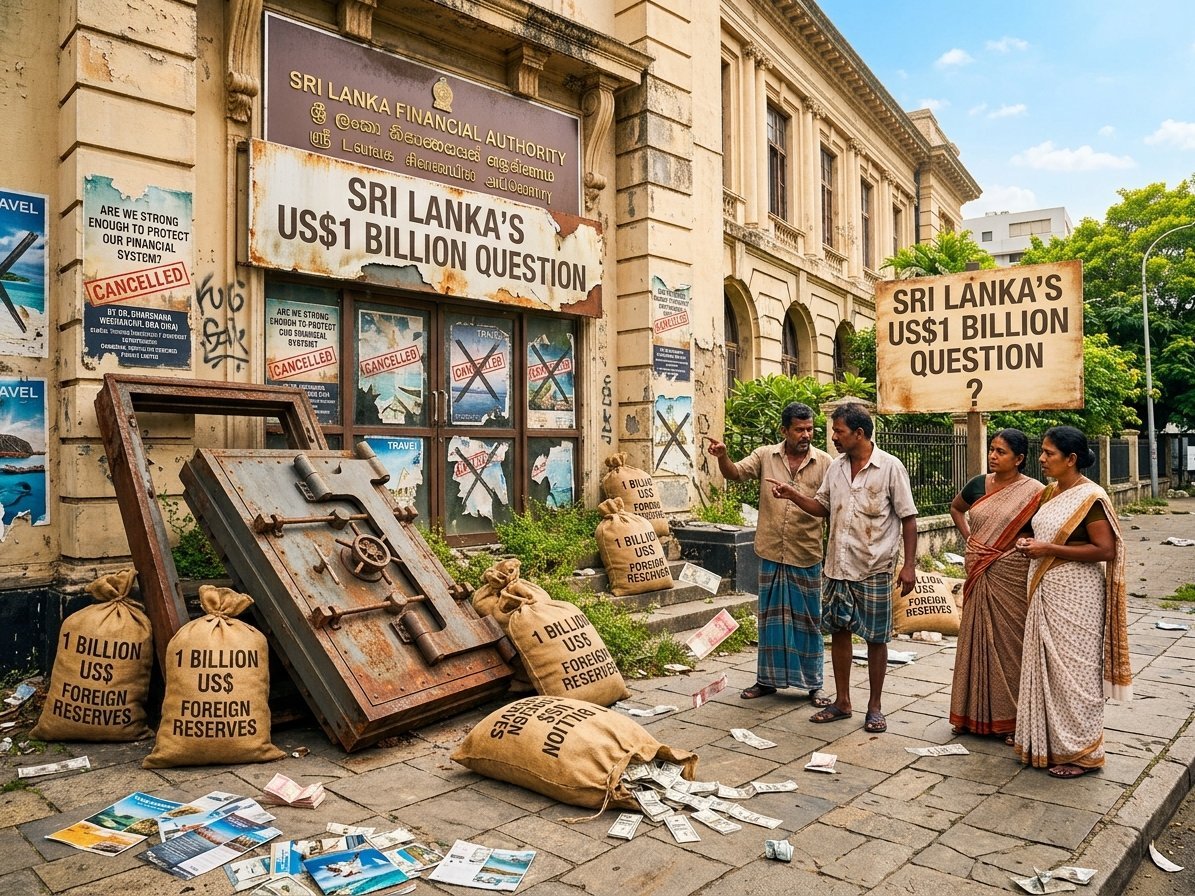
Sri Lanka is facing a financial question that deserves serious national attention:
How can a country strengthen its financial system so that legitimate international trade can flourish while suspicious or potentially irregular foreign-exchange movements are detected at the earliest possible stage?
Recent publicly reported investigations into suspected irregularities involving import transactions and outward foreign-exchange transfers have brought this question into sharper focus.
Public reporting has referred to figures running into hundreds of millions of US dollars. Some reports initially referred to an amount approaching US$1 billion, while subsequent publicly reported investigative information referred to approximately US$715 million, or around Rs.214.7 billion, associated with transactions involving numerous companies, bank accounts and telegraphic transfers.
These figures are significant.
However, they should be treated as reported figures associated with ongoing investigations, rather than as established findings of criminal liability.
That distinction matters.
An investigation is not a conviction.
At the same time, an investigation of this scale provides Sri Lanka with an opportunity to examine something much larger than any individual transaction:
The resilience of our financial architecture.
This is not simply a banking issue
When large international payments take place, several parts of the economic system may potentially be involved.
There can be:
- Importers
- Exporters
- Commercial banks
- Customs authorities
- Foreign-exchange regulators
- Company registries
- Tax authorities
- Freight and logistics providers
- Financial-intelligence authorities
- Law-enforcement agencies
Each institution may have access to only part of the picture.
And that creates an important question:
Can Sri Lanka connect those pieces of information quickly enough to identify unusual patterns?
That, in my view, is one of the most important questions arising from the current situation.
Case Study 1: When documentation is not the whole story
Consider a hypothetical example.
A Sri Lankan company reports that it is importing machinery worth US$2 million.
There may be an invoice.
There may be a purchase agreement.
There may be banking documentation.
There may be an overseas supplier.
The payment may therefore appear commercially structured.
But another question remains:
Did the economic transaction actually take place as represented?
This is where modern financial supervision becomes more complicated.
Documentation is essential.
But documentation alone may not always provide the complete economic picture.
A stronger system should, where legally and operationally appropriate, be capable of connecting:
Payment → shipment → Customs information → arrival → commercial activity.
Case Study 2: The information-gap problem
Imagine that a bank sees a payment.
Customs sees an import declaration.
A company maintains its own commercial records.
A financial-intelligence authority analyses transaction patterns.
Each institution may be performing its own legitimate function.
But what happens if these pieces of information are not connected?
The potential weakness is not necessarily the absence of regulation.
It may be the absence of integration.
This is why Sri Lanka should increasingly move from isolated compliance checks toward integrated financial intelligence.
Case Study 3: One transaction versus a pattern
One international payment may look perfectly ordinary.
Ten may still appear reasonable.
One hundred may require closer examination.
Thousands of transactions involving similar counterparties, companies, values, destinations or transaction structures could reveal a very different pattern.
This is where data analytics can become extremely valuable.
Financial-risk monitoring should increasingly ask:
“What does this transaction look like when compared with the customer’s entire financial behaviour?”
That is a much more powerful question than simply asking whether the paperwork exists.
Case Study 4: The beneficial-ownership question
Another important issue is corporate ownership.
A company may have a legitimate registration, directors and business activity.
But regulators and financial institutions also need to understand the ultimate beneficial ownership and the relationships between apparently separate businesses.
For example, several companies may potentially share:
- Directors
- Beneficial owners
- Addresses
- Contact information
- Professional advisers
- Suppliers
- Overseas counterparties
- Banking patterns
None of these characteristics, individually, proves wrongdoing.
But collectively, they may provide useful risk indicators.
This is why modern financial supervision increasingly depends upon network analysis.
Case Study 5: Foreign exchange is an economic resource
Sri Lanka learned a painful lesson during its foreign-exchange crisis.
Foreign currency is not merely another financial asset.
It is essential for:
- Fuel
- Medicine
- Machinery
- Education
- Technology
- Industrial inputs
- International trade
- Tourism
- Investment
Therefore, protecting the integrity of foreign-exchange flows is directly connected to national economic stability.
At the same time, Sri Lanka must be careful not to create unnecessary barriers for legitimate businesses.
The objective should not be:
“Stop foreign exchange from leaving.”
The objective should be:
“Ensure that legitimate foreign-exchange movements are facilitated and suspicious transactions are identified effectively.”
That is a very different approach.
Case Study 6: Trade-based financial crime risk
International organisations have long recognised trade as an area that can be vulnerable to money-laundering and other financial-crime risks.
Trade transactions can be complex.
They may involve different countries, currencies, companies, banks, shipping arrangements and documentation.
That complexity can make certain types of financial irregularity difficult to identify.
Therefore, Sri Lanka should continue strengthening its ability to detect unusual trade patterns while ensuring that legitimate international commerce remains efficient.
This is particularly important for a country seeking to attract:
Foreign investment.
Tourism investment.
Export businesses.
International companies.
Regional headquarters.
Case Study 7: The reputation of the financial system
There is another issue that deserves attention.
Trust.
Financial systems operate partly on trust.
Investors need confidence.
Businesses need confidence.
Tourism operators need confidence.
International banks need confidence.
Foreign investors need confidence.
Sri Lankan citizens also need confidence that the financial system operates according to clear rules.
Therefore, whenever a major financial investigation becomes public, the long-term objective should not simply be identifying what happened.
It should also be:
How do we make the system stronger afterwards?
Five reforms Sri Lanka should consider
1. Build stronger data integration
Where legally permissible, relevant information from banking, Customs, corporate registration, taxation and financial-intelligence systems should be capable of being analysed together.
The objective should be to identify patterns rather than examine transactions in isolation.
2. Strengthen beneficial-ownership transparency
Authorities and regulated institutions should have better tools for understanding who ultimately controls companies and how apparently separate businesses may be connected.
3. Improve post-payment monitoring
Where appropriate, international payments relating to imports should be capable of being reconciled with subsequent trade information.
The monitoring chain should not end when money leaves the country.
4. Expand responsible use of technology
Sri Lanka should make greater use of data analytics, artificial intelligence and automated risk-scoring tools to identify unusual transaction patterns.
However, technology should support—not replace—human investigation, professional judgment and due process.
5. Protect legitimate businesses
This point is critical.
A stronger compliance system must not become an unnecessary obstacle for genuine Sri Lankan entrepreneurs.
Legitimate companies should be able to import, export, invest and operate internationally without excessive administrative burdens.
The principle should be:
**High scrutiny for high-risk activity.
Efficient service for legitimate business.**
What should banks and businesses ask themselves?
I believe every organisation involved in international trade should periodically ask:
“If this transaction were reviewed several years from now, could we clearly explain why we considered it commercially legitimate?”
That question changes the mindset.
It moves organisations beyond:
“Do we have the documents?”
towards:
“Does the complete transaction make economic sense?”
That is the direction in which modern financial governance needs to move.
Sri Lanka does not necessarily need more paperwork
We often respond to financial problems by creating another form, another approval or another layer of administration.
But paperwork is not the same as intelligence.
A modern financial system needs:
Better data.
Better connectivity.
Better analytics.
Better risk assessment.
Better institutional cooperation.
Better accountability.
The objective should be to make the system smarter, not simply more complicated.
The US$1 billion question
The reported figures surrounding the current investigation are substantial.
Whether one refers to the initial public reporting of approximately US$1 billion or subsequent reporting concerning approximately US$715 million, the scale alone should encourage serious discussion.
But there is an equally important principle:
We should not confuse an allegation with a proven fact.
Investigations must be conducted independently.
Evidence must be assessed properly.
Individuals and institutions must be afforded due process.
And conclusions should ultimately be based on evidence and lawful proceedings.
That is how a credible financial system protects both the public interest and the rights of those under investigation.
My perspective
As someone involved in tourism, hospitality, international business and investment discussions, I believe financial-system credibility is directly connected to Sri Lanka’s future economic competitiveness.
A foreign investor does not look only at beaches, hotels, labour costs or tax incentives.
Investors also look at:
Governance.
Transparency.
Regulatory predictability.
Financial integrity.
Ease of doing business.
Institutional credibility.
Sri Lanka therefore has an opportunity.
Instead of viewing major financial investigations only as scandals, we can use them as stress tests.
Every weakness identified should become a lesson.
Every lesson should become a reform.
Every reform should make the system stronger.
The question we should really be asking
For me, the most important question is not:
“Who is guilty?”
That is for investigators and, ultimately, the courts where appropriate.
The question for policymakers, regulators, banks and the business community is different:
“What can we change today so that a similar financial risk becomes much harder to execute tomorrow?”
That is the conversation Sri Lanka needs.
Because protecting the integrity of our financial system is not only about preventing financial crime.
It is about protecting:
our foreign exchange,
our businesses,
our investors,
our economy,
and ultimately, public confidence in Sri Lanka.
A stronger financial system is not an obstacle to economic growth. It is one of the foundations of economic growth.
Disclaimer
This article has been authored and published in good faith by Dr. Dharshana Weerakoon, DBA (USA), for educational, professional and public-awareness purposes.
The analysis is based on publicly available information and publicly reported developments available at the time of writing, together with the author’s professional experience and independent analysis.
This article does not accuse or establish criminal liability against any particular individual, bank, financial institution, company, employee or other organisation. References to investigations, reported transactions, suspected irregularities or reported financial figures should not be interpreted as findings of guilt or as a determination that any person or institution has committed an offence.
Any investigation should be assessed on the basis of evidence and applicable law, with appropriate respect for due process and the presumption of innocence.
The views expressed are entirely personal and analytical. They are intended to stimulate informed discussion concerning financial integrity, foreign-exchange management, trade-related financial risks, corporate governance and institutional resilience.
This article does not constitute legal, financial, investment, banking, regulatory or compliance advice.
No representation is made that the article provides a complete account of any ongoing investigation. Readers should consult official authorities and qualified professional advisers for decisions requiring legal, financial or regulatory advice.
© Dr. Dharshana Weerakoon, DBA (USA). All rights reserved.
Further Reading: https://dharshanaweerakoon.com/indian-sme-investment-opportunities-in-sri-lanka/
Further Reading: https://www.linkedin.com/newsletters/outside-of-education-7046073343568977920/