Sunken Costs: Is Shipwreck Tourism in Sri Lanka Creating an Environmental Mortgage?
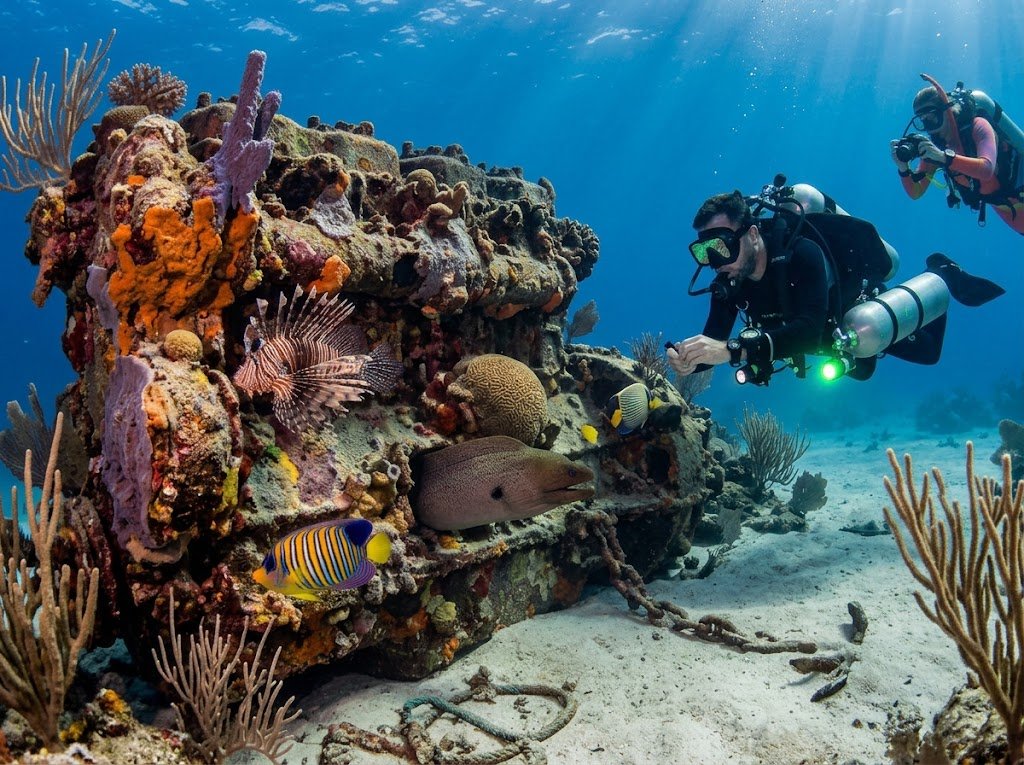
When does a shipwreck become an artificial reef—and when does it become an environmental liability?
A rusting ship beneath clear blue water can be one of the most powerful images in tourism.
For divers, a shipwreck is history, adventure and mystery. For dive operators, it is a marketable attraction. For destinations, it can become another reason for an international traveller to stay longer, spend more and return.
However, beneath the romance of wreck diving lies a question that Sri Lanka should begin asking more seriously:
Are we creating tourism assets—or environmental mortgages that future generations will be forced to pay?
Shipwreck tourism in Sri Lanka has enormous potential. From historic wrecks around Hikkaduwa to underwater attractions along other parts of our coastline, wreck diving adds diversity to Sri Lanka’s marine tourism product.
Yet we must avoid a dangerous assumption:
Every sunken ship is not automatically an artificial reef.
Some wrecks become extraordinary habitats. Others can damage coral, release contaminants, alter sediment conditions, attract excessive human pressure or simply concentrate marine life without actually increasing it.
That distinction matters.
If Sri Lanka wants to build a globally respected marine tourism industry, shipwreck tourism in Sri Lanka must be evaluated not only by the number of divers it attracts, but also by what it leaves behind underwater.
The difference between a reef and a wreck
A natural coral reef is not simply a hard surface covered with marine organisms.
It is a living ecosystem built over centuries.
A shipwreck, on the other hand, begins as an industrial object. It may contain or have historically contained fuels, lubricants, batteries, cables, coatings, paints, metals, plastics and other materials. Even after cleaning, the environmental story does not necessarily end.
Yes, marine organisms can colonise steel structures. Corals, sponges, algae and other organisms may establish themselves. Fish may gather around the wreck.
But there is an important scientific question:
Has the wreck created new ecological productivity—or has it simply attracted marine life away from nearby habitats?
This is known as the attraction versus production debate.
A wreck full of fish may look like an ecological success. However, the presence of fish alone does not prove that the wreck has increased the overall health, biomass or resilience of the marine ecosystem.
This is precisely why shipwreck tourism in Sri Lanka requires a more sophisticated conversation.
Sri Lanka’s reefs are already carrying enough pressure
Sri Lanka is not discussing shipwrecks in an untouched ocean.
Our coral ecosystems have already experienced severe environmental stress from coral bleaching, rising sea temperatures, destructive fishing practices, sedimentation, coastal development, pollution and tourism pressure.
Historical monitoring following the major 1998 bleaching event illustrates the scale of vulnerability. At some Sri Lankan reef locations, live coral cover experienced dramatic declines. Hikkaduwa, for example, recorded a fall from approximately 47% live coral cover before the bleaching event to around 7% afterwards in shallow monitored areas. At Bar Reef, the decline was even more severe, with reported live coral cover falling from approximately 78.5% to close to zero in some monitored areas.
These figures should give every tourism planner reason to pause.
When an ecosystem is already under pressure, we cannot evaluate a new or existing wreck attraction only by asking:
“How many divers can we bring?”
We must also ask:
“What is the carrying capacity of this underwater environment?”
Seven lessons from shipwrecks around the world
Sri Lanka does not need to reinvent the wheel. The global experience with shipwrecks and artificial reefs offers both inspiration and warnings.
Case Study 1: SS Conch – Sri Lanka’s living laboratory
The SS Conch, which sank off the Hikkaduwa area in 1903, has become one of the best-known examples of shipwreck tourism in Sri Lanka.
More than a century later, marine organisms and fish have colonised the wreck. It demonstrates the remarkable ability of nature to occupy and transform human structures.
However, the SS Conch also raises an important question.
Its apparent ecological value today does not mean that every vessel placed underwater will produce the same result.
The Conch has had more than 120 years of interaction with its marine environment. It exists in a specific location, depth, current system and ecological setting.
Therefore, using one successful historic wreck as justification for sinking another ship would be scientifically weak.
Lesson: Every wreck is site-specific. Success cannot simply be copied and pasted.
Case Study 2: The Mauritius grounding – when a wreck becomes a reef killer
In 2012, a fishing vessel ran aground on the reef at St. Brandon’s Atoll in Mauritius.
The consequences were alarming.
Research documented dead and blackened coral around the affected area, together with an extensive algal response down-current from the wreck. The study also investigated metal concentrations in affected corals.
This case is particularly relevant to island nations such as Sri Lanka.
A ship does not need to sink deliberately to become an environmental problem. A grounding can physically crush coral while damaged materials, coatings and associated pollutants can create additional ecological stress.
Lesson: A shipwreck can be both a tourism attraction and an environmental incident. The two possibilities are not mutually exclusive.
Case Study 3: USS Spiegel Grove – what planning and monitoring can achieve
The 510-foot USS Spiegel Grove was intentionally sunk off Key Largo, Florida, in 2002 as an artificial reef and diving attraction.
The important point is not simply that the vessel attracted marine life.
It was subjected to pre-deployment and post-deployment monitoring, including comparisons with nearby natural and artificial reef sites.
Within less than a month, 46 fish species had been documented on the wreck. Over five years, monitoring recorded 191 fish species.
That is impressive.
However, the real lesson is not “sink more ships.”
The real lesson is:
Measure the outcome.
Without baseline data and long-term monitoring, a destination may see fish gathering around a wreck and mistakenly declare victory.
Lesson: No baseline data means no credible proof of ecological success.
Case Study 4: USS Oriskany – cleaning a ship is not a symbolic exercise
The USS Oriskany, a former aircraft carrier, was intentionally deployed as an artificial reef in the Gulf of Mexico in 2006.
Before deployment, extensive environmental assessments examined issues including PCBs and other potential contaminants.
The project required risk analysis, regulatory review and environmental monitoring.
The lesson is highly relevant for Sri Lanka.
A vessel cannot simply be emptied of fuel, painted over and declared “eco-friendly.”
Environmental preparation must examine what remains within:
- electrical systems;
- cable insulation;
- paints and coatings;
- heavy metals;
- machinery residues;
- hazardous materials; and
- other persistent pollutants.
Lesson: “Clean enough to sink” and “safe enough for the marine ecosystem” should never be treated as the same standard.
Case Study 5: Türkiye – a recent warning about toxic residues
A recent environmental study of two artificial shipwrecks in the Mediterranean found that environmental concerns can remain even after vessels have undergone cleaning procedures.
The study identified contamination concerns involving elements associated with historic coatings and other materials. Monitoring of sediments and marine organisms demonstrated why visual inspection alone is not enough.
A wreck may look clean to a diver.
That does not mean it is chemically harmless.
This should be a wake-up call for policymakers.
If an artificial reef programme is based only on removing fuel and visible waste, it may overlook contaminants embedded in coatings, materials and components.
Lesson: Environmental safety must be tested scientifically—not assumed visually.
Case Study 6: SS Yongala – tourism success requires protection
Australia’s SS Yongala, which sank in 1911, has become one of the world’s most famous wreck dives.
It attracts an extraordinary concentration of marine life and has supported a significant dive tourism economy.
However, popularity also creates pressure.
The site has required active management, including a protected zone and systems designed to reduce destructive anchoring and uncontrolled access.
This is another important lesson for shipwreck tourism in Sri Lanka.
The success of a wreck can become its greatest threat.
More dive boats can mean more anchoring.
More divers can mean more accidental contact.
More tourism can mean greater physical pressure on fragile marine organisms.
Lesson: A successful wreck requires visitor management, not just marketing.
Case Study 7: Mauritius again – depth and location matter
Recent research on shipwrecks in the Western Indian Ocean has shown that ecological performance can differ significantly from one wreck to another.
Environmental conditions such as:
- depth;
- light availability;
- temperature;
- dissolved oxygen;
- salinity;
- nutrients; and
- structural complexity
can influence the biological communities that develop around a wreck.
In other words, there is no universal formula.
A ship placed in the wrong location may fail ecologically even if the vessel itself has been carefully prepared.
Lesson: The seabed is not an empty parking space.
The real risk: attraction without regeneration
This brings me to what I believe should be at the centre of Sri Lanka’s policy discussion.
A wreck that attracts fish is not automatically regenerating a marine ecosystem.
A wreck that attracts divers is not automatically sustainable tourism.
And a wreck covered in coral is not automatically proof that the wider reef is healthy.
We need to measure whether the wreck contributes to:
- New habitat creation
- Coral recruitment
- Fish reproduction and juvenile survival
- Increased biomass
- Biodiversity improvement
- Reduced pressure on natural reefs
- Water and sediment quality
- Long-term ecosystem resilience
If these questions are not answered, then shipwreck tourism in Sri Lanka may become a form of environmental gambling.
My proposal: Make Artificial Reef Audits a national requirement
Sri Lanka should consider introducing a mandatory Artificial Reef Audit for any vessel deliberately sunk, promoted or formally developed as an artificial reef or shipwreck tourism attraction.
This should not be another piece of paperwork that sits in a filing cabinet.
It should be a measurable environmental and tourism management system.
Stage 1: Before deployment
An independent assessment should examine:
- the ecological condition of the proposed site;
- existing coral and benthic communities;
- fish populations;
- water and sediment quality;
- currents and hydrodynamics;
- navigational and safety risks;
- potential displacement of existing habitats;
- hazardous materials;
- coatings, metals and possible toxic residues.
A baseline survey must be completed before deployment.
Stage 2: The ship itself
The vessel should undergo a documented environmental preparation process.
This should go beyond simply removing fuel.
A proper audit should examine:
- oils and lubricants;
- batteries;
- electrical equipment;
- cables and insulation;
- asbestos and other hazardous materials where relevant;
- antifouling and toxic coatings;
- heavy-metal residues;
- loose plastics and waste;
- tanks, machinery and inaccessible compartments.
Most importantly, the cleaning process should be independently verified.
Stage 3: Post-deployment monitoring
The first photograph of fish swimming around a newly sunk ship should not be the final environmental report.
Monitoring should continue at regular intervals—for example:
- immediately after deployment;
- six months;
- one year;
- three years;
- five years; and
- thereafter at defined intervals.
The audit should track:
- coral recruitment;
- biodiversity;
- fish abundance and biomass;
- invasive species;
- sediment contamination;
- water quality;
- structural deterioration;
- diver pressure;
- anchoring and boat activity.
The data should be compared with the original baseline and, where possible, with suitable reference sites.
Tourism must pay for conservation—not the other way around
Here is where I believe Sri Lanka has an opportunity to become a regional leader.
Every commercial shipwreck tourism operation could contribute a small, transparent conservation component towards:
- underwater monitoring;
- mooring systems;
- reef restoration;
- diver education;
- scientific surveys; and
- emergency environmental response.
The principle is simple:
If tourism earns money from the wreck, tourism should also contribute to measuring and protecting its environmental impact.
This is not anti-tourism.
It is better tourism.
In fact, it can become a competitive advantage.
Imagine Sri Lanka being able to market selected dive sites internationally as:
“Scientifically monitored underwater heritage and marine tourism destinations.”
That is a far stronger long-term brand than simply saying:
“Come and dive our wrecks.”
Sri Lanka should not choose between tourism and conservation
This is not an argument against shipwreck tourism.
I believe shipwreck tourism in Sri Lanka has significant potential.
It can diversify our tourism offering.
It can attract specialist travellers.
It can create opportunities for dive operators, boat owners, instructors, coastal communities and marine researchers.
Properly managed artificial reefs may also provide additional habitat and potentially help distribute recreational pressure.
But the word that matters is:
Properly.
Tourism development without measurement is speculation.
Environmental protection without economic opportunity is difficult to sustain.
Sri Lanka needs both.
The environmental mortgage question
A mortgage gives us something valuable today while creating an obligation that must be paid tomorrow.
That is why I describe poorly planned wreck tourism as a potential environmental mortgage.
We may enjoy the tourism income today.
We may celebrate beautiful underwater photographs today.
We may attract divers today.
However, if contamination, coral damage or ecological decline emerges years later, the cost will not disappear.
Someone will eventually have to pay.
The government.
The tourism industry.
Coastal communities.
Or future generations.
And by then, the bill may be much larger.
My final thought
Sri Lanka does not need fewer ideas.
We need better systems for testing our ideas.
Before we celebrate another shipwreck as an artificial reef, let us ask a simple question:
Have we actually measured whether it is helping the ocean?
If the answer is no, then we should not confuse underwater tourism success with environmental success.
The future of shipwreck tourism in Sri Lanka should not be determined only by how spectacular a wreck looks on Instagram or how many divers it can attract.
It should be determined by whether, ten, twenty or fifty years later, we can still say:
The ocean is better because we made this decision.
That is the standard I believe Sri Lanka should aim for.
My proposal is simple:
No Artificial Reef Without an Artificial Reef Audit.
Because the sea is not a dumping ground.
It is not an empty space.
And it should never become the place where today’s tourism ambitions are allowed to leave tomorrow’s environmental debt.
What do you think?
Should Sri Lanka introduce a mandatory Artificial Reef Audit before any vessel is deliberately sunk or formally developed as a marine tourism attraction?
I would particularly welcome the views of marine scientists, divers, tourism professionals, environmental authorities, coastal communities and policymakers.
Disclaimer
This article has been authored and published in good faith by Dr. Dharshana Weerakoon, DBA (USA), drawing upon publicly available environmental and tourism research, documented international case studies, professional observations and ongoing analysis of sustainable tourism development.
The purpose of this article is educational, analytical and intended to stimulate informed public and professional discussion regarding shipwreck tourism, artificial reefs, marine conservation and sustainable tourism development in Sri Lanka.
The views expressed are personal and analytical. They are not directed at, or intended to make allegations against, any individual, organisation, government authority, vessel owner, tourism operator or specific project. Examples and case studies are discussed for educational and comparative purposes.
Nothing in this article should be interpreted as legal, scientific, engineering, environmental, financial or investment advice, nor as a substitute for site-specific environmental assessments, statutory approvals, scientific testing or professional advice.
Any proposal relating to an Artificial Reef Audit should be subject to appropriate scientific review, stakeholder consultation and compliance with applicable Sri Lankan environmental, maritime, coastal, fisheries, heritage, tourism and other relevant laws and regulations.
While reasonable care has been taken in preparing this article, environmental conditions, scientific findings, regulations and policy frameworks may change over time. Readers and decision-makers should therefore verify current information and obtain advice from appropriately qualified professionals before taking action based on any matter discussed herein.
© Dr. Dharshana Weerakoon, DBA (USA). All rights reserved.
Further Reading: https://www.linkedin.com/newsletters/outside-of-education-7046073343568977920/
Further Reading: https://dharshanaweerakoon.com/dba-vs-phd-in-sri-lanka/