The Ramayana Trail: Why Indian Devotees Could Become Sri Lanka’s Next Major Tourism Opportunity
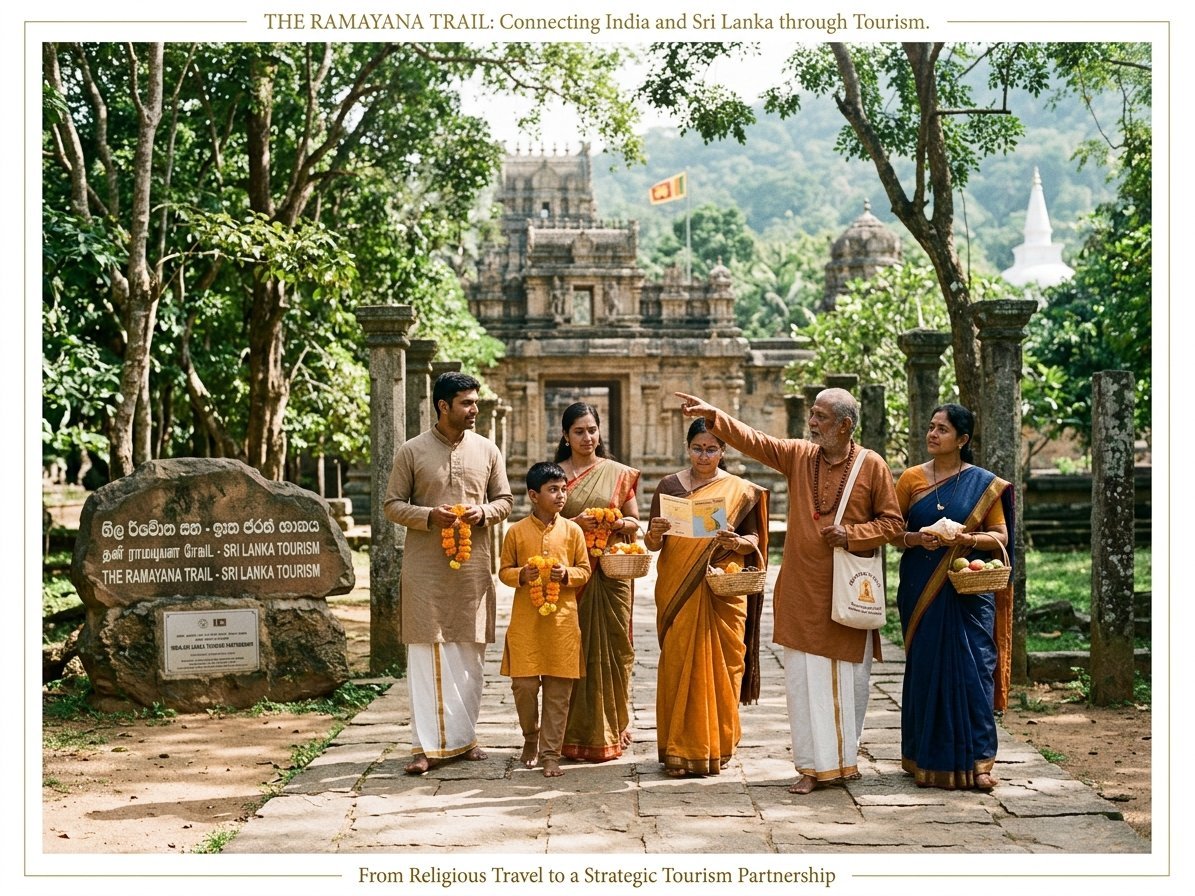
From Religious Travel to a Strategic India–Sri Lanka Tourism Partnership
India is not simply Sri Lanka’s nearest major tourism market. It is increasingly one of our most important tourism opportunities.
In 2025, Sri Lanka welcomed a record 2.33 million-plus international visitors, with India contributing approximately 531,511 visitors, representing around 27% of total arrivals. India was therefore Sri Lanka’s single largest tourism source market.
However, in my view, there is still significant untapped potential.
One of the strongest opportunities lies at the intersection of spiritual tourism, cultural tourism and experiential travel: the Ramayana Trail.
For millions of Indian travellers, the Ramayana is not merely a story. It is part of a living cultural, spiritual and emotional tradition. Sri Lanka therefore has an opportunity to present selected locations associated with Ramayana traditions as part of a carefully designed, respectful and professionally managed tourism experience.
Importantly, this should not be marketed through exaggerated historical claims.
It should be presented honestly as a cultural and spiritual journey based on traditions, beliefs, folklore and sites associated with the Ramayana narrative.
That distinction is important.
The Opportunity Is Larger Than a Traditional Tour Package
The Ramayana Trail can connect several major tourism sectors simultaneously:
✔ Spiritual tourism
✔ Cultural tourism
✔ Family travel
✔ Group travel
✔ Senior travel
✔ Wellness tourism
✔ Long-stay tourism
✔ India–Sri Lanka cultural exchange
Research and tourism discussions have identified more than 50 locations in Sri Lanka associated with Ramayana traditions, particularly across the Central, Uva and other regions of the island.
This creates an important commercial advantage.
A visitor does not need to come to Sri Lanka for only one temple or one day.
A well-designed itinerary can combine Colombo, Kandy, Nuwara Eliya, Ella, Bandarawela and other regions into a 5–10-day cultural and spiritual journey.
The objective should therefore be to increase not only visitor numbers, but also:
Length of stay. Visitor spending. Regional tourism income. Repeat visits.
Where IHV Can Play a Strategic Role
As the Managing Director of International Hospitality Ventures Private Limited (IHV), I believe our approach should be different from simply selling another holiday package.
IHV should work as an integrated tourism partnership platform connecting India and Sri Lanka.
Our model should focus on six key areas.
1. Strategic Partnerships with India
IHV can develop partnerships with:
- Indian travel agencies
- Religious and spiritual travel organisers
- Corporate travel networks
- Community organisations
- Tourism associations
- Wellness travel companies
- Educational and cultural institutions
Rather than trying to sell Sri Lanka from Colombo alone, we must build a network inside India.
The Indian market is not one market.
Delhi is different from Mumbai.
Tamil Nadu is different from Gujarat.
South Indian cultural travel patterns may differ significantly from travellers in Maharashtra, Karnataka, Uttar Pradesh or West Bengal.
Therefore, IHV’s strategy should be market-specific rather than one-size-fits-all.
2. Working Respectfully with Spiritual Communities
Organisations and communities involved in Hindu spiritual life can play an important role in cultural awareness and visitor engagement.
For example, ISKCON Colombo represents a potential point of connection within Sri Lanka’s wider spiritual and cultural ecosystem.
However, I believe tourism companies must approach religious organisations with respect and transparency.
The purpose should not be to commercialise faith.
Instead, the objective should be to facilitate:
safe travel + cultural understanding + quality hospitality + responsible visitor management.
Any partnership would naturally require discussion and agreement with the relevant organisations and should never imply endorsement without formal permission.
3. Creating a “Complete Journey” Rather Than a Bus Tour
Indian devotees increasingly expect convenience.
A professionally designed Ramayana-related journey should potentially include:
✈ Airport transfers
🏨 Suitable accommodation
🚌 Comfortable transport
🙏 Respectful access to relevant cultural and spiritual locations
🍛 Appropriate food options
🗣️ Knowledgeable multilingual guides
🧘 Wellness experiences
🛍️ Local community experiences
📱 Digital itinerary support
This is where Sri Lanka must improve.
The future traveller does not want to spend hours arranging transport, accommodation and meals separately.
They want one trusted journey.
4. The Six Case Studies Sri Lanka Should Learn From
Case Study 1: The Hajj and Umrah Travel Ecosystem
Religious travel succeeds when the entire visitor journey is organised around trust, logistics, accommodation and group management.
Lesson: Spiritual travel requires specialised operational capability.
Case Study 2: India’s Char Dham Yatra
The Char Dham demonstrates how a journey connecting multiple destinations can create economic benefits across an entire geographical corridor.
Lesson: Tourism trails can distribute visitors beyond one city.
Case Study 3: Buddhist Tourism Between India and Sri Lanka
For decades, Buddhist circuits have demonstrated the value of connecting countries through shared spiritual heritage.
Lesson: Tourism can become a bridge between nations and cultures.
Case Study 4: Camino de Santiago, Spain
The Camino has transformed a historic pilgrimage route into a global experience involving accommodation, food, transport and local communities.
Lesson: A trail becomes economically powerful when the entire ecosystem benefits.
Case Study 5: Japan’s Shikoku Pilgrimage
Japan has successfully combined pilgrimage traditions with local culture, hospitality and regional tourism.
Lesson: Authenticity and commercial success can coexist when managed responsibly.
Case Study 6: Ramayana-Focused Travel Between India and Sri Lanka
The growing interest of Indian travellers in Ramayana-related tours has already demonstrated that this market exists. During earlier tourism recovery periods, industry reporting indicated strong demand for Ramayana-focused travel among Indian visitors.
Lesson: The opportunity is not theoretical. The challenge is to professionalise and scale it responsibly.
My Proposal: An India–Sri Lanka Ramayana Tourism Partnership Platform
I believe IHV should explore developing a structured model built around:
STEP 1 – Identify Indian Market Partners
Build relationships with carefully selected travel companies and tourism networks.
STEP 2 – Develop Authentic Sri Lankan Experiences
Create professionally researched itineraries around locations promoted in connection with Ramayana traditions.
STEP 3 – Establish Service Standards
Transport, hotels, guides and food providers should meet agreed quality standards.
STEP 4 – Develop Special Interest Packages
Create separate programmes for:
- Devotional groups
- Families
- Senior travellers
- Luxury travellers
- Wellness travellers
- Educational groups
STEP 5 – Create Year-Round Demand
The Ramayana Trail should not become a seasonal campaign.
It should become a year-round India–Sri Lanka tourism product.
The Economic Opportunity
Let us consider one simple example.
If Sri Lanka attracted only an additional 50,000 Indian visitors annually through specialised spiritual and cultural tourism, and each visitor generated an average of USD 1,000 in direct travel expenditure, the potential gross visitor spending would be approximately:
USD 50 MILLION
This is only an illustrative scenario, not a forecast.
However, it demonstrates an important principle:
Sri Lanka does not always need millions of additional visitors to create significant tourism revenue.
We need better-designed tourism products.
We need longer stays.
We need higher-value experiences.
And above all, we need stronger partnerships with our largest neighbouring market.
A Personal Observation
Having worked in tourism and hospitality across different markets, I strongly believe that Sri Lanka’s future cannot depend only on beaches, wildlife and sightseeing.
Those products remain important.
But the next phase of tourism must be more specialised.
The Ramayana Trail represents an opportunity to bring together India’s enormous travel market and Sri Lanka’s cultural diversity.
However, it must be done responsibly.
We must respect religious beliefs.
We must respect local communities.
We must avoid exaggerated historical claims.
We must protect cultural sites.
And we must ensure that the economic benefits reach local communities, hotels, guides, transport providers and small businesses.
For me, the real question is not:
“Can Sri Lanka attract Indian devotees?”
The real question is:
“Are we organised enough to provide them with a world-class journey?”
That is where organisations such as International Hospitality Ventures Private Limited (IHV) can contribute.
The future of tourism will belong to destinations that do not simply attract visitors.
It will belong to destinations that create meaningful reasons to travel.
And for Sri Lanka and India, the Ramayana Trail could become one such journey.
What do you think?
Can the Ramayana Trail become one of Sri Lanka’s strongest specialised tourism products for the Indian market?
And more importantly, how can Sri Lanka develop it while protecting culture, faith, authenticity and local communities?
I would be interested to hear your views.
Disclaimer
This article has been authored and published in good faith by Dr. Dharshana Weerakoon, DBA (USA), based on publicly available tourism information, cultural references, professional observations and ongoing industry engagement.
It is intended solely for educational, analytical, journalistic and public-discussion purposes. References to the Ramayana Trail and related locations are made in the context of cultural traditions, beliefs, tourism promotion and visitor experiences and should not be interpreted as definitive archaeological, scientific or historical conclusions.
The views expressed are entirely personal and analytical and do not represent legal, financial, investment, religious, governmental or archaeological advice. The author does not claim endorsement, affiliation or partnership with any religious organisation, tourism authority or third party unless expressly stated through a formal agreement.
Any tourism development associated with spiritual, cultural or heritage locations should comply with applicable Sri Lankan law, regulatory requirements, site-management standards, intellectual property rights, community interests, environmental responsibilities and principles of dignity, non-discrimination and ethical tourism.
The author accepts no responsibility for decisions or actions taken solely on the basis of this article. Readers and organisations should undertake appropriate independent research, professional consultation and regulatory verification before implementing commercial initiatives.
© Dr. Dharshana Weerakoon, DBA (USA). All Rights Reserved.
Further Reading: https://www.linkedin.com/newsletters/outside-of-education-7046073343568977920/
Further Reading: https://dharshanaweerakoon.com/dba-vs-phd-in-sri-lanka/