
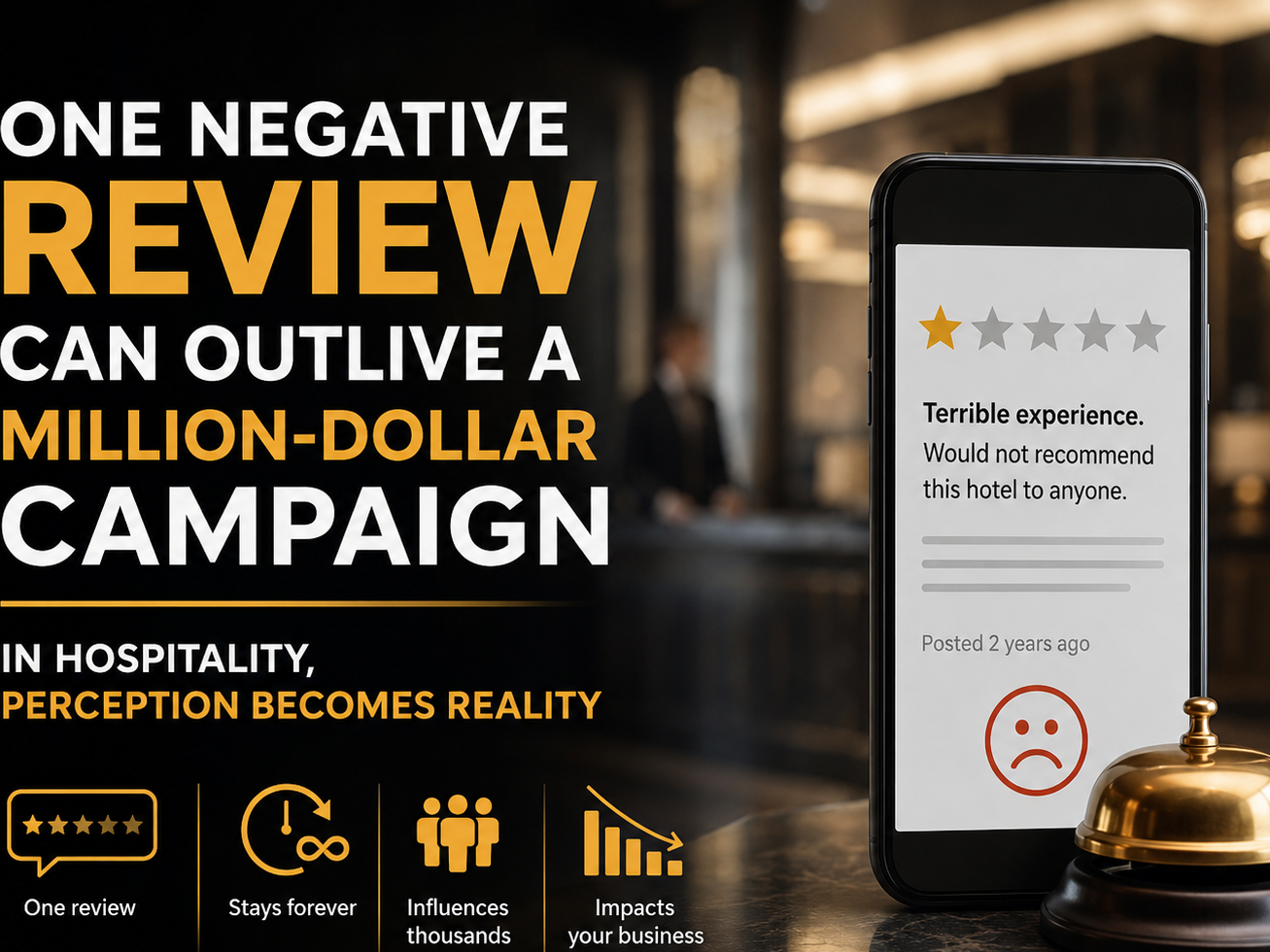
One Negative Review Can Outlive a Million-Dollar Marketing Campaign: The Permanent Reality of Online Reputation in Hospitality
Introduction
Having worked across Sri Lanka, Maldives, Zanzibar, Rwanda, UAE, and Saudi Arabia over several decades in hospitality leadership, I have witnessed tourism evolve from traditional word-of-mouth marketing to a digital ecosystem where a single online review can influence thousands of future travelers.
Today, travelers no longer depend solely on travel agents, brochures, destination marketing campaigns, or hotel advertisements. Instead, they trust the experiences of previous guests.
Before booking a room, selecting a restaurant, choosing a resort, or even deciding on a tour operator, most travelers read reviews.
The reality is simple.
A hotel can spend millions on construction, branding, advertising, staff training, public relations, and digital marketing. However, a dissatisfied guest armed with a smartphone can publish a review that remains visible for years.
More importantly, once that review becomes public, no amount of explanation, justification, argument, or apology can completely remove its influence.
This is the new reality of hospitality.
And many operators still underestimate its power.
The Global Power of Online Reviews
Online reviews have become one of the most influential purchasing factors in tourism and hospitality.
Industry research consistently indicates that:
- More than 80% of travelers read reviews before making booking decisions.
- Nearly 90% of consumers trust online reviews similarly to personal recommendations.
- Travelers often read between 6 and 12 reviews before finalizing a reservation.
- A one-star difference in ratings can significantly impact booking conversion rates.
- Properties with higher ratings generally achieve stronger occupancy and revenue performance.
The modern traveler is not simply purchasing accommodation.
They are purchasing confidence.
Reviews provide that confidence.
Consequently, the influence of review platforms has expanded beyond hotels into:
- Restaurants
- Resorts
- Airlines
- Tour operators
- Attractions
- Theme parks
- Cruise operators
- Event venues
- Wellness centers
- Destination experiences
Therefore, reputation has become a measurable commercial asset.
The Hospitality Industry’s Permanent Digital Footprint
One of the greatest challenges facing tourism businesses today is permanence.
In the past, guest complaints were mostly private.
A disappointed customer might tell family members or a few friends.
Today, however, a complaint can instantly become public and searchable.
Years later, future guests can still discover that review.
This creates what I call a “Digital Hospitality Footprint.”
Unlike traditional complaints, online reviews:
- Remain visible indefinitely
- Appear in search engine results
- Influence future guest perceptions
- Affect booking decisions
- Shape brand reputation
- Impact investor confidence
Even when management responds professionally, the original complaint often remains visible.
In many cases, readers remember the complaint more than the response.
Why Apologies Do Not Always Repair Damage
Many hospitality leaders believe a carefully written response can neutralize a negative review.
Unfortunately, this assumption is often incorrect.
Psychologists refer to a phenomenon called “negativity bias.”
Human beings naturally remember negative experiences more strongly than positive ones.
Consider these examples:
A traveler may read:
- Twenty excellent reviews
- One highly emotional negative review
Often, the negative review receives the most attention.
Why?
Because travelers are risk-averse.
Guests fear disappointment more than they anticipate satisfaction.
As a result, even a well-written management response cannot completely erase the concern created by a negative guest experience.
The review remains.
The doubt remains.
The perception remains.
Case Study 1: The Luxury Resort Service Failure
A luxury beachfront resort maintained strong ratings for several years.
However, a guest experienced delayed airport transfers and poor communication during arrival.
Management apologized immediately.
Compensation was offered.
The issue was resolved internally.
Nevertheless, the guest posted a detailed review describing the experience.
Years later, prospective guests continued referencing that review when making booking inquiries.
The operational problem lasted a few hours.
The reputational impact lasted several years.
Case Study 2: Restaurant Food Safety Concern
A restaurant received hundreds of positive reviews.
One guest publicly questioned food hygiene standards after becoming ill following a meal.
No definitive evidence connected the illness to the restaurant.
Management responded professionally.
Health inspections confirmed compliance.
Yet the review continued attracting attention.
Future customers repeatedly mentioned the incident.
The perception became more influential than the facts.
Case Study 3: The Maldives Guest Complaint
A luxury island resort delivered excellent service standards to thousands of guests.
One guest experienced an overwater villa maintenance issue.
Although the issue was rectified within hours, photographs were uploaded online.
The images spread rapidly across travel communities.
The visual evidence created a stronger emotional reaction than hundreds of positive reviews.
This demonstrates how visual content amplifies reputational risk.
Case Study 4: Staff Behaviour Incident
A guest reported feeling disrespected by a frontline employee.
Management investigated thoroughly.
The employee involved disputed the allegation.
No independent evidence conclusively supported either side.
Nevertheless, the guest’s account remained online.
Future readers interpreted the situation based on perception rather than facts.
The hotel’s challenge became managing trust rather than managing the incident itself.
Case Study 5: Resort Construction Noise
A resort was undergoing approved expansion work.
Guests had been informed in advance.
Most accepted the temporary inconvenience.
However, one traveler posted a strongly worded review criticizing construction noise.
Although disclosures were transparent, the review attracted considerable attention.
Future guests questioned whether the property was peaceful despite hundreds of positive reviews.
Case Study 6: The Check-In Experience
A five-star hotel delivered exceptional accommodation quality.
Unfortunately, one guest encountered a lengthy check-in process during peak occupancy.
The guest posted a detailed review.
The review became one of the most viewed comments on the property’s profile.
Ironically, the issue represented only 15 minutes of the guest journey.
Yet it became the defining narrative for many future readers.
Case Study 7: Social Media Amplification
A resort guest uploaded a complaint simultaneously to multiple platforms.
The original issue was relatively minor.
However, social media sharing multiplied visibility.
Within days, thousands of people had viewed the complaint.
The lesson was clear:
Digital amplification can transform small operational failures into major reputation challenges.
Why Guests Trust Other Guests More Than Hotels
Hospitality leaders often ask:
“Why do people believe a stranger more than a hotel?”
The answer is credibility.
Consumers assume:
- Hotels have commercial interests.
- Guests have personal experiences.
- Reviews are perceived as authentic.
- Peer recommendations feel unbiased.
Whether the review is completely accurate becomes secondary.
What matters is perceived authenticity.
And perception drives purchasing decisions.
The Financial Cost of Negative Reviews
Many operators focus on the emotional impact of criticism.
However, the financial consequences can be equally significant.
Negative reviews may influence:
Occupancy
Potential guests may select competing properties.
Average Daily Rate (ADR)
Hotels may discount prices to remain competitive.
Revenue Per Available Room (RevPAR)
Lower occupancy and lower rates combine to reduce revenue.
Restaurant Covers
Guests may avoid dining venues with recurring negative comments.
Event Business
Corporate clients increasingly review online reputation before selecting venues.
Recruitment
Talented employees also read reviews before joining organizations.
Consequently, reputation management is no longer a marketing function alone.
It is a commercial necessity.
The Biggest Mistake Hospitality Businesses Make
Many organizations focus on responding to reviews after problems occur.
The most successful businesses focus on preventing the review from being written in the first place.
This requires:
- Strong service culture
- Employee engagement
- Staff empowerment
- Rapid complaint resolution
- Consistent training
- Guest listening systems
- Quality assurance programs
The best review management strategy begins long before the guest leaves the property.
The Future of Hospitality Reputation Management
Artificial intelligence, review aggregation tools, social listening platforms, and predictive analytics are transforming reputation management.
However, technology cannot replace genuine hospitality.
Guests do not remember software.
Guests remember experiences.
They remember:
- How they were welcomed
- How problems were handled
- How staff treated them
- How valued they felt
Therefore, the future belongs to organizations that combine technology with authentic service excellence.
What Hospitality Leaders Must Understand
After decades of working across multiple continents and diverse tourism markets, I have learned one fundamental truth:
Guests may forget your advertising.
They may forget your promotions.
They may forget your room categories.
But they rarely forget how you made them feel.
Similarly, future travelers often trust those emotions more than your marketing messages.
This is why reputation management has become one of the most important leadership responsibilities in modern hospitality.
A negative review is not merely feedback.
It is a permanent part of your public history.
Sometimes fair.
Sometimes unfair.
Sometimes emotional.
Sometimes factual.
Yet once published, it becomes part of the story future guests use to evaluate your business.
That reality cannot be ignored.
Therefore, the smartest hospitality leaders no longer ask:
“How do we respond to negative reviews?”
Instead, they ask:
“How do we create experiences so memorable that negative reviews become the exception rather than the expectation?”
That shift in thinking separates good operators from exceptional ones.
And in today’s digital tourism economy, reputation is no longer what a hotel says about itself.
Reputation is what guests say about the hotel when management is no longer in the room.
Conclusion
The hospitality industry has entered an era where every guest has a global voice.
A single review can influence countless future decisions.
A single experience can shape perceptions for years.
A single complaint can remain searchable long after management changes, renovations occur, and operational issues are corrected.
Consequently, hotels, resorts, restaurants, and tourism businesses must treat every guest interaction as a reputational investment.
Because in the digital age, buildings can be renovated.
Brands can be refreshed.
Marketing campaigns can be replaced.
But online reputation leaves footprints that may last forever.
The challenge for hospitality leaders is not merely delivering service.
The challenge is delivering experiences worthy of being remembered for the right reasons.
Disclaimer: This article has been authored and published in good faith by Dr. Dharshana Weerakoon, DBA (USA) based on publicly available hospitality industry knowledge, professional observations, international tourism trends, and extensive executive experience across Sri Lanka, Maldives, Zanzibar, Rwanda, UAE, and Saudi Arabia. The article is intended solely for educational, professional, and industry discussion purposes. The views expressed are personal, analytical, and based on hospitality management principles. No specific organization, individual, hotel, resort, restaurant, platform, or review has been identified or targeted. Any examples or case studies are illustrative and generalized for educational purposes. This article does not constitute legal, financial, operational, or investment advice. Readers are encouraged to seek independent professional guidance where appropriate. The author accepts no responsibility for interpretations or decisions made based on this content. Authored independently through professional expertise, industry experience, and original analysis.
© Dr. Dharshana Weerakoon, DBA (USA). All Rights Reserved.
Further Reading: https://dharshanaweerakoon.com/sri-lankas-university-degree-revolution/
Further Reading: https://www.linkedin.com/newsletters/outside-of-education-7046073343568977920/