
Why Some South Asian Resort Investors Struggled in the Maldives: Strategic Lessons from One of the World’s Most Competitive Tourism Destinations
Introduction
For decades, the Maldives has been perceived as the ultimate tourism success story.
Crystal-clear lagoons, overwater villas, premium room rates, strong global branding, and a reputation as one of the world’s most exclusive tourism destinations have attracted investors from every corner of the globe.
Yet an interesting reality exists behind the picture-postcard images.
Not every investor succeeds in the Maldives.
Over the past two decades, several foreign investors, including prominent South Asian conglomerates, entered the Maldivian resort sector with ambitious plans. Some generated strong returns. Others struggled to achieve their expected objectives. A number eventually reduced exposure, restructured operations, divested assets, changed management strategies, or exited investments altogether.
This raises an important question:
Why do experienced investors who are successful in their home markets sometimes struggle in the Maldives?
The answer is not simple.
In fact, the Maldives may be one of the most challenging tourism destinations in the world to operate successfully. While visitor arrivals continue to break records and tourism receipts continue to grow, profitability remains heavily dependent on execution, positioning, operational discipline, financing structures, and long-term strategy. Recent industry data show that Maldives tourism surpassed 2.24 million visitors and generated more than USD 5 billion in tourism receipts, while accommodation capacity continues expanding rapidly.
Having worked across multiple countries and tourism markets, I believe the Maldives offers valuable lessons not only for resort investors but also for tourism policymakers, hospitality operators, and entrepreneurs throughout Asia.
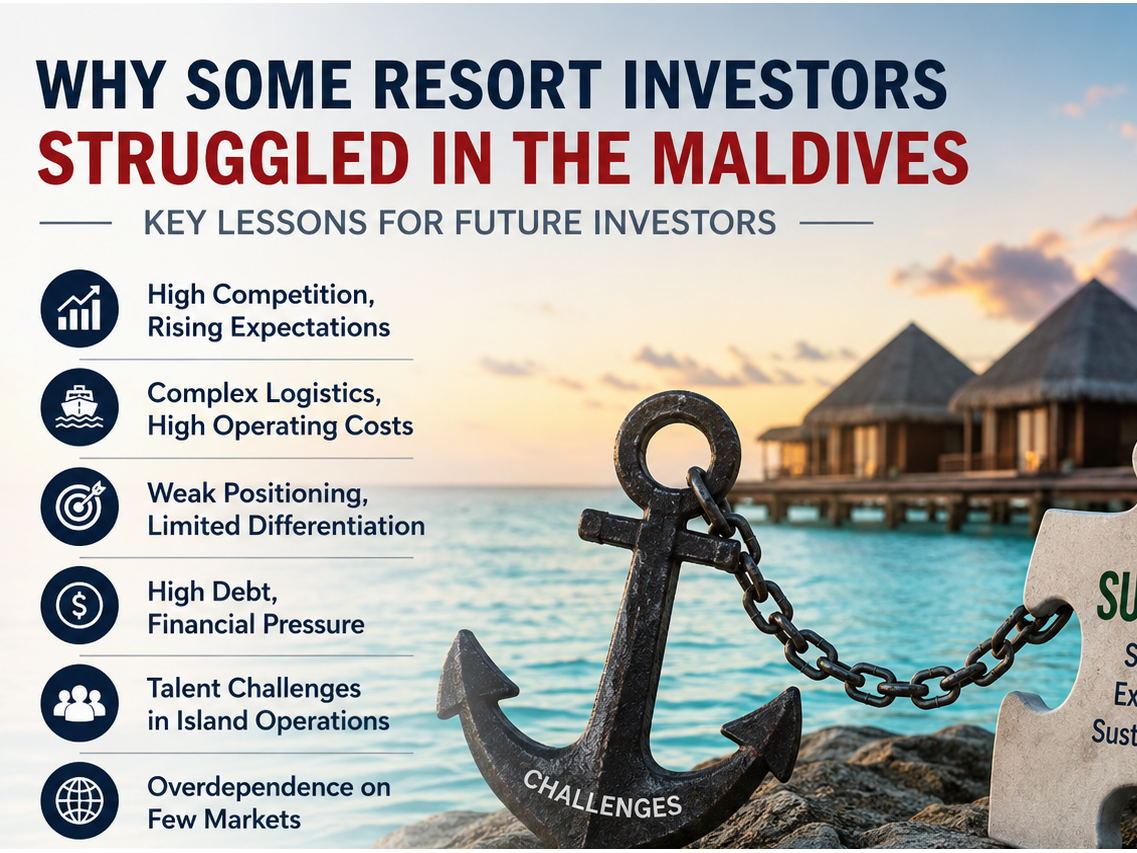
This article analyses the most common reasons why some South Asian resort ventures struggled in the Maldives and what future investors can learn from their experiences.
Understanding the Maldives Business Reality
Many outsiders mistakenly assume that operating a resort in the Maldives is similar to operating a beach hotel in Sri Lanka, Thailand, Indonesia, India, or the Middle East.
It is not.
The Maldives is essentially a collection of isolated tourism islands spread across the Indian Ocean.
Everything costs more.
Everything takes longer.
Everything requires stronger planning.
Every kilogram of food, beverage, furniture, linen, equipment, fuel, and construction material must be transported across islands.
As tourism capacity continues expanding, competition has intensified significantly. Resorts account for more than 44,000 beds while hundreds of guesthouses increasingly compete for tourists seeking value-based alternatives.
Therefore, simply owning a beautiful island is no longer enough.
Case Study 1: The Conglomerate Expansion Trap
One South Asian conglomerate entered the Maldives after achieving success in finance, leisure, and property sectors within its home market.
Management believed that existing corporate capabilities could be transferred directly into resort operations.
However, Maldives hospitality required specialized expertise in:
- Island logistics
- Marine operations
- Luxury resort marketing
- International distribution systems
- Sustainability management
- High-end guest experience delivery
The learning curve proved steeper than expected.
The key lesson:
Success in one industry does not automatically translate into success in luxury island tourism.
Case Study 2: The Diversification Mistake
Another investor viewed the Maldives primarily as a diversification opportunity.
The investment was financially attractive on paper.
However, the organization lacked deep tourism DNA.
As a result:
- Strategic decisions became finance-driven rather than guest-driven.
- Capital allocation decisions prioritized short-term returns.
- Market positioning lacked clarity.
Luxury tourism rewards operators who obsess about guest experience.
It punishes operators who treat resorts as passive real estate assets.
Case Study 3: Underestimating Logistics Complexity
One resort operator underestimated transportation costs.
In most destinations:
- Suppliers are nearby.
- Maintenance teams can travel quickly.
- Spare parts are easily available.
In the Maldives:
- Supply chains are longer.
- Marine transport is essential.
- Inventory requirements are higher.
- Emergency repairs are expensive.
Unexpected logistics costs gradually eroded margins.
This is one of the most underestimated challenges in the entire industry.
Case Study 4: Weak Brand Positioning
Several resorts entered the market positioned as “luxury.”
Unfortunately, almost every resort in the Maldives claims to be luxury.
The question therefore becomes:
Luxury for whom?
Successful resorts create distinct identities:
- Wellness luxury
- Family luxury
- Romance luxury
- Adventure luxury
- Eco-luxury
- Ultra-exclusive luxury
Struggling operators often failed to differentiate.
Consequently, they competed mainly on price.
Price competition is rarely sustainable in the Maldives.
Case Study 5: Excessive Debt and Capital Pressure
Many investors entered the Maldives during periods of optimism.
Development costs escalated.
Construction timelines extended.
Financing costs increased.
Meanwhile, debt repayments continued.
A resort may achieve high occupancy yet still struggle financially if capital structures are poorly designed.
This lesson remains relevant globally.
A profitable hotel operation does not always equal a profitable investment.
Case Study 6: Talent and Human Resource Challenges
Luxury hospitality is fundamentally a people business.
However, island operations create unique staffing challenges:
- Recruitment costs
- Staff accommodation requirements
- Retention difficulties
- Skills shortages
- Multinational workforce management
Some operators underestimated the importance of building strong organizational cultures.
Guest satisfaction inevitably suffered.
The world’s best resorts are built by people before they are built by architects.
Case Study 7: Market Dependency Risk
Many resorts became heavily dependent on a small number of source markets.
When geopolitical tensions, airline disruptions, economic downturns, pandemics, or currency fluctuations occurred, visitor numbers declined rapidly.
Successful operators diversified across:
- Europe
- China
- India
- Middle East
- Russia
- Southeast Asia
Risk diversification became a survival strategy.
The Competitive Reality Has Changed
The Maldives of 2005 is very different from the Maldives of today.
Tourism capacity continues expanding.
New resorts continue entering the market.
Guesthouses have created new competition.
Digital platforms have increased transparency.
Guests are more informed than ever before.
The destination recorded more than 2.24 million visitors and over USD 5.4 billion in tourism receipts recently, demonstrating continued growth. However, increased competition means operational excellence matters more than ever before.
Simply entering the market is no longer a competitive advantage.
What Successful Maldives Investors Do Differently
After observing successful operators across multiple countries, several common characteristics emerge.
1. Long-Term Thinking
Successful investors think in decades, not quarters.
2. Strong Brand Positioning
They create memorable identities rather than generic luxury offerings.
3. Operational Discipline
Every cost is monitored without compromising guest experience.
4. Global Distribution Strength
They invest heavily in international sales channels.
5. Sustainability Integration
Environmental responsibility is treated as a business strategy, not merely a marketing slogan. Sustainability increasingly influences resort competitiveness and operational resilience.
6. Talent Development
People remain their strongest competitive advantage.
7. Financial Resilience
They maintain stronger balance sheets and avoid excessive leverage.
Lessons for Sri Lankan Tourism Investors
Sri Lankan investors often look at the Maldives with admiration.
However, the key lesson is not to copy the Maldives.
The key lesson is to understand why the Maldives works.
The destination succeeded because it developed:
- Strong destination branding
- Consistent luxury positioning
- Controlled resort development
- International market reach
- High tourism yields
Sri Lanka possesses different advantages:
- Cultural diversity
- Wildlife
- Heritage
- Ayurveda
- Scenic landscapes
- Community tourism opportunities
Therefore, Sri Lanka should develop its own tourism model rather than attempting to replicate the Maldivian model.
The Bigger Strategic Question
The Maldives remains one of the world’s most successful tourism destinations.
Yet success at the destination level does not guarantee success at the investor level.
This distinction is critical.
Many investors see:
- Growing arrivals
- Premium room rates
- International visibility
But fail to appreciate:
- Operational complexity
- Capital intensity
- Market volatility
- Talent challenges
- Supply chain costs
- Competitive pressures
Consequently, some investments achieve expectations while others fall short.
Final Thoughts
The Maldives continues to attract investors because the destination remains exceptionally strong.
However, the notion that any investor can simply acquire an island and generate effortless profits is one of the biggest myths in global tourism.
The Maldives rewards expertise.
It rewards patience.
It rewards strategic thinking.
Most importantly, it rewards operators who understand that hospitality is ultimately about delivering unforgettable experiences rather than merely managing assets.
The experiences of several South Asian resort ventures provide valuable lessons for future investors.
Their journeys remind us that in tourism, success is never guaranteed by capital alone.
Execution remains the ultimate differentiator.
The Maldives is not merely a tourism destination.
It is one of the world’s most demanding hospitality classrooms.
And for those willing to learn, its lessons are invaluable.
Disclaimer
This article has been authored and published in good faith by Dr. Dharshana Weerakoon, DBA (USA), based on publicly available industry information, tourism performance data, international hospitality trends, professional observations, and extensive experience across global tourism and hospitality markets.
The article does not comment on, endorse, criticize, or evaluate any specific company, investor, shareholder, resort, management group, or individual. All case studies presented are anonymized, generalized, and intended solely to illustrate broader strategic and operational lessons within the tourism and hospitality sector.
The content is provided exclusively for educational, analytical, journalistic, and professional discussion purposes. It should not be interpreted as legal, financial, investment, valuation, accounting, or business advice.
The views expressed are entirely those of the author and are intended to encourage constructive discussion regarding tourism investment, destination competitiveness, hospitality management, and sustainable tourism development.
The author accepts no responsibility for decisions, actions, investments, or interpretations made by readers based on this content.
This article has been independently authored through professional expertise, industry observation, and analytical interpretation.
© Dr. Dharshana Weerakoon, DBA (USA). All Rights Reserved.
Further Reading: https://dharshanaweerakoon.com/sri-lanka-export-proceeds-conversion-rule/
Further Reading: https://www.linkedin.com/newsletters/outside-of-education-7046073343568977920/