
De-Dollarizing Tourism: Can BRICS Payment Systems and Digital Yuan Corridors Transform Sri Lanka’s Inbound Tourism?
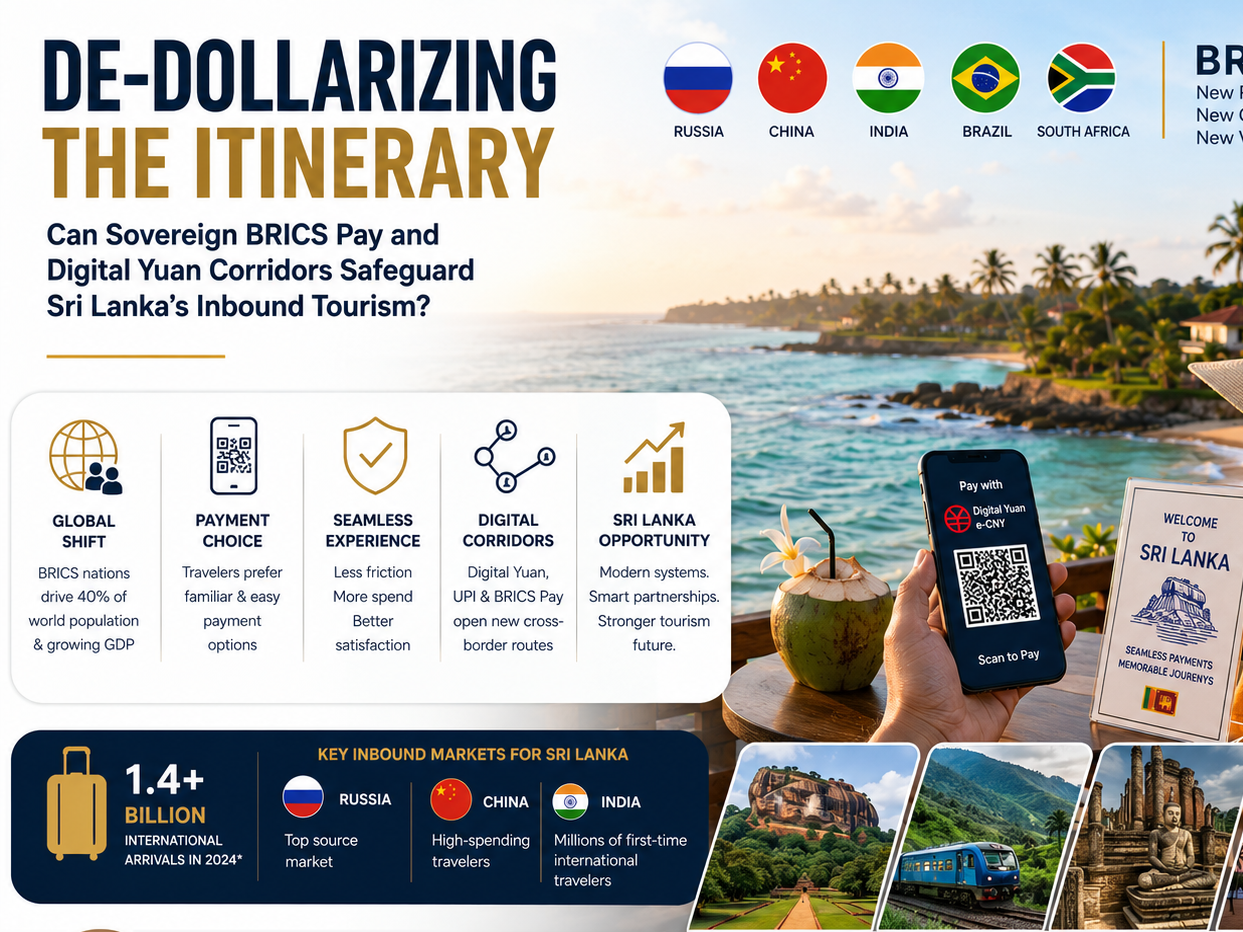
The next competitive advantage in tourism may not be another luxury resort. It may be the payment experience.
For decades, international tourism has relied heavily on a financial ecosystem dominated by the US Dollar, Visa, Mastercard and the SWIFT banking network. That model has served the industry well. However, global tourism is entering a new phase where payment preferences are becoming as important as destination marketing.
As a Global Tourism & Hospitality Strategist, I believe Sri Lanka should begin studying—not resisting—this shift.
The question is no longer whether alternative payment ecosystems will grow.
The real question is whether Sri Lanka will be ready when they become mainstream.
Tourism is becoming multipolar
The world economy is gradually becoming more diversified.
BRICS economies now represent approximately 40% of the world’s population and a growing share of global GDP measured by purchasing power. At the same time, China remains one of the world’s largest outbound tourism markets, India continues to produce millions of first-time international travellers every year, while Russian outbound tourism has increasingly adapted to alternative financial channels following changes in international banking access.
These developments do not replace existing Western financial systems.
Instead, they create parallel payment ecosystems.
For tourism destinations, that matters.
Travellers increasingly expect to pay using the financial tools they already trust at home.
Why this matters for Sri Lanka
Sri Lanka has successfully diversified its source markets.
Recent visitor arrivals increasingly include strong numbers from:
• India
• China
• Russia
These three markets alone have the potential to contribute a substantial proportion of Sri Lanka’s future international arrivals over the coming decade.
However, attracting visitors is only half the equation.
Making it easy for them to spend money is equally important.
Every payment barrier reduces visitor convenience.
Every friction point can reduce tourism expenditure.
A traveller who cannot easily pay often spends less—even if they enjoy the destination.
The next competition will be invisible
Hotels often compete through:
• Better rooms
• Better food
• Better beaches
• Better service
Soon they may also compete through:
• Faster payment options
• Multi-currency settlement
• Local currency acceptance
• Cross-border digital wallets
• QR-based international payment interoperability
Payment convenience may become part of the tourism product itself.
What are Digital Yuan corridors?
China’s Digital Yuan (e-CNY) is a central bank digital currency currently being expanded through pilot programmes and selected cross-border initiatives.
It is important to distinguish this from cryptocurrencies.
Digital Yuan is issued by China’s central bank.
It is government-backed.
Its purpose is payment efficiency rather than speculation.
Although international tourism usage remains limited today, many analysts believe future cross-border payment corridors may gradually expand as bilateral agreements evolve.
Sri Lanka should monitor these developments carefully while operating within its own legal and regulatory framework.
What could “Sovereign BRICS Pay” mean for tourism?
Different countries are exploring payment interoperability that reduces transaction friction between participating financial systems.
Whether branded as BRICS Pay or developed through other bilateral arrangements, the broader trend is clear:
Tourists increasingly want payment methods that work naturally across borders.
For destinations, the objective is simple.
Accept legal payments safely.
Settle efficiently.
Reduce unnecessary currency conversion costs.
Improve visitor satisfaction.
Case Study 1 — China: Mobile payments became tourism infrastructure
China transformed consumer behaviour through QR-based payment ecosystems.
Today, many urban consumers rarely carry cash.
Hotels, attractions, restaurants and transport providers adapted rapidly.
For Chinese outbound visitors, familiar payment options often influence travel convenience.
Lesson for Sri Lanka:
Payment familiarity improves visitor confidence.
Case Study 2 — Thailand: Adapting for Chinese visitors
Thailand invested heavily in accepting Chinese digital payment platforms across tourism businesses.
Rather than replacing traditional payment methods, these became additional options that improved visitor convenience.
Lesson:
Choice increases spending confidence.
Case Study 3 — UAE: Multi-currency tourism
Dubai has positioned itself as a global tourism hub by embracing diverse international payment methods, multiple currencies and digital financial innovation.
Its objective has been simple:
Remove friction from visitor spending.
Lesson:
Financial accessibility supports destination competitiveness.
Case Study 4 — India: UPI’s global expansion
India’s Unified Payments Interface (UPI) has become one of the world’s largest real-time payment systems, processing billions of transactions every month.
Several countries are now exploring interoperability with UPI for travellers.
Lesson:
Domestic payment innovation can become international tourism infrastructure.
Case Study 5 — Singapore: QR interoperability
Singapore has progressively expanded QR payment compatibility with neighbouring countries through bilateral initiatives.
Tourists increasingly benefit from familiar payment experiences.
Lesson:
Interoperability matters more than technology branding.
Case Study 6 — Russia: Alternative payment adaptation
Following significant changes in international financial connectivity, Russian travellers and businesses increasingly adapted to alternative domestic and regional payment mechanisms.
Destinations serving Russian visitors have gradually adjusted where legally permissible.
Lesson:
Tourism businesses must understand changing traveller behaviour while fully complying with applicable laws and financial regulations.
Case Study 7 — Sri Lanka: A strategic opportunity
Sri Lanka already possesses many advantages.
Modern banking.
Digital payment growth.
Expanding tourism.
Strong regional connectivity.
The next step may not require reinventing the financial system.
Instead, it requires collaboration among:
• Central Bank
• Commercial banks
• Payment technology providers
• Hotels
• Airlines
• Destination Management Companies
• Tourism regulators
Together they can evaluate which future payment innovations best support inbound tourism while maintaining financial security and regulatory compliance.
Numbers that deserve attention
Global international tourism exceeded 1.4 billion international arrivals in 2024, signalling a strong recovery toward pre-pandemic levels.
International tourism receipts worldwide have surpassed US$1.9 trillion.
India continues to produce tens of millions of outbound travellers annually.
China remains one of the world’s highest-spending outbound tourism markets despite changing travel patterns.
Russia continues to represent an important visitor source for several Asian destinations.
These figures suggest one conclusion.
The next decade of tourism growth will increasingly come from diverse source markets with evolving payment preferences.
My perspective
I do not believe Sri Lanka should choose between Western financial systems and emerging alternatives.
That would be a false choice.
Instead, Sri Lanka should remain open, compliant, technologically prepared and commercially flexible.
Tourism succeeds when visitors experience fewer obstacles.
Payment convenience is becoming one of those experiences.
Destinations that understand this early may gain a competitive advantage long before others realise the rules have changed.
The future of tourism may not simply be about where people travel.
It may also be about how effortlessly they can pay.
Sometimes the biggest innovation in tourism is the one guests never notice.
Disclaimer: This article has been authored and published in good faith by Dr. Dharshana Weerakoon, DBA (USA) based on publicly available information, industry reports, professional observations, and extensive international experience in tourism, hospitality, destination management, and strategic business development. The discussion is intended solely for educational, journalistic, and professional discourse. References to BRICS payment initiatives, central bank digital currencies, or cross-border payment systems are analytical in nature and should not be interpreted as endorsements, legal opinions, financial advice, or predictions of future government policy. Any payment systems discussed would necessarily operate subject to the laws, regulations, and oversight of the relevant national authorities, including the Central Bank of Sri Lanka and applicable international regulatory frameworks. The views expressed are entirely personal and do not represent those of any government, regulator, financial institution, or private organisation. Every effort has been made to ensure accuracy at the time of writing; however, payment technologies, regulations, and international financial arrangements continue to evolve. Readers should obtain independent professional advice before making commercial, legal, financial, or investment decisions.
© Dr. Dharshana Weerakoon, DBA (USA). All rights reserved.
Further Reading: https://dharshanaweerakoon.com/the-untold-reality-of-the-hospitality-industry/
Further Reading: https://www.linkedin.com/newsletters/outside-of-education-7046073343568977920/