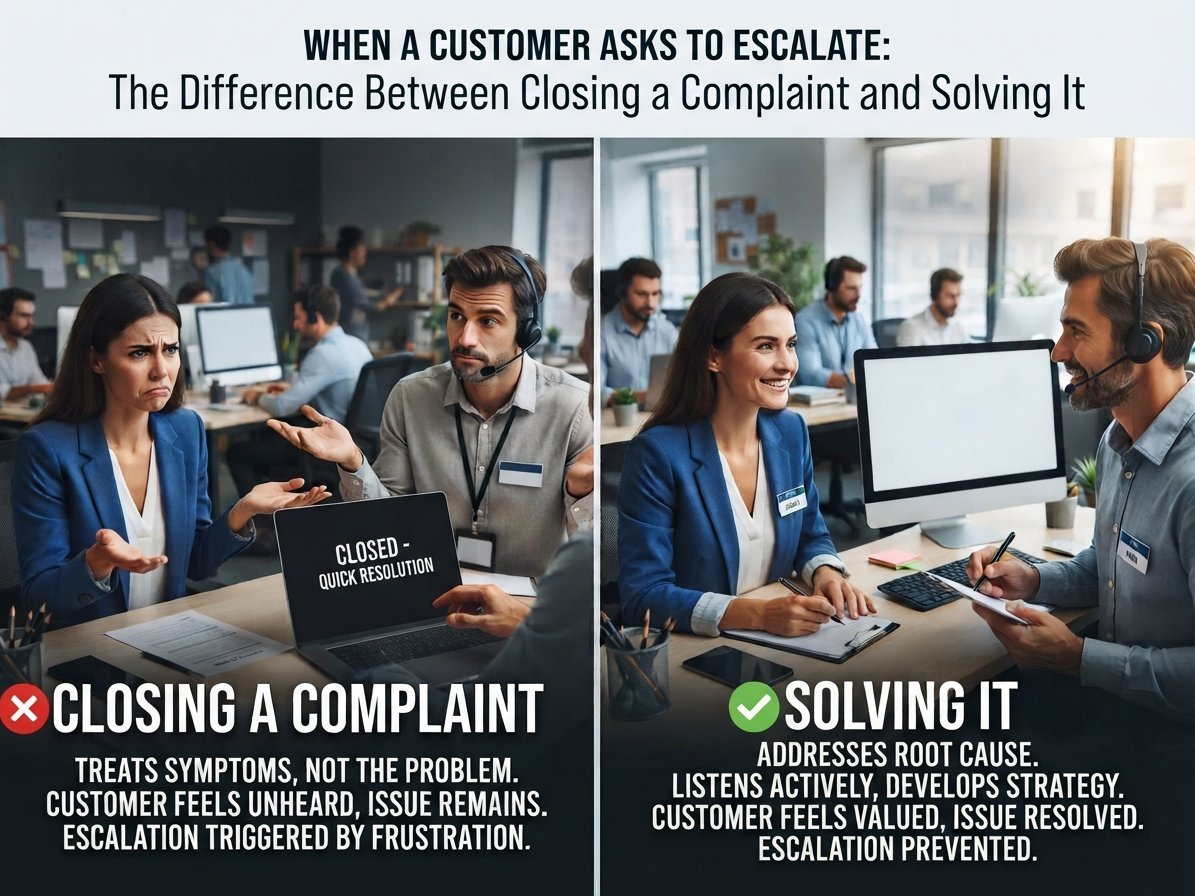
When a Customer Asks to Escalate: The Difference Between Closing a Complaint and Solving It
Why complaint management is becoming a leadership issue—not simply a customer-service issue
A customer complaint is rarely only about the original problem.
Very often, the real issue begins after the customer asks for help.
A customer may accept a delay.
A customer may accept a policy.
A customer may even accept that an employee cannot immediately solve the problem.
What customers find much harder to accept is not knowing what happens next.
That is where effective customer complaint management becomes critical.
I recently experienced a situation involving a customer-service escalation process. I do not intend to identify or criticise the organisation involved. Instead, I want to use the experience as a professional case study because the underlying lesson applies equally to banking, tourism, hospitality, aviation, healthcare, telecommunications, retail and almost every service industry.
The central question is simple:
When a customer asks to speak to a supervisor, does the organisation have a clearly understood escalation process?
That question deserves serious attention.
A complaint is not the same as an unreasonable customer
In service businesses, employees sometimes encounter frustrated customers.
That is part of the reality of customer-facing work.
However, there is an important distinction between unacceptable behaviour and legitimate dissatisfaction.
A customer can be wrong.
An employee can also be wrong.
Both can become frustrated.
Therefore, customer complaint management should not be designed around the assumption that the customer is always right—or always wrong.
It should be designed around a process.
A professional process should answer five basic questions:
- Who receives the complaint?
- What happens when the first-level employee cannot resolve it?
- Who has authority to escalate it?
- How is the customer informed about the next step?
- When and how will the customer receive a response?
If these five questions are unclear, the organisation does not have a customer-service problem alone.
It has a process-management problem.
Closing a complaint is not necessarily resolving a complaint
This is perhaps the most important distinction.
An organisation can internally close a complaint because its investigation is complete.
But from the customer’s perspective, the complaint may remain unresolved.
There are therefore two different concepts:
Administrative closure:
The organisation has completed its internal process.
Customer resolution:
The customer’s substantive concern has been addressed and the next steps are understood.
The difference matters.
Sri Lanka’s Central Bank has recognised the importance of structured financial consumer protection and complaint handling. Its Financial Consumer Protection Regulations introduced a more formal framework covering fair treatment, transparency and internal complaint-handling mechanisms.
In May 2026, the Central Bank also introduced an online Complaint Management System allowing financial consumers to submit complaints, track their progress and escalate matters where the response from a financial service provider remains unresolved or unsatisfactory.
That development illustrates an important principle:
A complaint should have a journey—not simply an ending.
Seven lessons from seven industries
1. Banking – escalation must be visible
A banking customer may contact a call centre about a card, transaction or account issue.
The first employee may not have authority to resolve it.
That is perfectly understandable.
But the customer should know:
“I cannot resolve this directly, but I can escalate it through this process.”
That single sentence can change the entire interaction.
The Central Bank’s own complaint framework demonstrates the importance of structured escalation and traceability. Its Financial Consumer Relations Department receives complaints relating to regulated financial institutions and assigns complaint reference numbers as part of its process.
The lesson is simple:
Do not make the customer discover the escalation system by becoming increasingly frustrated.
2. Hospitality – the manager should not appear only after the damage is done
In a hotel, a guest may complain about a room, reservation, billing issue or service failure.
A well-trained employee should attempt to resolve the matter.
However, if the guest asks for a manager, the request should not automatically be treated as a confrontation.
It may simply mean:
“I believe I have reached the limit of this conversation and need someone with greater authority.”
In hospitality, escalation is often part of service recovery.
The objective is not to prove who is right.
The objective is to recover trust.
3. Airlines – information can be as important as compensation
Flight disruptions provide another powerful example.
Passengers may accept that weather, operational restrictions or technical problems can cause delays.
What creates additional frustration is uncertainty.
No information.
Conflicting information.
Repeated transfers.
No clear person responsible.
Good customer complaint management therefore requires communication even when the organisation cannot immediately provide a solution.
Sometimes:
“We don’t have the answer yet, but we will update you at 4.00 p.m.”
is better than silence.
4. Telecommunications – don’t make customers repeat the same story
Anyone who has dealt with a complex telecommunications problem understands this frustration.
The customer explains the issue to one employee.
Then again to another.
Then again to a supervisor.
Then again to a technical team.
The organisation may believe the complaint has been transferred.
The customer experiences it as:
“Nobody is taking ownership.”
A good escalation system should transfer information—not transfer the burden to the customer.
5. Healthcare – escalation can be a safety mechanism
Healthcare provides an even more important lesson.
A patient or family member raising a concern should not automatically be regarded as difficult.
Sometimes escalation identifies a genuine communication, process or safety problem.
Consequently, customer complaint management in healthcare should focus on listening, documentation, escalation and resolution.
The principle extends beyond hospitals:
Complaints can be early-warning systems.
6. E-commerce – speed matters
Online businesses operate in an environment where customers can switch providers within minutes.
If a customer experiences a payment problem, delivery failure or refund dispute, the organisation’s response time becomes part of the product.
The complaint experience itself can determine whether the customer returns.
Modern service businesses therefore need:
- clear ownership;
- defined response times;
- escalation routes;
- customer updates; and
- documented closure.
7. Tourism – one complaint can represent many future customers
Tourism is particularly sensitive because the customer is purchasing an experience.
A dissatisfied traveller may not simply remember the original problem.
They remember how the organisation treated them when the problem occurred.
That memory can influence reviews, recommendations, repeat travel and business relationships.
This is why I consider customer complaint management to be part of destination competitiveness.
A destination can invest millions in marketing.
But one poorly handled service recovery can undermine years of brand-building.
What do the numbers tell us?
Complaint management is not a minor issue.
In Sri Lanka, the Central Bank reported that its Financial Consumer Relations Department has developed complaint-handling and market-conduct functions specifically to identify recurring conduct risks and service deficiencies.
The same 2026 Central Bank analysis of complaints relating to licensed financial institutions during 2023–2025 found that licensed banks accounted for 79% of complaints, with licensed finance companies accounting for 21%.
The wider lesson is significant.
Complaints are not merely unpleasant correspondence.
They are data.
They tell management where customers are experiencing friction.
International evidence also demonstrates the value of rapid problem resolution. In J.D. Power’s 2025 U.S. retail banking study, among customers who reported a problem, 66% of those whose problems were resolved said the issue was resolved within one day, while 59% said it was resolved with one contact.
Therefore, modern customer complaint management should measure more than the number of complaints.
Management should measure:
Time to acknowledge → Time to escalate → Time to resolve → Number of contacts → Customer understanding → Repeat complaints.
The five principles I recommend
After more than three decades working across tourism, hospitality, finance, technology, education and international business environments, I believe effective customer complaint management should follow five principles.
1. Listen before defending
The first objective should be understanding the complaint.
2. Explain the process
If an employee cannot transfer a customer directly to a manager, explain what will happen instead.
3. Give ownership
The customer should know who is responsible for the next step.
4. Communicate the timeline
Never leave customers wondering what happens next.
5. Close with understanding—not merely administration
Ask:
“Has the customer’s concern actually been addressed?”
That is more meaningful than:
“Has the case been closed?”
A simple formula for service leaders
I would summarise effective customer complaint management as:
LISTEN → ACKNOWLEDGE → EXPLAIN → ESCALATE → UPDATE → RESOLVE → LEARN
The final word is perhaps the most important:
LEARN.
A complaint should not disappear into a database.
It should return to management as information.
If 100 customers complain about the same process, the answer is not to become better at answering 100 complaints.
The answer may be to fix the process that created the 100 complaints.
The customer is not always right. But the customer deserves a process.
This is an important distinction.
Professional customer service does not mean agreeing with everything a customer says.
It means treating the customer fairly, explaining the rules clearly, maintaining appropriate boundaries and providing a reasonable mechanism to raise concerns.
At the same time, customers also have responsibilities.
Employees deserve dignity.
Abusive or threatening behaviour should not be accepted.
Mutual respect must work in both directions.
But when disagreement occurs, organisations should rely on process rather than emotion.
That is the foundation of mature customer complaint management.
My message to CEOs, General Managers and service leaders
Do not only ask your team:
“How many complaints did we close this month?”
Ask:
“How many customers understood what happened?”
Ask:
“How many complaints were solved at the first point of contact?”
Ask:
“How many customers had to repeat themselves?”
Ask:
“How many customers requested escalation?”
And perhaps most importantly:
“What did we change because customers complained?”
That is where customer service becomes leadership.
Because ultimately, customer complaint management is not about defending the organisation from customers.
It is about protecting the organisation by listening to customers.
A complaint can be uncomfortable.
But sometimes the most uncomfortable complaint is also the most valuable management report you will receive.
A final thought
Whether we operate a hotel, bank, airline, hospital, university, technology company, travel agency or multinational corporation, the principle remains the same:
Do not simply close complaints. Resolve them.
And when resolution is not immediately possible, communicate clearly, escalate properly and keep the customer informed.
Because customers may forget the original problem.
They are much less likely to forget how they were treated when they asked for help.
Disclaimer
This article has been authored and published in good faith by Dr. Dharshana Weerakoon, DBA (USA), from publicly available information, professional experience and general industry knowledge. It is intended for educational, professional and public-awareness purposes and does not identify or make allegations against any particular organisation, employee or individual. Any industry examples are illustrative and should not be interpreted as findings of fact concerning a specific organisation.
The views expressed are the author’s personal professional and analytical views and do not constitute legal, financial, regulatory or investment advice. Readers should obtain appropriate professional advice where required. The article does not seek to prejudice, determine or interfere with any existing complaint, investigation or dispute.
© Dr. Dharshana Weerakoon, DBA (USA). All rights reserved.
Further Reading: https://dharshanaweerakoon.com/sri-lanka-bank-call-centre-outsourcing/
Further Reading: https://www.linkedin.com/newsletters/outside-of-education-7046073343568977920/