
Are Low Audit Fees and Trainee Exploitation Undermining Audit Quality in Sri Lanka?
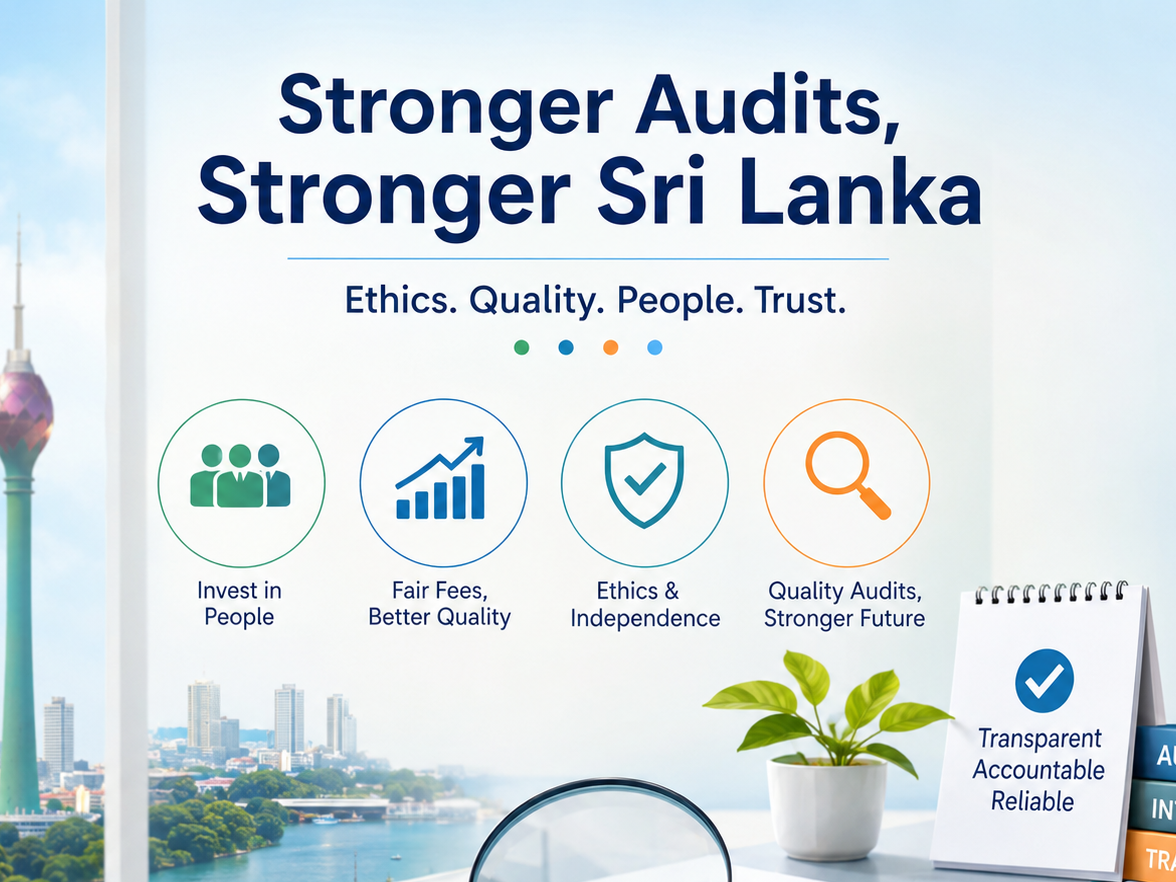
A Structural Risk the Profession Can No Longer Ignore
An Analytical and Critical Review of the Sri Lankan Audit Industry
Introduction
Sri Lanka has long been recognised for producing highly qualified accounting and finance professionals who serve not only the domestic economy but also global corporations, multinational audit firms, and international financial institutions. Over the past three decades, Sri Lankan accountants have earned a reputation for technical competence, adaptability, and strong analytical capability.
However, beneath this respected professional image lies a growing structural concern that many within the industry privately acknowledge but rarely discuss publicly.
The issue is not merely about salaries.
It is not merely about long working hours.
And it is certainly not an attack on the auditing profession itself.
The real issue is whether the current audit business model in Sri Lanka has gradually evolved into a system where:
- extremely low audit fees,
- excessive dependence on trainees and semi-qualified staff,
- unrealistic client expectations,
- price-based competition,
- and weak investment in human capital
are collectively creating a dangerous long-term risk to audit quality, professional ethics, employee wellbeing, and ultimately public trust in financial reporting.
Recent discussions in mainstream media, including reports regarding the treatment of accounting trainees and professional interns in Sri Lanka, have once again brought this issue into the public spotlight. Yet the conversation must now move beyond emotional reactions and social media debates.
What Sri Lanka urgently needs is a mature, balanced, evidence-based discussion about whether the current economic structure of the audit industry is sustainable — both commercially and ethically.
This article is written with professional respect for the auditing profession and with recognition of the immense contribution made by many reputable audit firms and senior professionals in Sri Lanka over decades. However, constructive criticism is essential for institutional progress.
If the system itself is structurally flawed, silence becomes complicity.
The Hidden Economics of Audit Firms in Sri Lanka
One of the least discussed realities in Sri Lanka is the severe underpricing of audit services.
In many sectors, especially among SMEs and mid-sized companies, audit appointments are often awarded primarily based on the lowest quotation rather than audit quality, sector expertise, technological capability, or human resource investment.
This has created a deeply problematic market dynamic.
In practical terms:
- some audit fees have remained stagnant for years despite inflation,
- professional salary costs have increased significantly,
- compliance requirements have become more complex,
- reporting standards continue to evolve,
- digital audit expectations are rising,
- and clients increasingly demand faster turnaround times.
Yet many firms are expected to complete audits at fees that are commercially unrealistic.
This creates a dangerous chain reaction.
Low audit fees reduce firm profitability.
Reduced profitability limits investment in experienced staff.
This increases dependence on trainees and junior-level employees.
Overloaded trainees produce lower-quality work under time pressure.
Senior reviewers become overwhelmed.
Audit quality weakens.
Professional burnout rises.
Staff turnover accelerates.
And eventually, the credibility of the profession itself becomes vulnerable.
This is not merely an HR problem.
It is a systemic economic issue.
The Trainee Dependency Model
The accounting profession traditionally relies on traineeships and practical exposure. There is nothing inherently wrong with that model. In fact, professional training is essential.
However, the concern arises when trainees become the operational backbone of the system rather than supervised learners.
Many young accounting trainees in Sri Lanka simultaneously:
- study for demanding professional examinations,
- work extremely long hours,
- travel significant distances daily,
- face high psychological pressure,
- and receive compensation that may not adequately reflect workload intensity.
In some cases, trainees are handling responsibilities far beyond their experience level due to staff shortages and tight engagement economics.
This creates several risks.
1. Declining Audit Quality
High-quality audits require:
- professional skepticism,
- industry understanding,
- technical judgment,
- analytical thinking,
- and experience.
These capabilities cannot be fully replaced by low-cost labour.
A trainee who is exhausted, under pressure, and inexperienced may complete checklists and documentation. However, identifying fraud risks, aggressive accounting treatments, going concern uncertainties, related-party irregularities, or internal control weaknesses requires mature professional judgment.
When engagement economics force excessive reliance on junior staff, audit quality may gradually become procedural rather than analytical.
That distinction is critical.
2. Professional Burnout Among Young Accountants
Sri Lanka is increasingly facing a talent migration crisis.
A large number of qualified accountants and finance professionals are leaving the country for:
- Australia,
- Canada,
- the Middle East,
- the UK,
- and Europe.
The reasons are not purely financial.
Many young professionals are also leaving because they seek:
- better work-life balance,
- healthier professional cultures,
- structured career growth,
- mental wellbeing,
- and professional dignity.
If young professionals begin associating the audit profession with exhaustion, burnout, and exploitation, the long-term attractiveness of the profession itself may decline.
That becomes a national economic concern.
3. Ethical Contradictions Within the Industry
Many audit firms advise clients on:
- governance,
- sustainability,
- ESG frameworks,
- human capital management,
- ethics,
- compliance,
- and corporate responsibility.
However, the profession must also ask itself an uncomfortable question:
Can firms genuinely advocate sustainable business practices externally while internally operating under economic models that place excessive strain on junior employees?
Ethical consistency matters.
Corporate governance cannot be selectively applied.
Are Clients Also Responsible?
Yes — partially.
Sri Lankan businesses themselves have contributed to this issue.
Many organisations still view audits primarily as:
- a statutory obligation,
- a compliance requirement,
- or a document needed for banks and regulators.
As a result, procurement decisions are often driven by price minimisation.
This mindset ignores the true purpose of auditing.
A quality audit is not merely a compliance exercise.
It is intended to:
- enhance investor confidence,
- strengthen governance,
- detect risk,
- improve transparency,
- and protect stakeholders.
When companies aggressively negotiate audit fees downward every year, they may unintentionally contribute to lower engagement quality.
Ironically, some organisations later spend millions dealing with:
- fraud,
- tax disputes,
- governance failures,
- regulatory penalties,
- and financial misstatements
that stronger audit processes may have identified earlier.
Cheap audits can become very expensive mistakes.
Case Study 1 – The SME Audit Pricing Trap
A mid-sized Sri Lankan manufacturing company reportedly sought quotations from multiple audit firms.
The selection decision was ultimately based almost entirely on price difference.
The winning quotation was substantially lower than competitors.
However, the engagement timeline became compressed, staff continuity weakened, and the audit team reportedly changed multiple times during the process.
The company later experienced inventory control weaknesses and reconciliation issues that required significant internal remediation.
The broader lesson is clear:
When audit services become commoditised purely on price, quality risks inevitably increase.
Case Study 2 – Trainee Overload During Peak Season
During peak audit periods, some trainees reportedly work extremely extended hours while simultaneously preparing for professional examinations.
Several industry observers have raised concerns regarding:
- sleep deprivation,
- mental exhaustion,
- declining motivation,
- and emotional stress.
The issue becomes even more serious when inexperienced staff are expected to complete technically complex work under severe time pressure.
Sustainable professional development cannot exist without sustainable working conditions.
Case Study 3 – Talent Migration from Audit to Overseas Markets
A growing number of Sri Lankan accountants use local audit firms primarily as short-term stepping stones before migrating overseas.
Why?
Because international employers often offer:
- significantly higher salaries,
- improved working environments,
- modern technology,
- and stronger employee protections.
This creates a continuous talent drain within Sri Lanka.
Audit firms then face recurring shortages of experienced staff, which increases dependence on new trainees again — creating a repeating cycle.
Case Study 4 – The Compliance-Only Client Mentality
Some businesses view audits merely as annual formalities.
In such environments:
- audit recommendations are ignored,
- internal controls remain weak,
- management cooperation becomes limited,
- and audit fees are continuously pressured downward.
This reduces the strategic value of the audit process itself.
When both clients and firms focus only on completing statutory requirements at minimum cost, audit effectiveness naturally suffers.
Case Study 5 – Technology Gaps in Smaller Audit Firms
Large global firms increasingly use:
- data analytics,
- AI-supported audit tools,
- automated sampling,
- continuous monitoring,
- and digital risk analysis.
However, many smaller firms in developing economies struggle to invest in advanced technologies due to financial limitations.
Low fee structures directly restrict technological investment capacity.
Without technology adoption, productivity remains constrained, staff workloads increase, and audit efficiency suffers further.
Case Study 6 – Public Expectations After Corporate Failures
Globally, major corporate collapses have repeatedly raised questions regarding audit effectiveness.
Whenever financial scandals emerge, public criticism almost immediately targets auditors.
However, society must also ask:
Can the public realistically expect world-class audit quality while simultaneously normalising unsustainably low audit pricing?
Audit quality has a cost.
Professional skepticism has a cost.
Experienced reviewers have a cost.
Technology investment has a cost.
Continuous training has a cost.
If the market refuses to pay sustainable professional fees, quality deterioration becomes an economic inevitability.
Case Study 7 – The Psychological Cost of Professional Prestige
Many young trainees continue working under difficult conditions because audit firms still carry prestige and strong career signaling value.
However, prestige alone cannot sustainably compensate for:
- chronic exhaustion,
- limited work-life balance,
- low compensation,
- and emotional strain.
Over time, younger generations increasingly prioritise wellbeing alongside professional advancement.
Industries that fail to recognise this shift may struggle to attract future talent.
The Global Perspective
This issue is not unique to Sri Lanka.
Globally, the audit profession faces growing criticism regarding:
- excessive workloads,
- burnout,
- talent retention,
- declining attractiveness to younger professionals,
- and concerns over audit quality.
Even major international firms have faced public scrutiny regarding workplace culture and staffing pressures.
However, Sri Lanka’s economic environment makes these challenges potentially more severe due to:
- currency depreciation,
- rising living costs,
- migration pressures,
- and fee sensitivity within the local market.
Therefore, Sri Lanka cannot simply ignore global lessons.
The Dangerous Myth: “Low Fees Can Still Deliver High Quality”
This is perhaps the most uncomfortable truth in the industry.
High-quality professional services require sustainable economics.
There is a direct relationship between:
- audit fees,
- staff quality,
- training investment,
- supervision quality,
- technology adoption,
- and final audit reliability.
While talented trainees can contribute meaningfully, it is unrealistic to expect inexperienced, underpaid, overloaded teams to consistently deliver world-class audit outcomes under severe economic pressure.
Professional excellence cannot be permanently built on unsustainable labour economics.
Eventually, something breaks:
- quality,
- ethics,
- morale,
- or credibility.
What Needs to Change?
1. Audit Fee Rationalisation
The profession must move away from destructive price competition.
Audit committees and company boards should evaluate firms based on:
- expertise,
- industry capability,
- staffing quality,
- technology,
- governance standards,
- and engagement methodology,
—not merely the lowest quotation.
2. Stronger Trainee Protection Frameworks
Professional bodies and industry stakeholders may need to strengthen discussions around:
- trainee welfare,
- mental health,
- reasonable workloads,
- structured mentorship,
- and ethical training practices.
Professional development should not become professional exhaustion.
3. Technology Investment
Sri Lankan firms must accelerate investment in:
- audit automation,
- data analytics,
- AI-assisted risk analysis,
- and digital audit platforms.
Technology should reduce repetitive manual burdens and allow professionals to focus on analytical judgment.
4. Better Public Understanding of Audit Value
Businesses must begin understanding that audits are not merely compliance expenses.
A strong audit process protects:
- investors,
- lenders,
- employees,
- regulators,
- and the company itself.
Good governance is not cheap — but poor governance is often far more expensive.
5. Cultural Reform Within the Profession
The profession must evolve beyond outdated glorification of excessive working hours as a badge of honour.
Long hours do not automatically equal excellence.
Healthy professionals make better judgments.
Better judgments produce stronger audits.
Final Reflection
The Sri Lankan audit profession remains critically important to the national economy.
Thousands of ethical, hardworking, highly competent professionals continue to contribute immense value to businesses and institutions every day.
This article is therefore not an attack on the profession.
It is a call for structural introspection.
The real question is not whether individual firms are good or bad.
The real question is whether the current economic structure of the industry is sustainable in the long term.
If audit fees continue declining while expectations continue rising, the system may eventually face:
- declining audit quality,
- accelerating talent migration,
- worsening burnout,
- weakened professional attractiveness,
- and erosion of public confidence.
That would not only harm audit firms.
It would harm Sri Lanka’s entire corporate governance ecosystem.
Sometimes the most dangerous risks are not sudden scandals.
They are the slow, normalised structural weaknesses that everyone sees — but nobody wants to discuss openly.
Sri Lanka must now have that discussion with maturity, balance, fairness, and courage.
Disclaimer
This article has been authored and published in good faith by Dr. Dharshana Weerakoon, DBA (USA), based on publicly discussed industry concerns, publicly available information, international professional observations, economic analysis, and decades of multidisciplinary business exposure across multiple industries and countries. The article is intended solely for educational, analytical, journalistic, and public discussion purposes relating to the sustainability, governance, and structural dynamics of the auditing and accounting profession in Sri Lanka.
The views expressed are entirely personal, independent, and analytical in nature, and do not target, accuse, or make allegations against any individual, audit firm, institution, professional body, or organisation. Any examples, case studies, or scenarios referenced are illustrative, generalized, and presented without defamatory intent.
This article does not constitute legal, accounting, financial, regulatory, investment, or employment advice. Readers are encouraged to seek qualified professional guidance where appropriate. Every effort has been made to maintain fairness, balance, ethical integrity, and compliance with applicable Sri Lankan laws, including defamation principles, labour standards, professional ethics obligations, intellectual property protections, and responsible public commentary standards.
Authored independently through professional expertise, industry analysis, lived experience, and human intellectual interpretation.
Further Reading: https://www.linkedin.com/newsletters/outside-of-education-7046073343568977920/
Further Reading: https://dharshanaweerakoon.com/low-audit-fees/