
Are Low Audit Fees Undermining Audit Quality in Sri Lanka? A Structural Risk We Can No Longer Ignore
Introduction: A Quiet Risk with Systemic Consequences
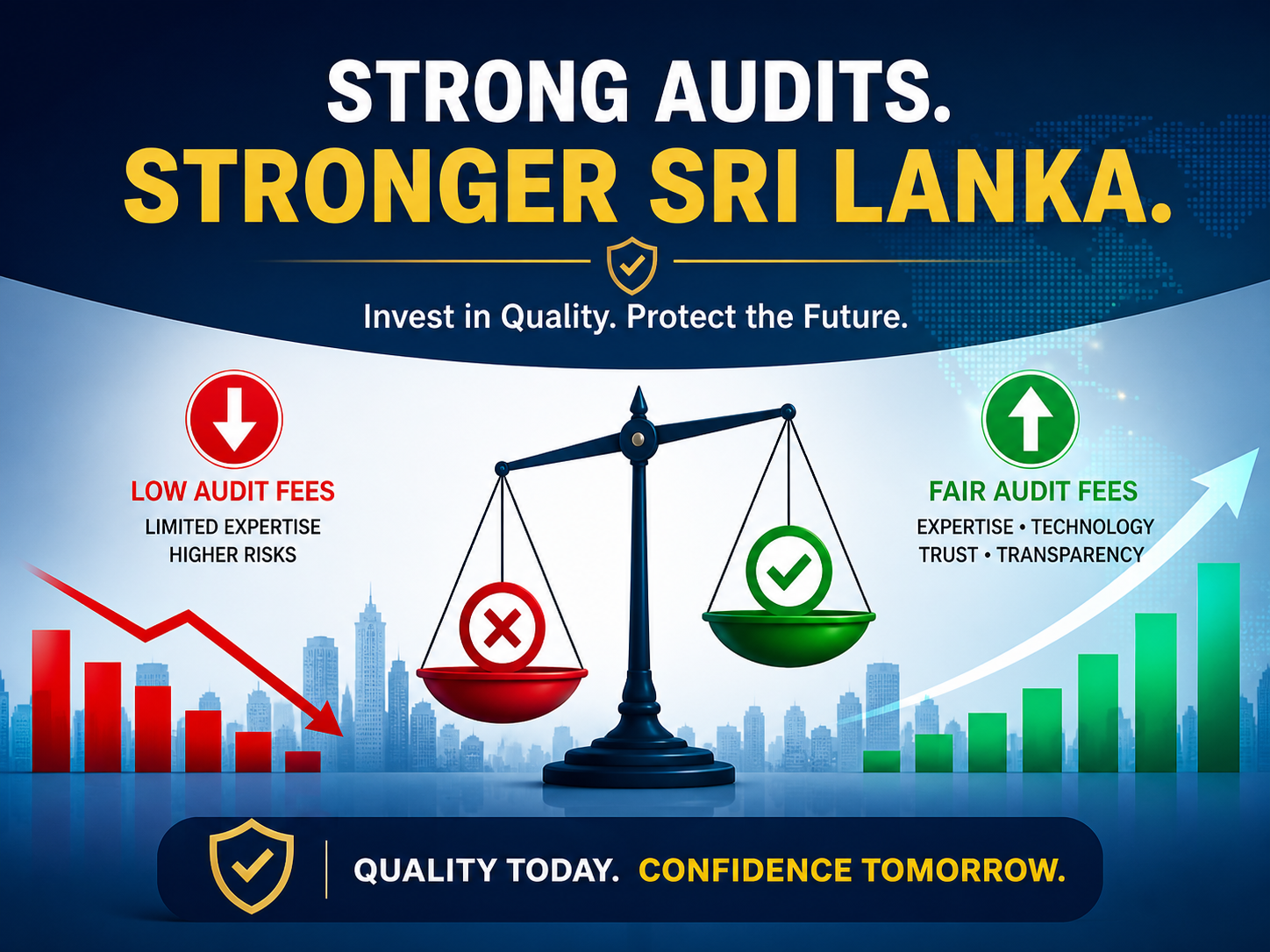
In every functioning economy, external audits serve as a cornerstone of trust. They validate financial integrity, reinforce investor confidence, and safeguard stakeholders. Yet, in Sri Lanka, a structural imbalance is increasingly evident—external audit fees remain disproportionately low compared to global benchmarks, while expectations placed on auditors continue to rise.
This is not a criticism of professionals within the audit ecosystem. Rather, it is a reflection on system design, economic constraints, and regulatory expectations that are misaligned with operational realities.
The question we must ask—honestly and urgently—is this:
Can high-quality audits exist in a low-fee environment?
The Sri Lankan Reality: Low Fees, High Expectations
Across Sri Lanka, audit fees—particularly for SMEs and even mid-tier corporates—are often 30% to 70% lower than comparable markets in Asia and globally.
Key Observations:
- Audit engagements are frequently priced as a compliance necessity rather than a value-driven assurance service
- Firms operate with tight margins, limiting reinvestment in talent and technology
- Audit timelines are compressed—often 2 to 6 weeks for full audits
- Heavy reliance on trainee-level staff (ages 20–25)
While young professionals bring energy and academic knowledge, complex modern audits require multi-disciplinary expertise—far beyond traditional accounting.
The Talent Constraint: A Structural Bottleneck
Audit firms in Sri Lanka largely depend on:
- CA, ACCA, CIMA, AAT students and affiliates
- Entry-level and semi-qualified trainees
- Limited number of fully qualified senior professionals
The Core Issue:
Low audit fees directly impact:
- Staff retention (high turnover rates)
- Attraction of specialized experts
- Investment in continuous professional development
Critical Expertise Gaps:
Modern audits increasingly require:
- Cybersecurity specialists
- Regulatory and compliance experts
- Industry-specific professionals (banking, hospitality, fintech, manufacturing)
- Data analytics and forensic accounting specialists
- Professionals with international exposure
However, these profiles command premium compensation, which is simply not feasible under current fee structures.
Audit Methodology vs Practical Constraints
In theory, audits follow robust methodologies:
- Risk-based planning
- Internal control assessments
- Substantive testing
- Sampling and vouching
- Analytical procedures
In practice, however:
Constraints Observed:
- Limited time allocation per client
- Heavy dependence on sampling
- Reduced depth in high-risk areas
- Over-reliance on management representations
This raises a fundamental concern:
Can limited sampling within a compressed timeframe truly capture financial reality?
“True and Fair View” — Is It Still Enough?
The concept of “true and fair view” has long been the foundation of audit reporting. However, in today’s environment of:
- Digital transactions
- Complex financial instruments
- Cross-border operations
- Cyber risks
…it may no longer be sufficient on its own.
Emerging Question:
Should audit frameworks evolve toward:
- “Reasonable assurance PLUS risk intelligence”
- Integration of real-time audit analytics
- Continuous audit models rather than annual snapshots
Statistical Perspective: Understanding the Gap
While precise fee disclosures vary, industry observations suggest:
- Average audit fees in Sri Lanka range between 0.05% to 0.15% of company revenue for many firms
- In contrast:
- Developed markets: 0.2% to 0.5%
- High-risk sectors: even higher
Human Capital Metrics:
- Over 60%–75% of audit fieldwork in Sri Lanka is conducted by trainees
- Staff turnover in some firms exceeds 25% annually
- Specialist hiring remains below 10% of workforce composition
These numbers point toward a systemic imbalance.
Case Study Analysis (Generalized and Non-Specific)
To maintain ethical and legal integrity, the following cases are presented as generalized industry patterns observed globally and regionally.
1. Financial Sector Irregularities (Global Pattern)
In several markets, post-incident reviews revealed:
- Limited scrutiny of complex transactions
- Over-reliance on sampling
- Insufficient IT audit integration
Learning: Financial audits require specialized domain expertise—not just accounting knowledge.
2. Corporate Collapse Due to Misstated Revenue
A large corporate entity (international case) reported inflated revenues over multiple years.
Audit Challenge:
- Revenue recognition complexity
- Lack of forensic-level testing
Learning: Traditional audit approaches may fail without forensic capabilities.
3. SME Sector Financial Misrepresentation
In developing economies:
- Weak internal controls
- Limited audit budgets
- Minimal testing depth
Learning: Low audit fees often correlate with limited audit scope.
4. IT System Breaches and Financial Impact
Companies facing cyber incidents often show:
- Weak IT general controls
- Lack of cybersecurity audit integration
Learning: Cybersecurity is now a financial risk—not just an IT issue.
5. Banking Compliance Gaps
Complex regulatory frameworks require:
- Deep understanding of compliance
- Continuous monitoring
Learning: Generalist auditors cannot fully address specialized regulatory environments.
6. Hospitality Sector Financial Leakages
In tourism-driven economies:
- Cash handling risks
- Revenue leakage points
- Inventory mismanagement
Learning: Industry-specific audit expertise is essential.
7. Rapidly Growing Startups
High-growth firms often:
- Scale faster than their control systems
- Lack governance maturity
Learning: Audits must adapt to dynamic business environments.
The Root Cause: It Comes Back to Fees
Every challenge discussed leads back to a single structural issue:
Low Audit Fees = Limited Capability
This impacts:
- Depth of audit work
- Quality of human resources
- Ability to adopt modern tools
- Independence and professional skepticism
A Strategic Way Forward: Rethinking the Model
1. Introduce a Revenue-Based Fee Framework
Audit fees could be structured as:
- A minimum percentage of revenue
- Adjusted based on:
- Industry risk
- Operational complexity
- Regulatory requirements
2. Build Multi-Disciplinary Audit Teams
Audit firms must evolve into:
- Financial + Technology + Compliance hubs
3. Strengthen Regulatory Guidelines
Professional bodies can:
- Define minimum audit fee benchmarks
- Encourage quality over price competition
4. Invest in Technology
- Data analytics
- AI-assisted auditing
- Continuous monitoring tools
5. Enhance Talent Retention
- Competitive compensation
- Structured career pathways
- International exposure opportunities
6. Shift Market Perception
Organizations must recognize:
Audit is not a cost—it is a risk management investment.
A Balanced Perspective: Shared Responsibility
It is important to emphasize:
This is not solely an auditor issue.
Responsibility lies with:
- Companies seeking low-cost audits
- Market competition dynamics
- Regulatory frameworks
- Talent migration trends
Conclusion: A Call for Strategic Reform
Sri Lanka stands at a critical juncture.
As the economy evolves and integrates further into global markets, audit quality must rise accordingly.
However, quality cannot exist in isolation from economic reality.
If we continue to:
- Underprice audit services
- Underinvest in expertise
- Overexpect outcomes
…we risk weakening one of the most critical pillars of financial trust.
Final Thought
Strong economies are built on strong systems.
Strong systems depend on credible audits.
Credible audits require sustainable economics.
Disclaimer
This article has been authored and published in good faith by Dr. Dharshana Weerakoon, DBA (USA), based on publicly observable industry patterns, professional experience across multiple sectors and regions, and general market insights. It is intended solely for educational, analytical, and public awareness purposes to encourage informed discussion on audit quality and structural challenges within professional services.
The views expressed are personal, independent, and non-specific to any individual organization, institution, or entity. This article does not make allegations against any specific firm or professional and should not be interpreted as legal, financial, or investment advice.
The author accepts no responsibility for any misinterpretation or application of the content. All perspectives are shared with full respect for ethical standards, professional integrity, and applicable laws and regulations in Sri Lanka and internationally.
✍ Authored independently through professional expertise and industry observation.
Further Reading: https://www.linkedin.com/newsletters/outside-of-education-7046073343568977920/
Further Reading: https://dharshanaweerakoon.com/uncredentialed-tourism-experts-sri-lanka/