
The Real Problem in Banking Isn’t Complexity — It’s Control and Capability
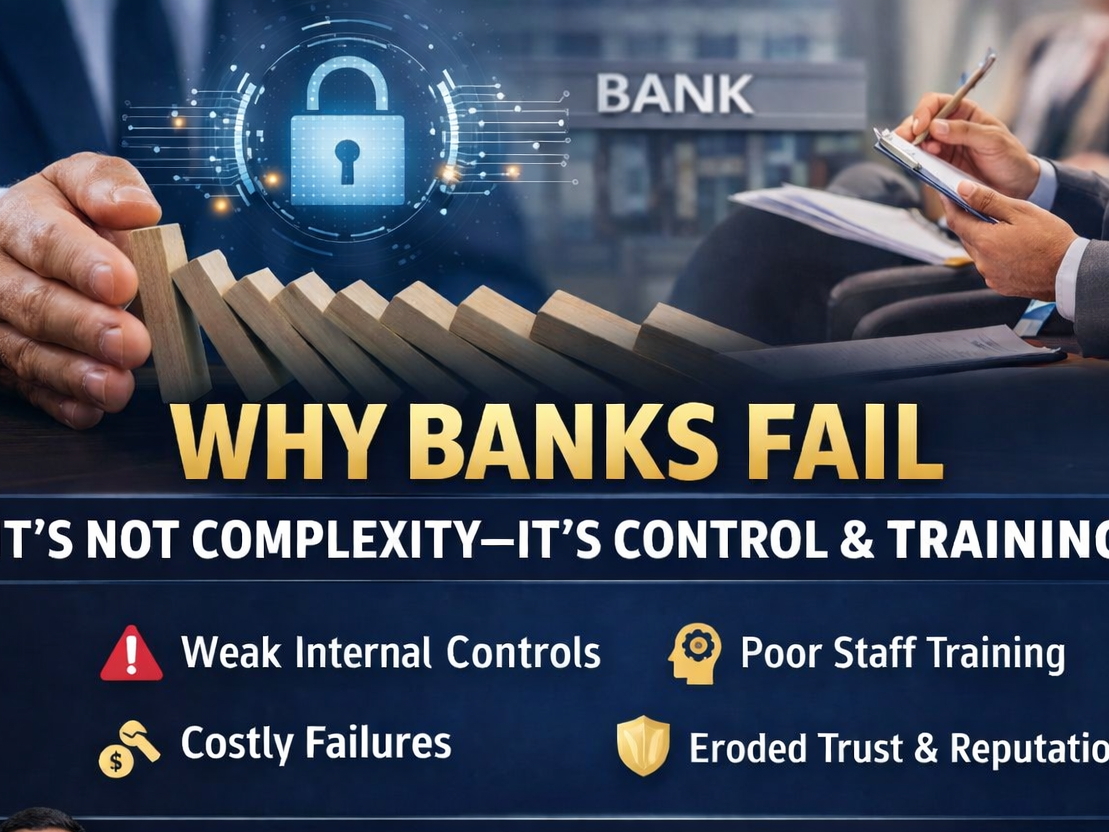
Why most banking failures come down to two overlooked fundamentals
Introduction: A Simple Truth the Industry Avoids
The banking sector today appears complex on the surface—digital transformation, regulatory pressure, cybersecurity risks, global interconnectedness. Yet, when we strip away the jargon, the failures we repeatedly witness are surprisingly simple.
Banks, regardless of size or geography, largely suffer from two core issues:
- Internal control and system weaknesses
- Inadequate training and judgment of staff
Everything else—fraud, compliance breaches, operational failures, reputational damage—is usually a consequence of these two.
This is not an oversimplification. It is a pattern.
Across continents, regulatory environments, and institutional sizes, the root causes remain consistent. The industry often invests heavily in technology and compliance frameworks, yet underestimates the human and structural gaps that quietly undermine those investments.
Understanding Internal Control Failures
Internal control is not about documentation. It is about behavior, enforcement, and timing.
Many banks have policies. Fewer have effective controls. Even fewer have controls that actually work when needed most.
What Goes Wrong
Internal control failures typically emerge in the following ways:
- Segregation of duties exists on paper but is bypassed operationally
- Approval hierarchies are weakened by informal influence
- Exception reporting is ignored until it becomes a crisis
- Audit findings are treated as routine, not urgent
- Systems are implemented but not fully integrated or monitored
According to global banking studies, over 60% of operational risk losses are linked to control failures, not external threats.
Even more concerning, more than 70% of fraud cases involve internal actors or collusion, highlighting that the issue is rarely just technological—it is deeply human.
The Illusion of Systems
Banks often believe that implementing advanced systems solves risk.
It does not.
A system is only as effective as:
- The data entered into it
- The people interpreting its outputs
- The discipline applied to its alerts
Many institutions invest millions in core banking upgrades, fraud detection tools, and compliance platforms. Yet, incidents still occur—not because systems fail, but because systems are misunderstood, underutilized, or overridden.
A Critical Insight
A weak process inside a strong system is still a weak system.
The Second Problem: Training That Doesn’t Translate to Judgment
Training in banking is often compliance-driven rather than decision-driven.
Staff are trained to:
- Follow procedures
- Pass audits
- Complete modules
But not necessarily to:
- Identify anomalies
- Challenge irregular behavior
- Make judgment calls under pressure
This creates a dangerous gap.
Key Data Point
Industry observations suggest that over 50% of operational errors are not due to lack of knowledge—but lack of situational awareness and critical thinking.
Training programs often fail because they are:
- Theoretical rather than practical
- One-time rather than continuous
- Generic rather than role-specific
Case Studies: Lessons from Real-World Failures
Below are selected case-style insights (generalized and anonymized for ethical safety) that illustrate how these two issues repeatedly manifest.
Case Study 1: The Silent Override
A mid-sized bank in Asia implemented a robust loan approval system. However, senior management had informal authority to override risk flags.
Outcome:
Non-performing loans increased by 28% within 18 months, largely due to overrides not being independently reviewed.
Root Cause:
Control existed—but enforcement did not.
Case Study 2: The Trusted Employee Trap
A long-serving employee in a treasury department manipulated transaction timing over several years.
Outcome:
Losses exceeded USD 10 million before detection.
Root Cause:
Over-reliance on trust, combined with weak monitoring controls.
Case Study 3: The Compliance Checkbox Culture
A bank passed all regulatory audits but failed to detect internal fraud.
Outcome:
Reputational damage and regulatory penalties.
Root Cause:
Compliance was treated as a checklist, not a mindset.
Case Study 4: System Without Understanding
A European bank implemented an advanced fraud detection system.
Outcome:
Alerts increased by 300%, but response rates dropped.
Root Cause:
Staff were not trained to interpret or prioritize alerts.
Case Study 5: Branch-Level Vulnerability
A regional branch consistently bypassed dual authorization procedures due to workload pressure.
Outcome:
Fraudulent transactions went unnoticed for months.
Root Cause:
Operational pressure overriding control discipline.
Case Study 6: Training Without Context
New recruits completed all mandatory training modules but failed to identify suspicious transactions.
Outcome:
Delayed detection of compliance breaches.
Root Cause:
Training lacked real-world scenarios.
Case Study 7: Audit Without Impact
Internal audits repeatedly flagged the same issues over three years.
Outcome:
Eventually led to a major operational loss.
Root Cause:
Audit findings were not enforced or escalated effectively.
Why These Problems Persist
If the issues are so clear, why do they continue?
1. Cultural Resistance
Organizations resist change when it challenges hierarchy or exposes weaknesses.
2. Overconfidence in Systems
Technology creates a false sense of security.
3. Misaligned Incentives
Performance metrics often prioritize growth over control.
4. Fragmented Accountability
Responsibility is distributed, but ownership is unclear.
The Cost of Ignoring the Basics
The financial impact is significant:
- Global banking fines exceeded USD 10 billion annually in recent years
- Operational risk losses account for a substantial portion of total losses
- Reputational damage often exceeds direct financial loss
But beyond numbers, the real cost is trust erosion.
Banks do not fail overnight. They weaken gradually—through small, repeated lapses.
What Needs to Change
The solution is not more complexity. It is better execution of fundamentals.
1. Reinvent Internal Controls
- Move from static controls to dynamic monitoring
- Introduce real-time escalation mechanisms
- Ensure independence in oversight
2. Redefine Training
Training must evolve from knowledge transfer to judgment development.
- Scenario-based learning
- Simulation exercises
- Continuous reinforcement
3. Strengthen Accountability
- Clear ownership of risks
- Measurable accountability frameworks
- Consequences for control failures
4. Align Culture with Control
Culture is the invisible control system.
- Encourage questioning
- Reward integrity
- Normalize escalation
A Strategic Perspective
From a leadership standpoint, this is not just a risk issue—it is a strategic issue.
Banks that master internal controls and staff capability gain:
- Higher operational resilience
- Stronger regulatory confidence
- Better long-term profitability
A Broader Reflection
Interestingly, this pattern is not unique to banking.
Across industries—including tourism and hospitality—the same principle applies:
Systems and strategies fail not because they are wrong, but because they are not executed with discipline and understanding.
This reinforces a universal truth:
Execution is the real differentiator.
Conclusion: Back to Basics
The banking industry does not need more frameworks. It needs more clarity and courage.
Clarity to recognize that the problem is simple.
Courage to address it without hiding behind complexity.
Internal controls and staff training are not operational details—they are strategic foundations.
Until these are treated as such, the cycle will continue.
Disclaimer
This article has been authored and published in good faith by Dr. Dharshana Weerakoon, DBA (USA), based on publicly available industry insights, general banking practices, global risk observations, and decades of professional experience across multiple sectors and regions.
It is intended solely for educational, analytical, and public awareness purposes to stimulate constructive discussion on banking systems, governance, and institutional resilience.
The author does not reference or disclose any confidential, proprietary, or institution-specific information. All case studies are generalized and anonymized to maintain ethical integrity and legal compliance.
The views expressed are entirely personal and do not constitute legal, financial, regulatory, or investment advice. No responsibility is accepted for any interpretation, application, or decision made based on this content.
This work is independently authored, grounded in lived professional experience, and presented in an original narrative form.
Further Reading: https://www.linkedin.com/newsletters/outside-of-education-7046073343568977920/
Further Reading: https://dharshanaweerakoon.com/strengthening-institutional-integrity/