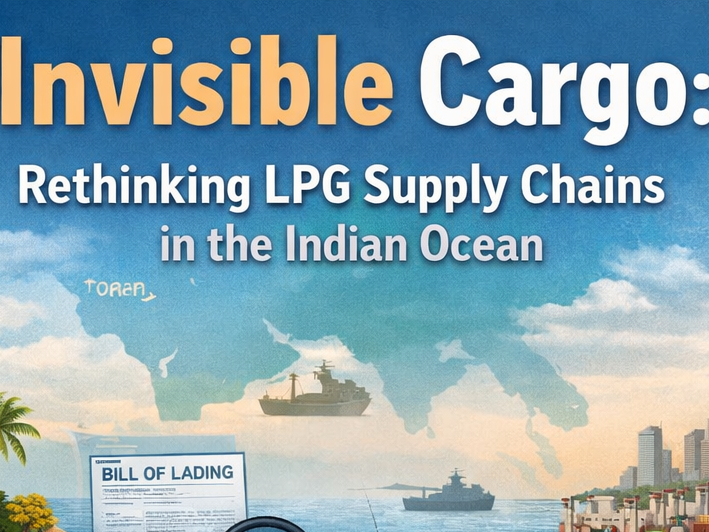
Invisible Cargo: Rethinking LPG Supply Chains in the Indian Ocean
A Ground-Level Industry Perspective on Transparency, Trade Structures, and Maritime Risk
Introduction: What the Data Shows—and What It Doesn’t
Over the years, working across shipping, bulk supply chains, and international trade corridors, one thing has become increasingly clear: energy logistics in the Indian Ocean are far more complex than they appear on the surface.
Liquefied Petroleum Gas (LPG), in particular, operates within a layered ecosystem—where physical cargo movement, contractual ownership, and financial flows do not always align in a straightforward manner.
This article is not an accusation, nor an exposé. Rather, it is an analytical reflection based on observable patterns, industry structures, and long-standing operational realities across markets such as Sri Lanka and the Maldives.
The intention is simple: to encourage deeper thinking around transparency, efficiency, and compliance in regional LPG trade.
1. The Indian Ocean LPG Corridor: A Strategic Energy Artery
The Indian Ocean region plays a critical role in global LPG redistribution.
Key Market Indicators:
- Global LPG trade volume exceeds 350 million metric tonnes annually
- Asia accounts for over 60% of global LPG consumption
- The Middle East—particularly Oman and Gulf producers—remains a key supply hub
- Island economies rely almost entirely on imports
Within this structure, smaller economies such as Maldives and Sri Lanka operate very differently from large-scale importers like India or China.
2. Maldives: A Controlled and Consistent Supply Model
The Maldives represents a low-volume, high-dependency LPG market.
Observed Characteristics:
- Annual demand estimated between 45,000–60,000 MT
- Imports handled through structured supply arrangements
- Heavy reliance on regional suppliers rather than long-haul global routes
- Use of small to medium LPG carriers (3,000–7,000 MT parcels)
Rather than sourcing from distant markets such as Latin America, the Maldives appears to prioritize logistical efficiency and supply reliability.
This is consistent with:
- Limited storage capacity
- Fragmented island distribution networks
- Need for frequent, smaller deliveries
From an operational standpoint, this model is practical and risk-averse.
3. Sri Lanka: Procurement Complexity and Market Dynamics
Sri Lanka presents a more layered procurement structure.
Market Snapshot:
- Annual LPG demand: ~250,000–300,000 MT
- Household penetration: ~35–40%
- Import dependency: Above 85%
Structural Reality:
While LPG is often physically sourced from the Middle East, procurement tends to occur through:
- International tenders
- Spot market contracts
- Global trading companies (including European-based intermediaries)
This creates a multi-layered supply chain, where:
- The producer
- The trader
- The shipping entity
- The end buyer
…may all be different parties.
4. The Role of Intermediaries: Efficiency vs. Opacity
Intermediaries are not inherently problematic—in fact, they are essential to global energy trade.
However, their presence introduces certain dynamics:
Advantages:
- Risk absorption
- Flexible pricing mechanisms
- Access to diversified supply sources
Challenges:
- Reduced price transparency
- Additional cost layers
- Complex cargo ownership trails
In smaller economies, these factors can amplify cost pressures and reduce visibility into true landed pricing.
5. Maritime Logistics: Understanding Vessel Behavior
Modern LPG logistics rely heavily on:
- Voyage declarations
- AIS (Automatic Identification System) tracking
- Port clearance records
However, global shipping practices also include legitimate operational variations, such as:
- Route adjustments due to weather or congestion
- Offshore anchorage waiting times
- Ship-to-ship (STS) transfers in designated zones
Industry Context:
In international shipping, Bill of Lading (BoL) reissuance and cargo transfers are recognized practices, particularly in:
- Trading optimization
- Storage management
- Multi-destination cargo splitting
Importantly:
These practices are legal when conducted within regulatory frameworks, but they require strong oversight to ensure compliance.
6. Emerging Risk Signals: A Global Perspective
Across multiple regions—not limited to South Asia—certain patterns have historically raised compliance concerns.
Typical Red Flags (Globally Observed):
- Extended AIS signal gaps
- Unexplained routing deviations
- Mid-sea cargo ownership changes
- Documentation inconsistencies
It is crucial to emphasize:
The presence of these indicators does not imply wrongdoing, but may justify closer regulatory attention.
7. Case Studies: Lessons from Global LPG Trade
Case Study 1: Sanctions-Affected Trade Routes
In sanctioned environments, vessels have historically:
- Altered AIS signals
- Conducted offshore transfers
- Reissued documentation
Result: Increased global monitoring and enforcement.
Case Study 2: Caribbean Ship-to-Ship Transfers
Used for:
- Cargo consolidation
- Destination flexibility
Lesson: Transparency improves when STS zones are regulated and disclosed.
Case Study 3: Southeast Asian Micro-Distribution
Countries like Indonesia rely on:
- Small parcel distribution
- High-frequency deliveries
Outcome: Efficient but requires tight logistics coordination
Case Study 4: Indian Public Sector Procurement
India minimizes intermediaries through:
- State-backed procurement
- Long-term contracts
Result: Greater pricing control
Case Study 5: Sri Lanka Crisis Procurement (2022)
Emergency закупки led to:
- Price volatility (20–30% spikes)
- Increased dependence on traders
Case Study 6: Middle Eastern Long-Term Contracts
Producers like Oman provide:
- Stable pricing
- Reliable supply
Case Study 7: African Market Leakages
Weak monitoring systems resulted in:
- Informal trade flows
- Revenue losses exceeding $200 million annually
8. The Transparency Gap: Where Attention is Needed
Based on industry experience, the most critical gap is not supply—but visibility.
Key Gaps:
- Limited real-time cargo tracking integration
- Fragmented regulatory oversight
- Lack of unified regional reporting standards
9. Strategic Recommendations
For Sri Lanka:
- Strengthen direct procurement mechanisms
- Enhance tender transparency frameworks
- Invest in real-time maritime tracking analytics
For Maldives:
- Maintain structured supply
- Introduce digital verification systems
Regional Opportunity:
An Indian Ocean Energy Transparency Framework could:
- Improve data sharing
- Strengthen compliance
- Reduce systemic inefficiencies
10. Conclusion: From Assumptions to Accountability
The LPG trade in the Indian Ocean is not broken—but it is evolving.
As markets grow more interconnected, the need for:
- Transparency
- Efficiency
- Regulatory clarity
…becomes increasingly important.
This is not about identifying fault—it is about recognizing patterns early and strengthening systems proactively.
Because in global energy trade, what is invisible often matters just as much as what is visible.
Disclaimer
This article has been authored and published in good faith by Dr. Dharshana Weerakoon, DBA (USA), based on publicly observable industry practices, non-confidential data patterns, and extensive professional experience in global shipping, logistics, and bulk supply chains.
It is intended solely for analytical, educational, and public discussion purposes, with the objective of enhancing awareness around LPG trade structures, maritime logistics, and supply chain transparency in the Indian Ocean region.
No specific vessel, company, transaction, or jurisdiction is being accused of wrongdoing. Any references to operational patterns are illustrative and based on widely recognized global industry practices.
The views expressed are personal and do not constitute legal, financial, regulatory, or investment advice. The author assumes no responsibility for external interpretations or decisions made based on this content.
This work is independently developed, aligned with international maritime norms, ethical standards, and responsible industry discourse.
Further Reading: https://www.linkedin.com/newsletters/outside-of-education-7046073343568977920/
Further Reading: https://dharshanaweerakoon.com/a-strategic-perspective-on-economic-survival/