
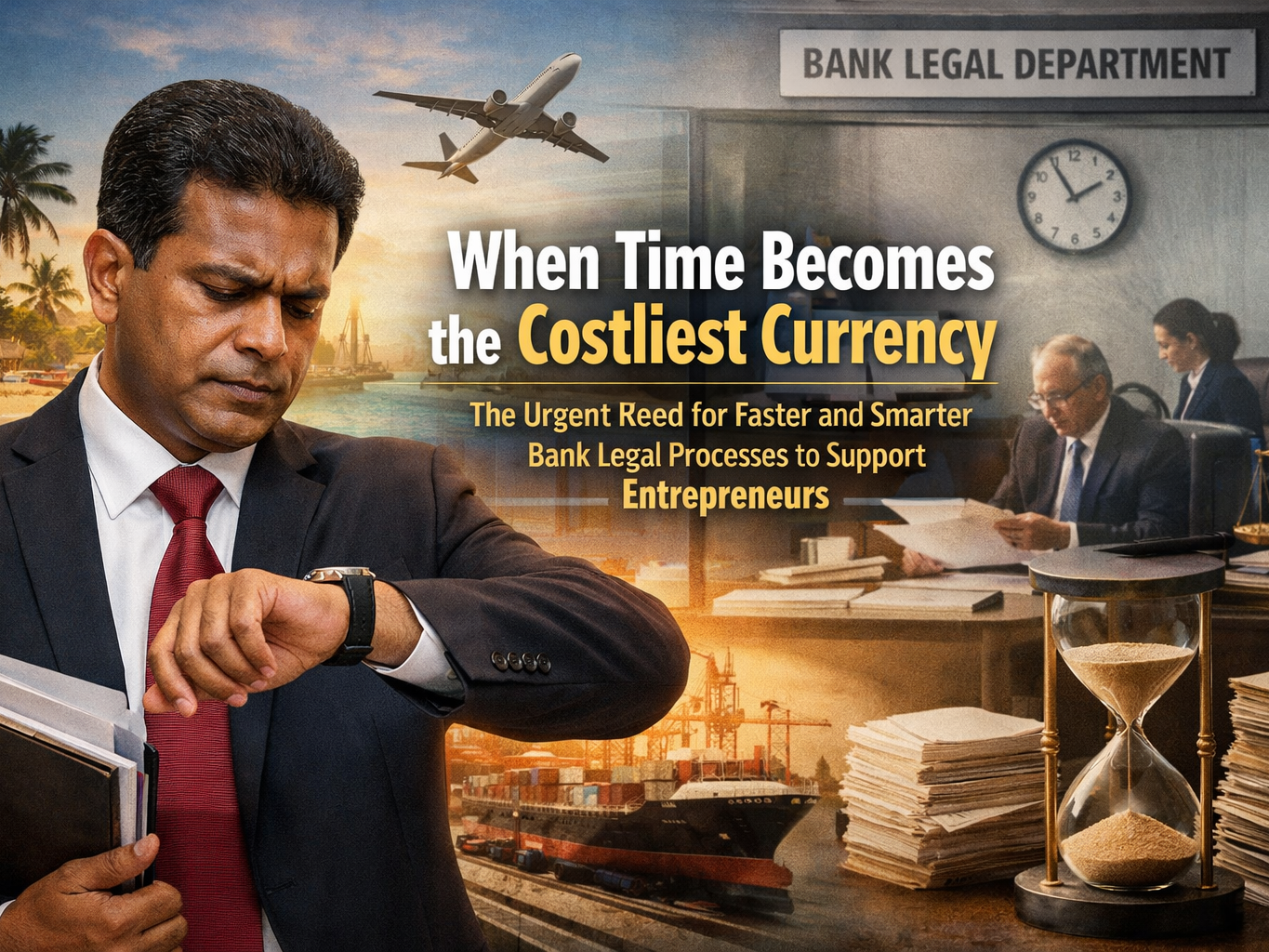
When Time Becomes the Costliest Currency: Why Sri Lankan Bank Legal Departments Must Evolve to Support Entrepreneurs
Introduction: A Reality Many Entrepreneurs Quietly Experience
Across Sri Lanka, thousands of entrepreneurs wake up every day with the same goal: to build businesses, create employment, and contribute to national economic progress. From tourism investors in coastal towns to technology founders in urban innovation hubs, the entrepreneurial spirit remains one of the country’s most valuable economic assets.
However, behind many business ventures lies a structural challenge that is rarely discussed openly in public forums or policy conversations: the slow pace and rigid culture often experienced within the legal departments of banks and finance institutions.
This article is written from years of personal experience dealing with multiple banks and financial institutions, as well as from countless discussions with fellow entrepreneurs who have encountered similar situations. It is not directed at any single institution or individual. Rather, it reflects a systemic issue within parts of Sri Lanka’s financial ecosystem that deserves constructive attention.
The purpose of raising this discussion is not to undermine the importance of legal safeguards. On the contrary, legal due diligence is an essential component of responsible banking. But when legal procedures become slow, impractical, unresponsive, or disconnected from commercial realities, they can unintentionally create obstacles for the very businesses that banks are meant to support.
In today’s competitive economic landscape, time has become the most valuable currency of all.
The Entrepreneurial Clock: Why Time Matters More Than Ever
Entrepreneurs operate under constant pressure to move quickly, seize opportunities, and adapt to rapidly changing market conditions. Unlike large corporations with complex bureaucratic structures, entrepreneurs often make decisions swiftly in order to stay competitive.
In industries such as tourism and hospitality, timing can determine the entire success of a project. Renovations must be completed before peak tourist seasons, marketing campaigns must align with global travel patterns, and new services must be launched ahead of competitors.
If financing processes become delayed—even by a few weeks—the consequences can be significant.
Sri Lanka’s small and medium enterprise (SME) sector contributes approximately 52% of national GDP and provides around 45% of employment, according to economic estimates and policy reports. These businesses rely heavily on financial institutions for:
- Working capital financing
- Overdraft facilities
- Investment loans
- Property-backed credit lines
- Expansion capital
In theory, the relationship between banks and entrepreneurs should be collaborative and mutually beneficial. Banks provide financial resources, while businesses generate economic activity that ultimately strengthens the financial system.
However, in practice, many entrepreneurs encounter an operational bottleneck when transactions reach internal legal departments.
The Structural Disconnect Between Legal Practice and Business Reality
Legal professionals are trained to identify risks, interpret regulations, and protect institutions from potential liabilities. This training is vital for maintaining the integrity of financial systems.
Yet commercial banking operates in an environment where speed and efficiency are essential.
Entrepreneurs often observe that while relationship managers and credit officers attempt to move transactions forward, the process can slow significantly once documentation reaches legal departments.
Common concerns raised by business clients include:
- Extended waiting periods for legal document verification
- Repeated requests for documentation already submitted
- Lack of clear timelines for completion of legal reviews
- Limited communication about the progress of internal processes
These issues create a perception that legal departments sometimes function in isolation from the commercial objectives of the institution.
From an entrepreneur’s perspective, it can feel as though legal procedures are being applied with a courtroom mindset rather than a commercial banking approach.
This gap between legal caution and business urgency is where many frustrations arise.
Personal Observations From Working With Financial Institutions
Over the years, I have personally engaged with numerous banks and finance companies in Sri Lanka while managing business operations and investment initiatives.
While I have encountered many dedicated and highly competent banking professionals, I have also repeatedly experienced situations where the legal processing stage became the slowest and least flexible part of the entire financial transaction.
In conversations with fellow entrepreneurs across industries, similar experiences often emerge.
Some of the recurring concerns include:
- Inefficiency in document processing timelines
- Rigid interpretations of routine administrative requirements
- Limited flexibility in resolving practical documentation issues
- Insufficient understanding of the urgency faced by business clients
- Communication styles that sometimes appear unnecessarily dismissive or overly formal
Entrepreneurs often feel that legal departments are focused solely on protecting institutional risk without considering the commercial urgency of the customer’s situation.
At the end of the day, lawyers are lawyers. Their professional instinct is to analyze every possible risk scenario. While this caution serves an important role in protecting institutions, it can sometimes lead to overly conservative procedures that slow down legitimate business activities.
The Human Factor: Professional Conduct and Customer Experience
Another issue that deserves attention is the interpersonal aspect of client interactions with legal departments.
Many entrepreneurs report that legal communication within financial institutions can occasionally feel rigid, bureaucratic, or even discouraging.
This is not necessarily due to ill intention. Rather, it may reflect the traditional professional culture within legal environments.
However, in modern commercial banking, customer relationships must be built on mutual respect, collaboration, and solution-oriented dialogue.
Clients approaching banks for financial services are not adversaries. They are partners in the broader economic ecosystem.
When legal professionals communicate with empathy and commercial awareness, their expertise becomes far more effective in facilitating secure and efficient transactions.
The Economic Cost of Delays
The implications of inefficient legal processes extend far beyond individual business clients.
When entrepreneurs face repeated delays in accessing financing, the broader economic effects can include:
- Postponed investment projects
- Slower job creation
- Reduced competitiveness of local industries
- Missed opportunities in international markets
For example, in the tourism sector—a field in which I have worked extensively—project timelines are often linked to seasonal travel demand.
A resort renovation delayed by legal review procedures may miss the entire winter tourist season, which could represent the majority of annual revenue for that property.
When such delays occur across multiple businesses, the cumulative impact on the national economy becomes substantial.
Lessons From International Banking Systems
Several countries have successfully modernized their banking legal processes to balance risk management with operational efficiency.
Singapore
Singapore’s financial institutions use integrated digital platforms where legal verification, credit assessment, and compliance checks occur simultaneously. This reduces approval timelines dramatically.
United Arab Emirates
Property-backed lending processes benefit from government-backed digital land registries, allowing instant verification of property ownership.
United Kingdom
Banks frequently apply risk-based legal review systems where routine lending transactions undergo streamlined legal processing.
Estonia
The country’s advanced digital governance infrastructure enables banks to verify company registrations, ownership records, and property data instantly.
Australia
Legal teams within banks receive regular training in commercial finance principles, ensuring they understand the practical implications of lending decisions.
India
Large-scale digitization projects linking identity verification, credit data, and property records have significantly accelerated secured lending processes.
Thailand
Tourism-focused financing units within banks ensure hospitality sector projects receive faster financial approvals aligned with seasonal investment cycles.
These international examples demonstrate that strong legal oversight and operational efficiency can coexist.
Why Organizational Reform Is Necessary
For Sri Lanka to strengthen its position as an entrepreneur-friendly investment destination, financial institutions must continuously evolve their internal structures.
Legal departments should remain strong guardians of regulatory compliance, but they must also function as commercially aware partners in enabling business activity.
Several practical improvements could help achieve this balance.
Commercial Awareness Training
Legal professionals working within financial institutions should be exposed to the realities of entrepreneurship, project financing, and industry-specific business models.
Transparent Processing Timelines
Banks could establish internal service-level standards for legal review processes, ensuring predictable turnaround times.
Digital Document Tracking
Technology platforms allowing customers and internal teams to track document status would improve transparency.
Risk-Based Legal Procedures
Routine transactions could follow simplified legal pathways, while complex deals receive detailed scrutiny.
Collaborative Communication Culture
Encouraging constructive dialogue between legal teams and clients would help resolve issues more efficiently.
A Shared Responsibility for National Growth
Sri Lanka’s economic future depends heavily on innovation, entrepreneurship, and private sector investment.
Banks play an indispensable role in enabling this growth. Their legal departments, therefore, must evolve beyond purely defensive frameworks to become strategic contributors to commercial success.
This transformation does not require sacrificing legal integrity. Instead, it requires aligning legal expertise with operational efficiency and commercial awareness.
When banks and entrepreneurs work together with mutual understanding, both sides benefit—and the national economy grows stronger.
Conclusion: The Need for Balance
The intention of this article is not to criticize individuals or institutions but to encourage reflection and constructive dialogue.
Sri Lanka possesses a capable banking sector and a resilient entrepreneurial community. Bridging the operational gap between these two pillars will unlock significant economic potential.
Legal safeguards will always remain essential in financial systems. But in a rapidly changing global economy, efficiency, flexibility, and responsiveness are equally important.
When legal departments evolve to combine professional excellence with commercial practicality, they will not only protect their institutions more effectively—they will also help empower the entrepreneurs who drive Sri Lanka’s economic future.
Because in modern business, time is no longer just money—it is opportunity, innovation, and national progress.
Disclaimer
This article has been authored and published in good faith by Dr. Dharshana Weerakoon, DBA (USA), based on publicly available data from cited national and international sources (e.g., Sri Lanka Tourism Development Authority, Central Bank of Sri Lanka, international tourism monitors, conservation bodies), decades of professional experience across multiple continents, and ongoing industry insight. It is intended solely for educational, journalistic, and public awareness purposes to stimulate discussion on sustainable tourism models and business efficiency. The author accepts no responsibility for any misinterpretation, adaptation, or misuse of the content. Views expressed are entirely personal and analytical, and do not constitute legal, financial, or investment advice. This article and the proposed model are designed to comply fully with Sri Lankan law, including the Intellectual Property Act No. 52 of 1979, the ICCPR Act No. 56 of 2007, and relevant data privacy and ethical standards.
✍ Authored independently and organically through lived professional expertise—not AI-generated.
Further Reading: https://www.linkedin.com/newsletters/7046073343568977920/
Further Reading: https://dharshanaweerakoon.com/the-paradox-of-digital-efficiency-and-paper-chaos-in-sri-lankan-banking/