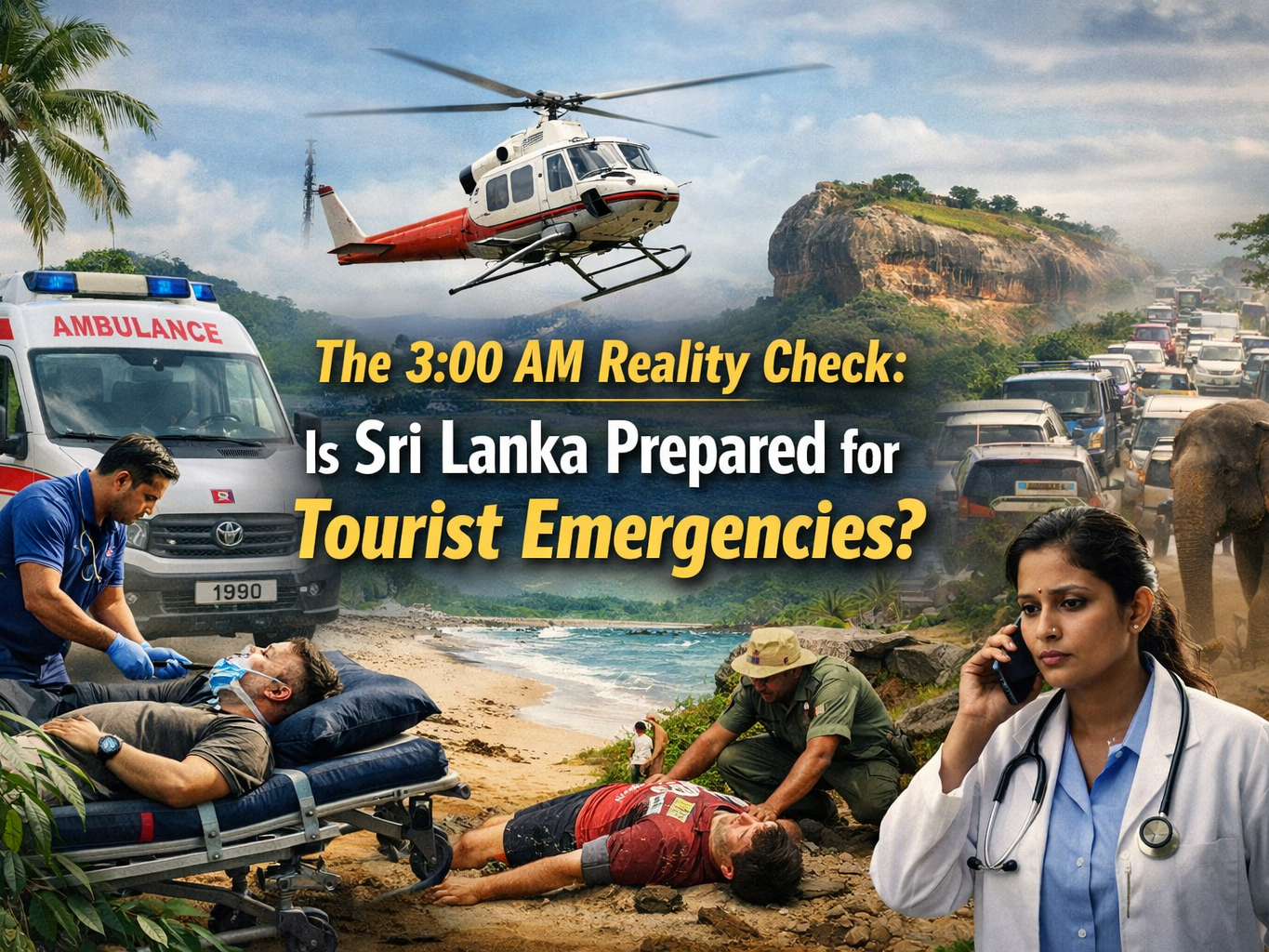
The 3:00 AM Reality Check: Is Sri Lanka Truly Prepared for Tourist Emergencies?
Introduction: When Paradise Meets Panic
At 3:00 AM, the illusion of paradise is tested.
A tourist collapses on a remote southern beach. A diving accident unfolds off the eastern coast. A child develops acute respiratory distress in a hill country villa far from urban medical care. In such moments, glossy brochures and five-star service promises fade into irrelevance. What remains is one critical question:
Is Sri Lanka truly prepared to respond—swiftly, professionally, and reliably—to tourist emergencies?
While Sri Lanka has made impressive strides in tourism development, infrastructure expansion, and destination branding, a deeper and less visible layer remains under-examined: emergency response readiness. This includes medical evacuation systems, multilingual ambulance coordination, inter-agency communication, and the alignment between resort-level assurances and national-level capabilities.
This article presents a grounded, evidence-based analysis of Sri Lanka’s emergency response ecosystem as it relates to tourism—identifying strengths, exposing structural gaps, and offering a forward-looking strategy for resilience.
1. The Growth of Tourism vs. Emergency Preparedness
Sri Lanka’s tourism industry has shown strong recovery and growth momentum:
- Tourist arrivals surpassed 2 million annually pre-pandemic, with projections aiming toward 3–4 million arrivals within the next five years.
- Tourism contributes approximately 5–7% of GDP, with indirect impacts reaching 10–12%.
- Coastal and experiential tourism (surfing, diving, eco-tourism) have grown by over 18–22% annually in emerging zones.
However, emergency response infrastructure has not scaled proportionately.
Key concern:
- Tourist density has increased faster than emergency service coverage, particularly in secondary and tertiary destinations.
2. Anatomy of a Tourist Emergency in Sri Lanka
A typical emergency involving a tourist unfolds across multiple layers:
- Incident occurrence (hotel, beach, excursion site)
- First response (hotel staff, bystanders)
- Ambulance dispatch (public or private)
- Hospital triage (public/private)
- Specialized care or evacuation (if required)
Breakdowns often occur in:
- Communication delays
- Ambulance availability gaps
- Language barriers
- Geographical accessibility
3. Emergency Medical Services (EMS): Current Landscape
Sri Lanka operates a mixed emergency response system:
Public Sector
- National ambulance service (free at point of use)
- Approximately 300–350 ambulances nationwide
- Coverage strongest in urban centers (Colombo, Kandy)
Private Sector
- Premium ambulance services linked to private hospitals
- Faster response but cost-prohibitive for uninsured tourists
Critical Gaps
- Average response times in rural areas: 25–45 minutes
- Lack of standardized triage protocols across regions
- Limited advanced life support (ALS) units
4. The Language Barrier: A Silent Risk
Tourists come from diverse linguistic backgrounds:
- Top markets include India, UK, Russia, Germany, and China
- Yet, multilingual dispatch systems remain underdeveloped
Observed issues:
- Emergency call centers primarily operate in Sinhala and English
- Limited availability of real-time translation support
- Miscommunication can delay life-saving interventions
5. Medical Evacuations: A Critical Weak Link
In high-risk scenarios—diving accidents, cardiac events, trauma—rapid evacuation is essential.
Current Reality:
- Air ambulance services exist but are limited and expensive
- Helicopter evacuation is not systematically integrated
- Remote regions (East Coast, Yala, Arugam Bay) face delays exceeding 2–4 hours
Risk Exposure:
- High-end resorts market “world-class safety”
- Ground-level evacuation logistics often do not match these claims
6. Case Studies: When Systems Are Tested
Case Study 1: Southern Coast Diving Incident
A European tourist suffered decompression sickness. Delay in transfer to a hyperbaric chamber exceeded 5 hours. Outcome: long-term neurological complications.
Case Study 2: Hill Country Cardiac Emergency
A middle-aged traveler experienced cardiac arrest in a boutique hotel. Ambulance arrival time: 38 minutes. No AED on-site.
Case Study 3: Eastern Coast Road Accident
A tourist injured in a tuk-tuk accident waited over 50 minutes for transport. Local hospital lacked trauma care capacity.
Case Study 4: Wildlife Safari Incident
A safari jeep rollover resulted in multiple injuries. Coordination between park authorities and EMS was fragmented.
Case Study 5: Urban Luxury Hotel Medical Event
Despite being in Colombo, response delays occurred due to traffic congestion and unclear dispatch routing.
Case Study 6: Surfing Injury in Arugam Bay
Spinal injury suspected. No immobilization protocol followed at the scene. Transport exacerbated injury.
Case Study 7: Pediatric Emergency in Villa Rental
A child with severe allergic reaction lacked immediate access to epinephrine. Delayed response increased severity.
7. Resort Safety Promises vs. Ground Reality
Luxury hotels often advertise:
- 24/7 medical assistance
- Emergency protocols
- Doctor-on-call services
However:
- Many rely on external providers without guaranteed response times
- Staff training varies significantly
- Emergency drills are often compliance-driven, not performance-driven
This creates a liability gap between brand promise and operational reality.
8. International Benchmarking: Where Sri Lanka Stands
Comparative insights:
| Indicator | Sri Lanka | Regional Best Practice |
| Ambulance density | Moderate | High |
| Response time (rural) | 25–45 mins | 10–20 mins |
| Air evacuation | Limited | Integrated |
| Multilingual dispatch | Basic | Advanced |
| Trauma network | Fragmented | Structured |
Countries that excel in tourism safety treat emergency response as core infrastructure, not a support function.
9. Economic Implications of Emergency Readiness
Tourist safety directly impacts:
- Destination reputation
- Insurance premiums
- Repeat visitation
- High-value tourist segments
A single high-profile incident can result in:
- Negative global media exposure
- Travel advisories
- Revenue losses exceeding millions of USD
10. Strategic Gaps Identified
- Fragmented coordination across agencies
- Lack of integrated emergency command system
- Insufficient rural coverage
- Limited public-private synergy
- Inconsistent training standards
11. The Way Forward: A National Emergency Tourism Framework
To align with global standards, Sri Lanka must adopt a multi-layered strategy:
A. Integrated Emergency Command System
- Centralized coordination platform
- Real-time tracking of ambulances
B. Tourism-Focused EMS Units
- Dedicated response teams in high-density tourist zones
C. Air Evacuation Network
- Public-private partnerships for helicopter services
D. Multilingual Dispatch Centers
- AI-assisted translation integration
- Language coverage for top 10 tourist markets
E. Mandatory Resort Compliance
- AEDs, trained staff, emergency drills
- Transparent reporting standards
F. Insurance Integration
- Partnerships with global travel insurers
- Cashless emergency services
12. Technology as a Game Changer
Digital solutions can bridge gaps:
- Mobile emergency apps with GPS tracking
- Telemedicine integration
- Predictive analytics for risk zones
13. Building a Culture of Preparedness
Emergency readiness must become:
- A national priority
- A tourism brand pillar
- A regulatory requirement
Training should extend to:
- Hotel staff
- Tour operators
- Local communities
14. Conclusion: The True Test of a Destination
A destination is not judged by its beauty in daylight—but by its response in crisis at 3:00 AM.
Sri Lanka has the opportunity to position itself not only as a destination of natural beauty and cultural richness, but also as a benchmark for safety, reliability, and resilience.
However, this requires a shift:
From reactive response → to proactive preparedness
From fragmented systems → to integrated infrastructure
From marketing promises → to operational truth
Only then can Sri Lanka confidently say:
When luxury meets liability, we are ready.
Disclaimer
This article has been authored and published in good faith by Dr. Dharshana Weerakoon, DBA (USA), drawing upon publicly available national tourism and healthcare data, industry observations, and extensive professional experience in global tourism strategy and hospitality operations.
It is intended solely for educational, analytical, and public awareness purposes, particularly in relation to tourism safety, emergency preparedness, and service infrastructure in Sri Lanka. The perspectives presented aim to encourage informed dialogue and policy-level thinking.
The author does not assume responsibility for any interpretation, decision, or action taken based on this content. Views expressed are strictly personal and do not constitute legal, medical, financial, or investment advice.
This article has been independently developed through professional insight and original analysis, in alignment with Sri Lankan legal frameworks, ethical standards, and responsible publishing practices.
Further Reading: https://www.linkedin.com/newsletters/7046073343568977920/
Further Reading: https://dharshanaweerakoon.com/hospitality-is-not-a-machine/