The Silent Resort Model: Designing Sri Lankan Getaways for the Global Burnout Generation
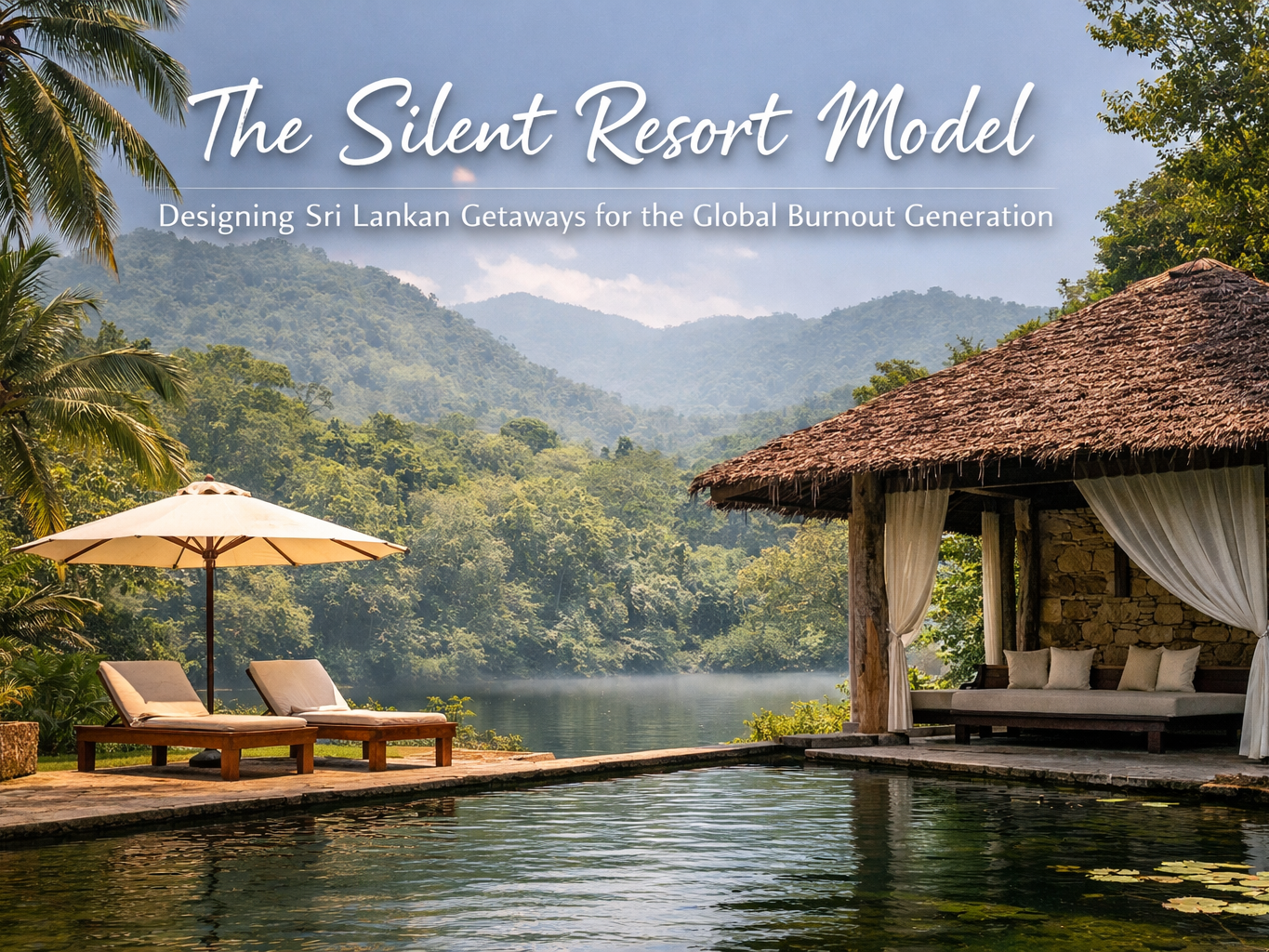
Reimagining Luxury Through Silence, Stillness, and Sensory Restraint
An Industry at an Inflection Point
As someone who has spent over three decades across tourism, hospitality, strategy, technology-enabled services, and sustainable development—working with destinations, investors, governments, and private operators across Asia, Europe, Africa, and North America—I can state this with confidence: global tourism is undergoing a quiet but irreversible shift.
The post-pandemic traveler is not merely seeking destinations. They are seeking relief.
Relief from screens. Relief from noise. Relief from urgency. Relief from decision fatigue. Relief from themselves.
In 2024, the World Health Organization formally recognized burnout as an occupational phenomenon. Global workforce surveys now show that over 62% of professionals in developed economies report chronic stress symptoms, while digital screen exposure has increased by nearly 70% over the last decade. The average urban professional checks a mobile device 96–110 times per day. Sleep deprivation, anxiety disorders, and cognitive fatigue are no longer fringe concerns; they are mainstream realities.
Tourism, as an industry, has a choice: continue selling stimulation—or begin selling restoration.
This article introduces and analyses what I term “The Silent Resort Model”: a distinctly Sri Lankan opportunity to position silence, low sensory input, digital minimalism, and deep nervous-system recovery as a high-value luxury export.
What Is the Silent Resort Model?
The Silent Resort Model is not about austerity, isolation, or denial of comfort. On the contrary, it is a highly curated luxury experience designed around one radical proposition:
The absence of noise, distraction, and excess can be more valuable than abundance.
At its core, the model integrates:
- Ultra-low auditory, visual, and digital stimulation
- Intentional architectural restraint
- Digital minimalism by design (not by instruction)
- Deep rest protocols rooted in neuroscience, Ayurveda, and contemplative traditions
- Controlled guest capacity and slow operational rhythms
This is not a “spa concept.” It is not wellness tourism as traditionally understood. It is cognitive and sensory rehabilitation packaged as experiential luxury.
Sri Lanka—by geography, culture, biodiversity, and civilizational philosophy—is uniquely positioned to lead this category globally.
Why Sri Lanka, and Why Now?
1. Geographic and Environmental Advantage
Sri Lanka offers within a compact landmass:
- Rainforests with ambient noise levels below 30 decibels
- Highland mist zones with year-round natural cooling
- Remote coastal belts unaffected by urban light pollution
- Ancient irrigation landscapes engineered for calm and balance
Very few destinations can offer accessibility without overexposure. A guest can transition from an international airport to profound ecological quiet within hours.
2. Cultural Alignment with Silence
Silence is not foreign to Sri Lanka. It is deeply embedded in:
- Buddhist monastic traditions
- Forest hermitage practices
- Ayurvedic healing protocols
- Village spatial planning
- Craft and artisan cultures emphasizing patience and presence
Unlike destinations that must invent stillness, Sri Lanka can authentically host it.
3. Economic Timing
Tourism contributed approximately 5–6% of Sri Lanka’s GDP pre-2019. While arrivals have rebounded post-crisis, average daily spend remains below potential, especially when compared to destinations such as Bhutan, Maldives, or Costa Rica.
The Silent Resort Model shifts the equation from volume to value.
A 20-key silent resort charging USD 800–1,500 per night can outperform a 100-room conventional hotel—while exerting a fraction of the environmental and social pressure.
The Global Burnout Generation: A Market Overview
The target audience is not niche. It is growing.
Key Data Points
- Global wellness tourism is valued at USD 900+ billion, growing at 7–9% annually
- “Digital detox travel” searches increased by over 40% between 2021–2024
- High-income travelers now average 2–3 short restorative trips per year, rather than one long holiday
- Over 55% of Gen X and Millennial executives state that “mental recovery” is a primary travel motivation
This cohort is willing to pay a premium—but only for credibility, privacy, and results.
Core Design Principles of a Silent Resort
1. Architectural Quiet
- Use of earth tones, natural materials, and non-reflective surfaces
- Spatial layouts minimizing echo and footfall noise
- No televisions in rooms
- Controlled sightlines to reduce visual clutter
2. Digital Minimalism by Design
- No Wi-Fi in private villas (optional access in designated zones)
- No televisions or digital signage
- Guests informed before arrival that disconnection is part of the value
This avoids ethical issues around coercion. Silence is consent-based.
3. Sensory Governance
- No piped music
- Fragrance-free public spaces
- Limited menu choices to reduce decision fatigue
- Natural lighting aligned with circadian rhythms
4. Staff Training for Quiet Service
Luxury here is anticipation without intrusion.
- Whisper-level communication
- Minimal verbal interaction unless initiated
- Non-invasive housekeeping schedules
Case Studies and Comparable Models (Global and Regional)
Case Study 1: Bhutan’s High-Value, Low-Volume Tourism Policy
Bhutan limits visitor numbers through a daily sustainability fee. Despite lower arrivals, it maintains one of the highest per-tourist revenues in Asia.
Insight for Sri Lanka: Regulation and positioning can outperform mass marketing.
Case Study 2: Digital Detox Retreats in Japan
Japanese forest therapy (Shinrin-yoku) retreats report measurable reductions in cortisol levels within 72 hours.
Insight: Scientific validation strengthens premium pricing.
Case Study 3: Scandinavian Silent Lodges
Remote lodges in Norway and Finland market silence as a core product feature, charging premium rates despite extreme climates.
Insight: Silence sells—even without tropical appeal.
Case Study 4: Sri Lankan Forest Hermitage-Inspired Retreats
Select boutique properties near Sinharaja and Knuckles already operate on low-sensory principles, achieving occupancy rates above 70% year-round with minimal marketing.
Insight: The model already works locally—without formal branding.
Case Study 5: Luxury Yachting’s “No-Connectivity” Voyages
Ultra-high-net-worth clients increasingly request signal-free itineraries.
Insight: Disconnection is no longer a downgrade—it is a status marker.
Case Study 6: Post-Burnout Executive Retreats in Europe
Small, invitation-only retreats report repeat visitation rates exceeding 60%.
Insight: Silent experiences create loyalty, not just satisfaction.
Legal, Ethical, and Cultural Safeguards
The Silent Resort Model must:
- Respect local communities and land rights
- Avoid spiritual commodification
- Protect artisan intellectual property
- Ensure inclusivity and non-discrimination
- Maintain transparent data and privacy practices
Silence must never be extracted at the cost of dignity.
Economic and National Impact Potential
If Sri Lanka developed just 25 silent resorts over 10 years, each with:
- 20 keys
- Average occupancy of 60%
- ADR of USD 900
The sector could generate:
- Over USD 98 million annually
- Thousands of skilled, low-impact rural jobs
- Minimal infrastructure strain
This is sustainable tourism in its truest sense.
The Strategic Opportunity Ahead
Sri Lanka does not need to compete louder.
It needs to compete quieter.
In a world addicted to stimulation, silence is rebellion. Stillness is status. Disconnection is privilege.
The Silent Resort Model offers Sri Lanka a chance to:
- Lead a new global tourism category
- Increase per-visitor value without massification
- Protect ecosystems while empowering communities
- Reclaim tourism as a healing exchange, not an extractive industry
This is not a trend. It is a correction.
Final Reflection
Luxury, in the next decade, will not be defined by excess.
It will be defined by what we are finally allowed to escape.
Sri Lanka can—and should—be the place where the world comes to listen to nothing.
Disclaimer
This article has been authored and published in good faith by Dr. Dharshana Weerakoon, DBA (USA), based on publicly available national and international tourism data, industry benchmarks, and decades of professional experience across multiple continents. It is intended solely for educational, journalistic, and public awareness purposes to stimulate informed discussion on sustainable tourism models. The author accepts no responsibility for any misinterpretation, adaptation, or misuse of the content. Views expressed are entirely personal and analytical and do not constitute legal, financial, or investment advice. The concepts discussed are designed to comply with Sri Lankan law, including applicable intellectual property, non-discrimination, data privacy, and ethical standards. This work is independently authored through lived professional expertise and original analysis.
Further Reading: https://www.linkedin.com/newsletters/7046073343568977920/
Further Reading: https://dharshanaweerakoon.com/the-nomadic-executive-suite/