The Nomadic Executive Suite
How Sri Lanka Can Build a Premium Workation Network by Partnering with Global Co-Working Brands
Introduction: A Structural Shift, Not a Travel Trend
The global tourism industry is no stranger to trends. Backpacking, luxury travel, wellness tourism, eco-lodges—each has enjoyed its moment. However, the rise of the “Digital Nomad” and “Remote Executive” is not a trend; it is a structural shift in how work, travel, and residency intersect.
As of 2024, an estimated 35–40 million people globally identify as digital nomads, a figure projected to exceed 60 million by 2030. More importantly, over 17 million of these are high-income professionals, earning above USD 75,000 annually, travelling with laptops instead of luggage-heavy itineraries, and staying weeks or months—not nights.
Sri Lanka, despite its tourism setbacks over the past decade, holds a rare strategic advantage in this new global equation:
➡️ Geographic diversity
➡️ Competitive cost structures
➡️ Strong English proficiency
➡️ Year-round climate
➡️ A hospitality workforce with international exposure
What Sri Lanka lacks is not demand, but a coherent, premium, branded system that speaks the language of global remote professionals.
This article proposes a concrete, implementable business model:
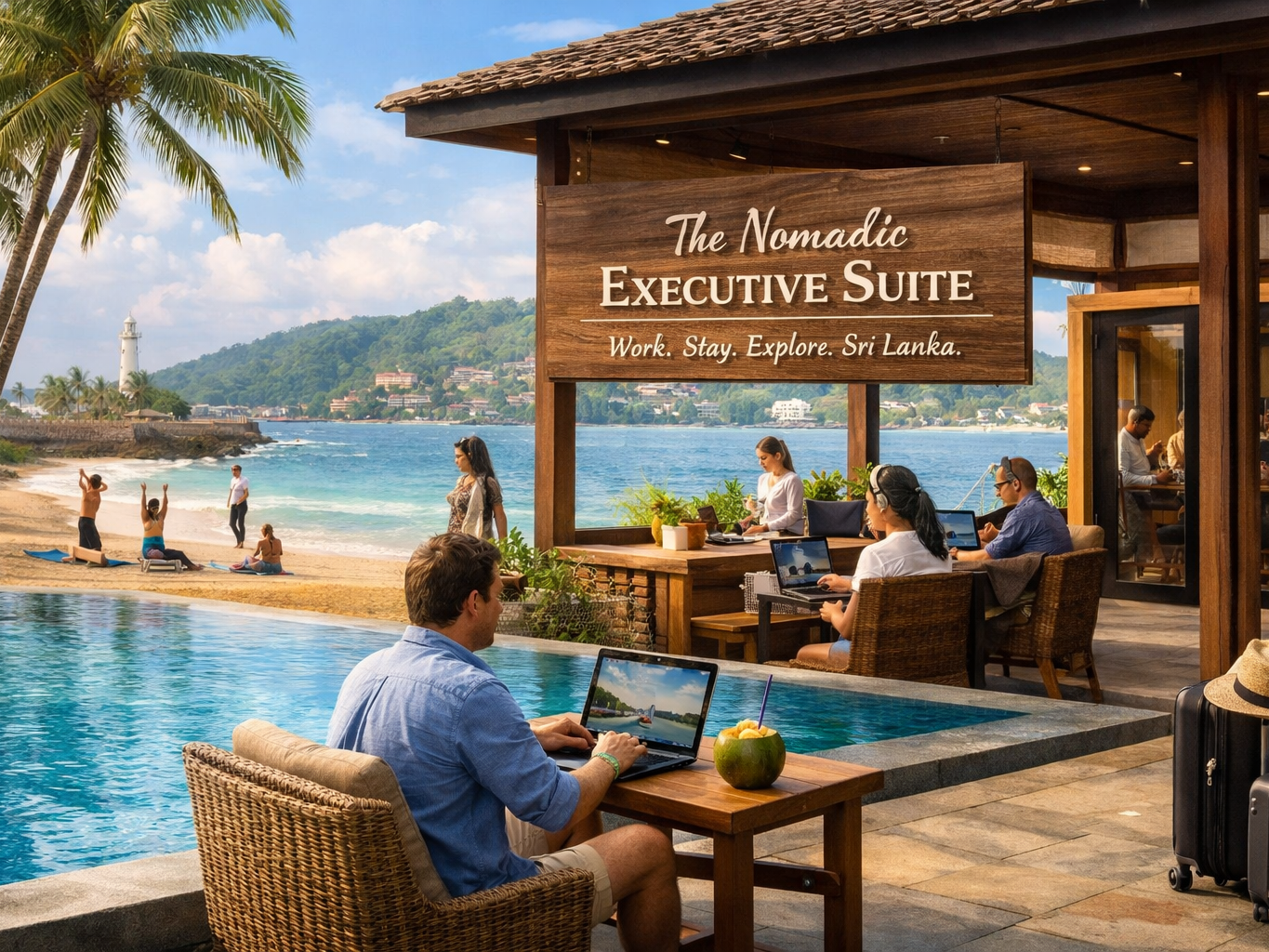
The Nomadic Executive Suite—a nationwide, membership-based workation ecosystem, created through strategic partnerships with global co-working brands, embedded across Sri Lanka’s hotel, villa, and heritage property portfolio.
Understanding the Digital Nomad Economy: Numbers That Matter
To appreciate the opportunity, we must move beyond slogans and look at hard data.
- Average length of stay (digital nomad): 21–90 days
- Average monthly spend: USD 2,500–4,000
- Accommodation preference: Private, quiet, premium, work-enabled
- Primary decision factors:
- Internet reliability
- Workspaces
- Safety & healthcare
- Lifestyle balance
- Visa clarity
Countries that moved early—Portugal, Estonia, UAE, Indonesia—have already captured billions in long-stay tourism revenue, without pressure on mass tourism infrastructure.
By comparison:
- Sri Lanka’s average tourist stay remains 8–10 nights
- Average daily spend: USD 170–180
- Occupancy volatility remains high outside peak seasons
The Nomadic Executive Suite model directly addresses these structural weaknesses.
What Is the “Nomadic Executive Suite”?
The Nomadic Executive Suite is not a hotel category and not a visa product alone.
It is a branded national network offering:
- Seamless co-working + living + lifestyle integration
- Standardized premium workspaces embedded inside hotels, resorts, villas, and adaptive-reuse heritage properties
- Mobility without friction—members move from Colombo to Galle, Kandy, Ella, Jaffna, Trincomalee, or the East Coast using a single membership
- Consistent service quality aligned with global co-working standards
At its core, this is a partnership model, not a capital-heavy construction exercise.
Why Partner with Global Co-Working Brands?
Sri Lanka does not need to reinvent credibility—it needs to borrow it strategically.
Global co-working brands bring:
- Established design standards
- Proven community management
- Recognized membership ecosystems
- Corporate trust
Sri Lankan hospitality partners contribute:
- Prime locations
- Underutilized spaces
- Service excellence
- Cultural depth
This creates a win-win structure:
- Hotels improve weekday and off-season occupancy
- Co-working brands expand footprint without real estate risk
- The country builds a globally recognizable workation brand
The Business Model: How It Works in Practice
1. Property Integration
Selected hotels and villas allocate:
- 5–15 rooms as “Nomadic Executive Suites”
- One professionally designed co-working lounge
- Soundproof meeting pods
- High-speed redundant internet
2. Membership Structure
- Monthly / quarterly / annual memberships
- Tiered pricing (solo professionals, teams, founders)
- Cross-property access nationwide
3. Revenue Streams
- Room revenue (long-stay premium)
- Membership fees
- F&B spend
- Wellness, experiences, excursions
- Corporate retreat packages
4. Governance & Quality Control
- Central brand standards authority
- Service audits
- Data privacy compliance
- Ethical employment practices
Case Studies: Proof That the Model Works (6–7 Examples)
Case Study 1: Portugal – Lisbon & Madeira
Portugal’s workation strategy increased long-stay tourism revenue by over 40% between 2021–2023, stabilizing hotel occupancy year-round.
Case Study 2: Bali – Ubud & Canggu
Hybrid co-living/co-working resorts report average stays of 45–60 days, with spend levels exceeding leisure tourists by 30–35%.
Case Study 3: Dubai – One Central
Corporate-grade co-working integrated into hospitality assets attracted regional headquarters teams, not just freelancers.
Case Study 4: Estonia – Tallinn
Digital nomad policies combined with work-enabled accommodation positioned Estonia as a serious business destination, not a backpacker hub.
Case Study 5: Maldives (Selective Resorts)
High-end resorts quietly introduced “work-from-paradise” suites, generating incremental revenue without rebranding.
Case Study 6: Thailand – Phuket Sandbox
Extended-stay professionals cushioned tourism revenue during recovery phases through longer average stays.
Case Study 7: Rwanda – Kigali Innovation City
Integrated work-live hubs attracted international consultants and NGOs, supporting hotel demand beyond conferences.
Why Sri Lanka Is Exceptionally Suited
Sri Lanka’s compact geography allows a nomad to experience:
- Urban business (Colombo)
- Colonial heritage (Galle)
- Hill country productivity (Kandy, Nuwara Eliya)
- Beachside creativity (East Coast)
—all within weeks.
Additionally:
- English is widely spoken
- Time zone bridges Asia, Europe, and the Middle East
- Hospitality talent has global exposure
What is missing is coordination, branding, and product clarity.
Legal, Ethical, and Social Safeguards
The Nomadic Executive Suite must:
- Respect local employment laws
- Avoid displacement of local communities
- Ensure data protection
- Maintain non-discriminatory access
- Support SME suppliers
This is not gentrification tourism, but value-added, low-impact, high-yield tourism.
Economic Impact: Beyond Hotels
If Sri Lanka attracts just 20,000 long-stay professionals annually, staying an average of 45 days, spending USD 3,000 per month:
➡️ Direct annual inflow: USD 270–300 million
➡️ Indirect benefits: transport, wellness, food, education, local services
➡️ Stable FX inflows without peak-season stress
Conclusion: From Volume Tourism to Value Tourism
Sri Lanka does not need more tourists—it needs better-aligned visitors.
The Nomadic Executive Suite represents a strategic reset:
- From nights to months
- From brochures to ecosystems
- From seasonal dependency to continuity
If executed correctly, Sri Lanka can position itself not just as a destination—but as a place where the world’s decision-makers live, work, and think.
Disclaimer
This article has been authored and published in good faith by Dr. Dharshana Weerakoon, DBA (USA), based on publicly available national and international tourism, economic, and industry data, combined with decades of professional experience across Asia, the Middle East, Africa, and island resort markets. It is intended solely for educational, journalistic, and public-interest discussion to encourage dialogue on sustainable and value-driven tourism development.
The views expressed are personal and analytical, and do not constitute legal, financial, or investment advice. While every effort has been made to ensure accuracy, the author accepts no responsibility for misinterpretation or third-party use of the content. The proposed concepts are designed to align with Sri Lankan law, ethical tourism principles, data privacy standards, and international best practices.
Further Reading: https://www.linkedin.com/newsletters/7046073343568977920/
Further Reading: https://dharshanaweerakoon.com/sense-swap-dining/