Owning Paradise: Can Sri Lanka Unlock a New Era of Tourism Through the “Shared Luxury Villa” Model?
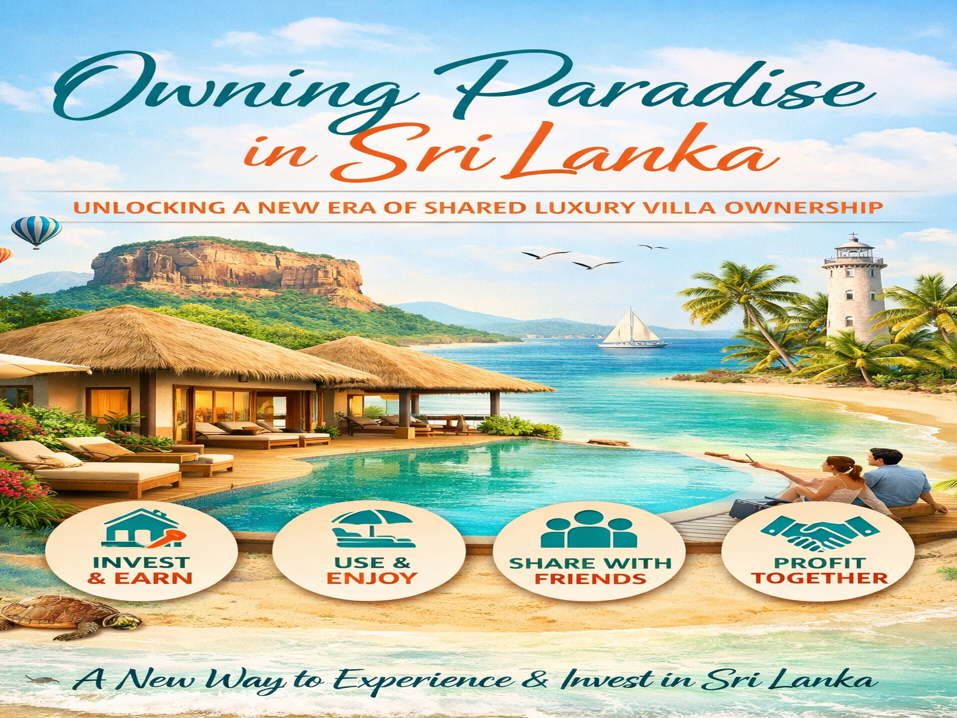
Introduction: A Timely Opportunity for Reinvention
Sri Lanka’s tourism sector stands at a defining crossroads. After years of economic volatility, global travel disruption, and shifting investor sentiment, the country now faces a fundamental question: How do we move beyond traditional hotel ownership and unlock sustainable, high-value tourism growth?
One answer may lie in an innovative ownership structure already proven in ultra-luxury markets—exemplified by Soneva Kiri in Thailand.
This model—often referred to as shared luxury villa ownership with managed rental returns—reimagines hospitality investment. It blends real estate, tourism, and lifestyle into a single, high-performing asset class.
More importantly, it is not just a concept—it is a scalable solution for Sri Lanka.
Understanding the Model: Beyond Traditional Ownership
At its core, the model works as follows:
- Investors purchase a villa or room unit within a resort
- They retain usage rights for a fixed number of days annually
- When not in use, the property is:
- Operated by a professional hotel brand
- Marketed at premium global rates
- Revenue generated is shared between operator and owner
- Owners pay fixed maintenance and operational costs
This is not timeshare. It is not conventional real estate. It is a hybrid hospitality investment ecosystem.
Why This Model Works Globally
The global luxury travel market has undergone a structural shift:
- Luxury travel market size (2025): ~USD 1.4 trillion
- Projected growth (2030): USD 2.2 trillion
- High-net-worth individuals (HNWIs): Over 22 million globally
- Private villa demand growth: +18% YoY post-pandemic
Travelers increasingly seek:
- Privacy over crowds
- Experiences over brands
- Flexibility over rigid ownership
Simultaneously, investors prefer:
- Yield-generating assets
- Diversified portfolios
- Lifestyle-linked investments
This model satisfies both sides.
Sri Lanka’s Strategic Advantage
Sri Lanka is uniquely positioned to adopt this model successfully.
1. High Natural Asset Value
From coastal belts like Mirissa and Tangalle to inland destinations like Ella and Sigiriya, the country offers world-class settings at comparatively low development cost.
2. Competitive Land Pricing
Compared to Maldives, Thailand, or Bali:
- Land costs remain 30–70% lower
- Entry barriers for investors are significantly reduced
3. Tourism Growth Potential
- Tourist arrivals (pre-crisis peak): ~2.3 million
- Target (medium-term): 5 million annually
- Average stay: 10–14 days
- High potential for long-stay luxury segments
4. Diaspora Investment Appetite
Sri Lanka’s global diaspora represents a powerful but underutilized investment base—particularly for lifestyle assets tied to heritage and identity.
Applying the Model in Sri Lanka: A Practical Framework
To successfully replicate this model, Sri Lanka must adopt a structured approach.
1. Legal Structuring
The model must operate within:
- Condominium property laws
- Foreign ownership regulations
- Leasehold structures (where necessary)
- Tax frameworks for rental income
A Special Purpose Vehicle (SPV) can be created for each resort, ensuring:
- Transparent ownership
- Clear profit-sharing agreements
- Legal protection for all parties
2. Developer–Operator Alignment
One of the biggest risks globally is misalignment between:
- Property developers (focused on sales)
- Hotel operators (focused on guest experience)
Sri Lanka must ensure:
- Long-term operator contracts
- Performance-based management agreements
- Brand accountability
3. Revenue Model Design
A typical structure could include:
- Owner usage: 30–60 days annually
- Rental pool: Remaining days
- Revenue split:
- 50–65% to owner
- 35–50% to operator
Average projected figures (Sri Lankan context):
- Villa value: USD 300,000 – 1.2 million
- Nightly rate: USD 400 – 1,500
- Occupancy: 55–70%
- Net yield: 6–10% annually
4. Target Investor Segments
- Sri Lankan diaspora (UK, Australia, Canada)
- Regional investors (India, Middle East)
- European lifestyle investors
- Digital nomads and long-stay professionals
5. Location Strategy
Not every destination fits this model.
High-potential zones:
- South Coast (Tangalle, Weligama, Ahangama)
- East Coast (Passikudah, Nilaveli)
- Cultural Triangle (Sigiriya, Dambulla)
- Hill Country (Ella, Haputale)
Case Studies: Lessons from Global Markets
1. Thailand – Ultra-Luxury Integration
Soneva’s model demonstrates:
- Strong brand trust
- High occupancy
- Premium pricing power
2. Maldives – Leasehold Villa Ownership
Resorts offer:
- 50-year leasehold villas
- Guaranteed returns (6–8%)
- Strong resale value
3. Bali – Boutique Villa Investment
- Smaller-scale developments
- High Airbnb integration
- Strong digital nomad market
4. Dubai – Branded Residences
- Operator-backed developments
- High transparency
- Strong legal frameworks
5. Portugal – Golden Visa Tourism Assets
- Property-linked residency
- Strong European investor inflow
6. Seychelles – Limited Inventory Luxury
- Scarcity drives premium pricing
- Strong environmental positioning
7. Mauritius – Integrated Resort Schemes (IRS)
- Foreign ownership enabled
- Tax incentives
- Strong governance
Key Risks and How to Mitigate Them
1. Over-Supply Risk
Mitigation:
- Controlled approvals
- Demand-driven development
2. Mismanagement Risk
Mitigation:
- International operator partnerships
- Transparent reporting systems
3. Legal Ambiguity
Mitigation:
- Government-backed frameworks
- Clear ownership rights
4. Environmental Impact
Mitigation:
- Sustainable design
- Carrying capacity limits
Economic Impact for Sri Lanka
If implemented strategically, this model could:
- Attract USD 1–2 billion in FDI within 5–7 years
- Generate high-value tourism receipts
- Increase average tourist spending from:
- USD 170 → USD 300+ per day
- Create skilled employment opportunities
- Boost foreign exchange reserves
A Shift in Thinking: From Selling Rooms to Selling Experiences
Sri Lanka must move from:
❌ Volume-driven tourism
✔ Value-driven tourism
❌ Hotel-centric models
✔ Experience-centric ecosystems
❌ Short-term revenue
✔ Long-term asset creation
Implementation Roadmap
Short Term (0–2 Years)
- Policy framework development
- Pilot projects (2–3 locations)
- Investor awareness campaigns
Medium Term (3–5 Years)
- Scale developments
- Introduce branded partnerships
- Strengthen regulatory oversight
Long Term (5–10 Years)
- Position Sri Lanka as a global lifestyle investment hub
- Integrate with wellness, sustainability, and eco-tourism
Conclusion: A Transformational Opportunity
Sri Lanka does not need to reinvent tourism—it needs to restructure it intelligently.
The shared luxury villa ownership model presents:
- A low-risk entry for investors
- A high-value experience for travelers
- A sustainable revenue stream for the country
If executed correctly, this could redefine Sri Lanka’s global tourism positioning—from a beautiful destination to a premium investment-driven hospitality ecosystem.
Disclaimer
This article has been authored and published in good faith by Dr. Dharshana Weerakoon, DBA (USA), based on publicly available data from national and international tourism authorities, central banking insights, global hospitality benchmarks, and extensive professional experience across international markets.
It is intended solely for educational, analytical, and industry discussion purposes to explore sustainable tourism investment models relevant to Sri Lanka.
The views expressed are personal, professional, and interpretative, and do not constitute legal, financial, or investment advice. Any implementation of the concepts discussed should be undertaken in full compliance with Sri Lankan laws, including property regulations, foreign investment guidelines, environmental standards, and applicable intellectual property and data protection frameworks.
The author assumes no responsibility for any decisions made based on this content or for any misinterpretation thereof.
Further Reading: https://www.linkedin.com/newsletters/outside-of-education-7046073343568977920/
Further Reading: https://dharshanaweerakoon.com/polished-smiles-to-decisive-minds/