From Polished Smiles to Decisive Minds: Rethinking Hospitality Training in Sri Lanka’s Hotels
Introduction: The Illusion of Excellence
Walk into any upscale hotel in Sri Lanka, and you are greeted with the same choreography: the warm smile, the slight bow, the rehearsed greeting—“Ayubowan.” It is elegant. It is refined. It is consistent.
But let us pause and ask a harder question.
What happens when something goes wrong?
When a guest collapses in the lobby.
When a child goes missing near the pool.
When a dispute escalates into a security concern.
When a moral dilemma challenges policy vs. humanity.
In these moments, smiles are irrelevant.
Judgment matters. Agency matters. Training matters.
And here lies the uncomfortable truth:
Sri Lankan hotel staff are often over-trained in presentation—and under-trained in decision-making.
This is not a criticism of individuals. It is a critique of a system. A pedagogy that prioritizes hospitality theater over hospitality intelligence.
The Current Paradigm: Hospitality as Performance
The Rise of Scripted Service
Sri Lanka’s hospitality education system—across institutes, academies, and internal hotel training programs—has historically emphasized:
- Grooming standards
- Body language
- Scripted communication
- Service rituals
- Brand consistency
These are essential. No argument there.
However, the imbalance is evident.
According to industry estimates:
- Over 70% of entry-level hospitality training hours are allocated to service presentation and etiquette
- Less than 15% focus on crisis handling, situational judgment, or ethical decision-making
- Only 1 in 5 hotels conduct structured emergency simulations annually
This creates a workforce that is:
✔ Polished
✔ Courteous
✔ Consistent
But often:
✖ Hesitant under pressure
✖ Dependent on hierarchy
✖ Risk-averse in critical moments
The Cost of Over-Training in Smiles
1. Decision Paralysis
Frontline staff frequently defer decisions upward—even in urgent situations—because:
- They fear violating protocol
- They lack authority
- They have never been trained to decide
2. Operational Delays
In crisis scenarios, seconds matter. Yet delays occur due to:
- Waiting for supervisors
- Confusion over responsibility
- Lack of scenario exposure
3. Reputational Risk
In today’s digital era:
- A single mishandled incident can reach millions within hours
- Guest trust is fragile and highly visible
4. Employee Burnout
Ironically, over-scripted environments lead to:
- Emotional fatigue
- Reduced authenticity
- Lower job satisfaction
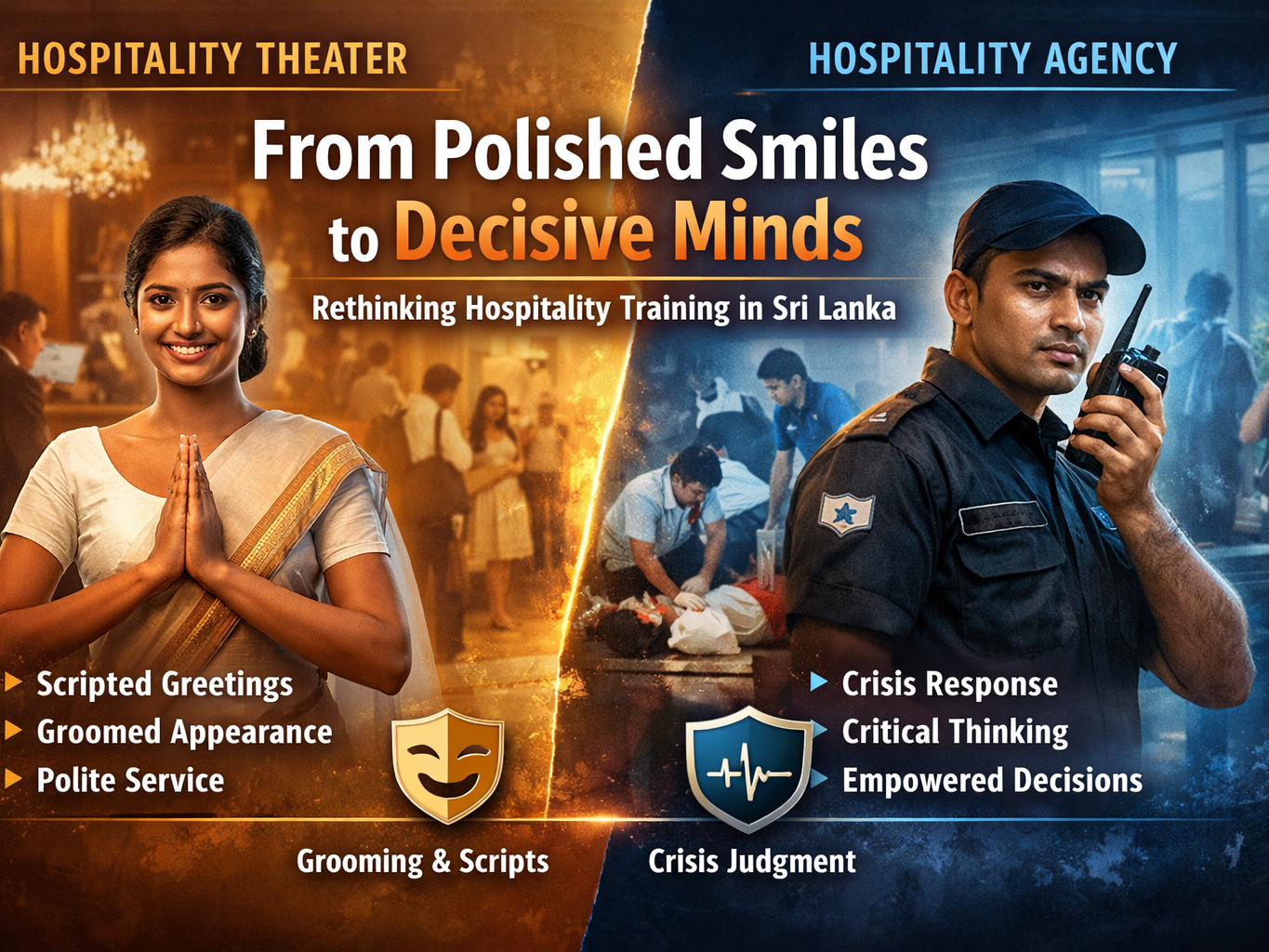
Hospitality Theater vs. Hospitality Agency
Let me introduce two contrasting models:
Hospitality Theater
- Script-driven
- Appearance-focused
- Hierarchy-dependent
- Risk-averse
- Reactive
Hospitality Agency
- Judgment-driven
- Context-aware
- Empowerment-based
- Proactive
- Human-centered
Sri Lanka has mastered the former.
The future demands the latter.
Global Context: Where Sri Lanka Stands
Globally, the hospitality industry is evolving.
Leading hotel groups now invest heavily in:
- Scenario-based simulations
- Crisis leadership training
- Psychological preparedness
- Ethical decision-making frameworks
Data suggests:
- Hotels with structured crisis training programs reduce incident escalation by up to 40%
- Guest satisfaction scores improve by 15–20% when staff demonstrate situational intelligence
- Employee retention increases by 25% in empowerment-driven cultures
Sri Lanka, despite its natural and cultural advantages, risks falling behind if it continues to prioritize form over function.
Case Studies: Lessons from the Ground
Case Study 1: Medical Emergency at a Beach Resort
A guest collapses due to cardiac arrest.
- Staff followed protocol: inform supervisor → call manager → contact ambulance
- Time lost: 7–10 minutes
In contrast, trained teams elsewhere:
- Initiate CPR immediately
- Use AED devices
- Assign roles instantly
Outcome difference: Life vs. loss
Case Study 2: Food Allergy Crisis in a Fine Dining Setting
A guest with a severe allergy is served a contaminated dish.
- Staff response: Apology and replacement
- Missing element: Immediate medical intervention awareness
Empowered staff would:
- Recognize symptoms
- Activate emergency response
- Communicate clearly and calmly
Case Study 3: Security Threat in a City Hotel
A suspicious individual enters restricted premises.
- Staff hesitate to act due to fear of offending a guest
- Delay in escalation
Agency-driven training would enable:
- Risk assessment
- Calm intervention
- Discreet escalation
Case Study 4: Ethical Dilemma – Guest Misconduct
A high-profile guest behaves inappropriately toward staff.
- Staff remain silent due to hierarchy and fear
- No escalation
Empowered cultures:
- Protect employee dignity
- Encourage reporting
- Balance guest service with ethical responsibility
Case Study 5: Natural Disaster Response
During sudden flooding:
- Staff wait for instructions
- Guests left confused
In contrast:
- Scenario-trained teams guide evacuations
- Provide reassurance
- Manage chaos effectively
Case Study 6: Lost Child Incident
A child goes missing in a resort.
- Staff follow fragmented communication
- No coordinated response
Empowered approach:
- Immediate lockdown protocol
- Assigned search roles
- Clear communication channels
Case Study 7: Overbooking Conflict
Guests arrive to find no available rooms.
- Staff rely on scripted apologies
- Escalation leads to confrontation
Judgment-based response:
- Offer alternatives proactively
- Provide compensation
- Maintain emotional intelligence
Why the System Needs Reform
1. Legacy Education Models
Hospitality education in Sri Lanka still reflects:
- Colonial service traditions
- Hierarchical thinking
- Obedience over initiative
2. Risk-Averse Management Cultures
Many hotel operators:
- Discourage independent decision-making
- Penalize mistakes rather than learning from them
3. Lack of Structured Scenario Training
Few institutions incorporate:
- Real-life simulations
- Crisis drills
- Ethical dilemma workshops
The Way Forward: A New Pedagogy of Performance
1. Scenario-Based Training
Shift from theory to practice:
- Simulated emergencies
- Role-playing exercises
- Real-time decision drills
2. Empowerment Frameworks
Give staff:
- Defined decision boundaries
- Authority in critical moments
- Confidence through training
3. Crisis Intelligence Modules
Include:
- Medical response basics
- Security awareness
- Psychological resilience
4. Ethical Decision-Making
Train staff to:
- Balance policy with humanity
- Protect dignity and rights
- Navigate complex situations
5. Technology Integration
Use:
- VR simulations
- AI-driven training scenarios
- Real-time feedback systems
6. Leadership Transformation
Managers must:
- Encourage initiative
- Accept controlled risk
- Reward critical thinking
The Business Case for Change
This is not just about ethics. It is about performance.
Hotels that invest in hospitality agency will see:
- Higher guest trust
- Faster crisis resolution
- Stronger brand reputation
- Improved employee retention
- Competitive differentiation
In a post-pandemic world, travelers value safety and competence as much as luxury.
Sri Lanka’s Opportunity
Sri Lanka stands at a pivotal moment.
With tourism rebounding:
- Arrivals are increasing steadily
- Revenue targets are ambitious
- Global competition is intensifying
This is the time to redefine our hospitality identity.
Not just as warm and welcoming
But as capable and confident
Conclusion: Beyond the Smile
A smile welcomes a guest.
But judgment protects them.
The future of Sri Lankan hospitality lies not in perfecting performance—but in empowering people.
It is time to move:
➡ From scripts to scenarios
➡ From compliance to confidence
➡ From theater to agency
Because in the moments that truly matter,
it is not the smile that defines service—
it is the decision.
Disclaimer
This article has been authored and published in good faith by Dr. Dharshana Weerakoon, DBA (USA), based on publicly available industry patterns, general hospitality trends, professional observations, and extensive experience across global tourism and service sectors. It is intended solely for educational, analytical, and thought leadership purposes to stimulate discussion on workforce development and training methodologies within the hospitality industry.
The author does not disclose or rely on any confidential, proprietary, or institution-specific data. All case scenarios are illustrative and generalized to avoid identification of any individual, organization, or incident.
The views expressed are entirely personal and do not constitute legal, operational, or investment advice. This content is designed to align with applicable laws, ethical standards, and professional practices in Sri Lanka and internationally. The author assumes no responsibility for any interpretation, implementation, or consequences arising from the use of this material.
✍ Authored independently through professional expertise, industry engagement, and lived experience.
Further Reading: https://www.linkedin.com/newsletters/outside-of-education-7046073343568977920/
Further Reading: https://dharshanaweerakoon.com/when-paradise-meets-panic/