Silver Horizons: Positioning Sri Lanka as Asia’s Next Hub for Elderly Care Tourism
Introduction: A Demographic Shift the World Cannot Ignore
There is a structural transformation underway—quiet, but irreversible. The global population is ageing at a pace never seen before. This is not a temporary cycle; it is a long-term demographic reality reshaping economies, healthcare systems, and importantly, tourism demand patterns.
By 2050, the number of people aged 65 and above is expected to exceed 1.6 billion globally, nearly doubling from around 771 million in 2022. More critically, this segment is no longer passive. Today’s elderly population is healthier, financially more independent, and increasingly seeking purposeful, experience-driven living environments—even in their later years.
This is where elderly care tourism becomes more than a niche. It becomes a strategic industry.
Sri Lanka, if positioned correctly, can lead this space—not by imitation, but through integration of care, culture, climate, and consciousness.
Global Elderly Population: Key Countries & Statistics
To understand the scale of opportunity, let us examine the proportion of elderly (65+) across major economies. These figures are based on the most recent available global demographic datasets (2023–2024 estimates):
| Country | % of Population (65+) | Estimated Elderly Population |
| Japan | 29.1% | ~36.2 million |
| Italy | 24.1% | ~14.2 million |
| Germany | 22.1% | ~18.4 million |
| Finland | 22.0% | ~1.2 million |
| Greece | 22.5% | ~2.4 million |
| Portugal | 23.4% | ~2.4 million |
| France | 21.0% | ~14.4 million |
| United Kingdom | 19.2% | ~13.0 million |
| Canada | 19.0% | ~7.5 million |
| United States | 17.3% | ~57.8 million |
| China | 14.9% | ~210 million |
| South Korea | 18.4% | ~9.5 million |
| Australia | 17.0% | ~4.5 million |
| Singapore | 17.6% | ~1.0 million |
| Sri Lanka | 12.5% | ~2.8 million |
Key Insight
While countries like Japan and Italy are already “super-aged societies,” emerging economies—including Sri Lanka—are ageing faster than they are getting rich. This creates both a domestic challenge and a global opportunity.
The Rise of Elderly Care Tourism
Traditionally, tourism focused on leisure, luxury, or adventure. However, a new hybrid segment is emerging:
Elderly Care Tourism = Long-Stay Wellness + Assisted Living + Cultural Integration
This model is gaining traction because:
- Healthcare costs in developed countries are rising sharply
- Loneliness and isolation among elderly populations are increasing
- There is a growing preference for experience-based ageing, not institutional care
- Families are geographically dispersed, especially in Western economies
Countries like Thailand, Spain, and Portugal have already begun tapping into this segment. However, Sri Lanka offers something uniquely differentiated.
Why Sri Lanka? A Strategic Advantage Framework
1. Climate Stability & Healing Geography
Sri Lanka’s tropical climate offers:
- Consistent temperatures (26°C–30°C)
- Coastal, hill country, and forest microclimates
- Low seasonal volatility compared to Europe
For elderly individuals, this reduces:
- Joint pain aggravation
- Seasonal depression
- Respiratory complications
2. Cost Effectiveness Without Compromising Quality
Compared to Western countries:
- Elderly care costs in Sri Lanka can be 60%–75% lower
- Skilled nursing and caregiving resources are relatively affordable
- Long-stay accommodation (villas, boutique hotels) remains competitively priced
This creates a powerful value proposition:
Affordable dignity—not discounted care
3. Cultural Compatibility & Hospitality DNA
Sri Lanka’s social fabric inherently respects elders:
- Multi-generational living traditions
- Deep-rooted caregiving culture
- High emotional intelligence in service delivery
This is not something that can be artificially manufactured.
4. Accessibility & Connectivity
- Direct and one-stop connectivity to Europe, Middle East, and Asia
- Compact geography—travel time between destinations is minimal
The Missing Link: Integrating Spiritual & Wellbeing Tourism
Sri Lanka’s real advantage lies not just in care—but in holistic living.
Elderly care tourism must evolve beyond medical support into:
Spiritual + Emotional + Physical Wellbeing Ecosystems
Core Pillars of Integration
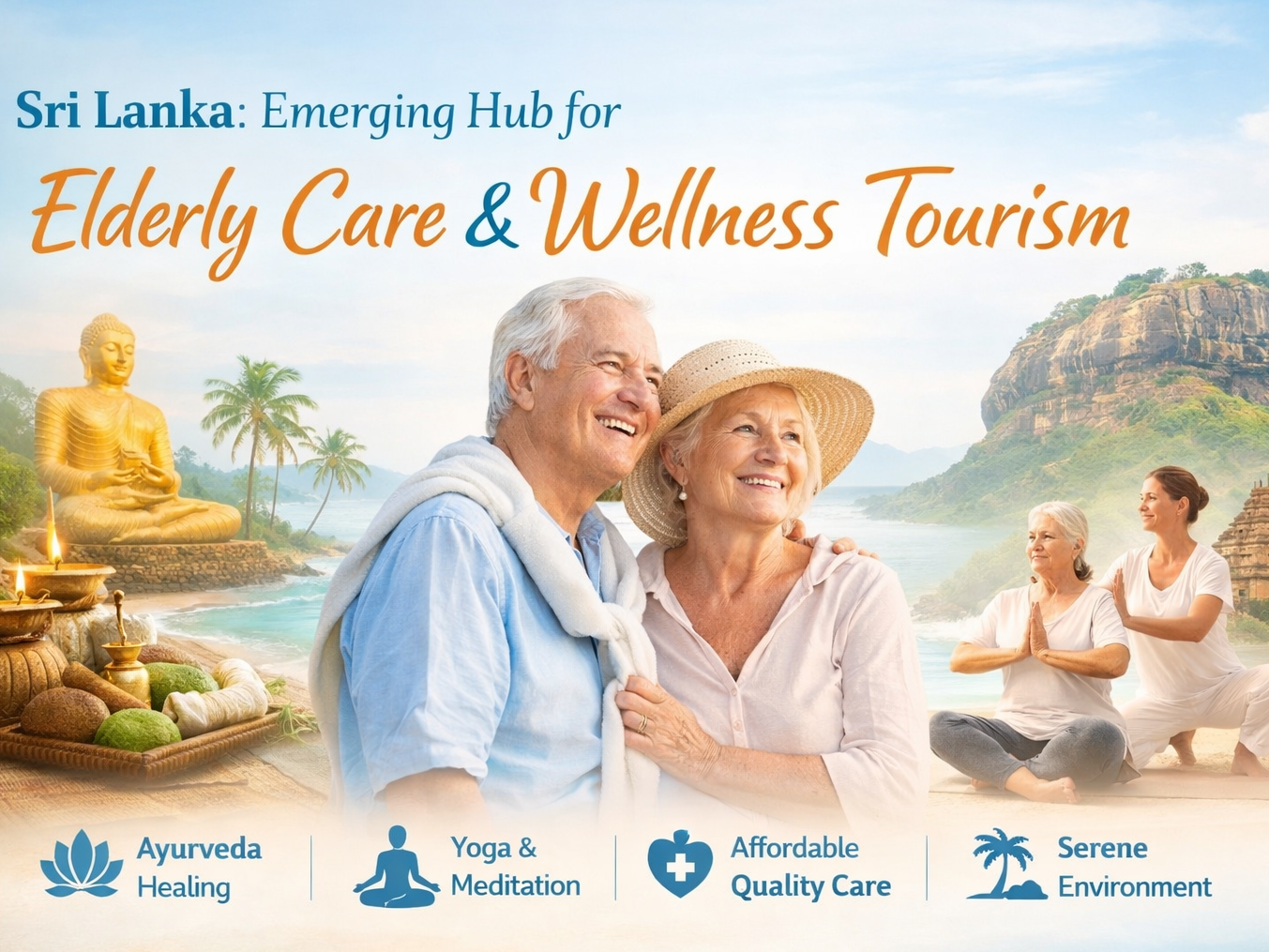
1. Ayurveda-Based Longevity Programs
- Preventive healthcare focus
- Detoxification therapies
- Chronic disease management (arthritis, hypertension)
2. Meditation & Mindfulness Retreats
- Structured programs for stress reduction
- Cognitive health improvement
- Emotional stability and purpose-building
3. Yoga for Active Ageing
- Low-impact flexibility and mobility programs
- Breathing techniques (Pranayama) for lung health
- Balance improvement to prevent falls
4. Nature-Immersion Therapy
- Forest walks
- Ocean therapy (blue space healing)
- Tea plantation experiences
Activities That Define the Experience
To differentiate Sri Lanka globally, elderly care tourism must be experience-rich but physically appropriate.
Suggested Activity Portfolio
- Guided heritage walks (low intensity)
- Cultural immersion sessions (music, art, cooking)
- Intergenerational community programs
- Spiritual site visits (temples, monasteries)
- Nutrition-focused culinary workshops
- Digital detox programs
- Memory stimulation activities (storytelling, journaling)
Case Studies: Global Benchmarks & Lessons for Sri Lanka
1. Thailand – Assisted Living for Japanese Retirees
Thailand has successfully attracted Japanese elderly through:
- Language-specific care centers
- Cultural adaptation
- Long-term residency models
Lesson: Targeted segmentation works.
2. Spain – Retirement Migration Model
Spain attracts Northern European retirees due to:
- Climate
- Healthcare access
- Lifestyle appeal
Lesson: Lifestyle is as important as care.
3. Portugal – Golden Visa & Retirement Ecosystem
Portugal combines:
- Residency incentives
- Affordable living
- Safety and infrastructure
Lesson: Policy alignment is critical.
4. Malaysia – “Malaysia My Second Home” Program
Long-term visa programs tailored for retirees.
Lesson: Immigration policy drives demand.
5. India – Ayurveda & Medical Tourism Integration
Kerala’s wellness tourism model integrates:
- Ayurveda
- Spiritual retreats
- Medical services
Lesson: Traditional healing systems are global assets.
6. Japan – High-Tech Elderly Care
Robotics and AI in elderly care facilities.
Lesson: Technology enhances scalability—but human touch remains essential.
7. Costa Rica – Eco-Retirement Model
Focus on:
- Nature-based living
- Sustainability
- Community integration
Lesson: Environment matters more than infrastructure.
A New Model for Sri Lanka: “Assisted Living Resorts”
Sri Lanka should not replicate nursing homes. Instead, it should pioneer:
Luxury Assisted Living Resorts
Key Features
- Private villas or suite-style living
- On-site medical and nursing support
- Integrated wellness centers
- Cultural programming
- Long-stay packages (3–12 months)
Economic Impact Potential
If Sri Lanka captures even:
- 0.1% of global elderly travelers annually, it could translate into:
- ~1.5 million high-value long-stay visitors over time
Given an average spend of USD 2,500–4,000 per month:
- Annual revenue potential exceeds USD 3–5 billion
This is significantly higher than traditional short-stay tourism yield.
Risks & Ethical Considerations
This model must be built responsibly:
- No exploitation of vulnerable individuals
- Strict healthcare standards and licensing
- Data privacy and dignity protection
- Cultural sensitivity
Sri Lanka must position itself as:
A country of care—not a low-cost outsourcing destination for ageing populations
Strategic Recommendations
- Policy Framework Development
- Long-stay visa categories for elderly tourists
- Regulatory standards for assisted living facilities
- Public-Private Partnerships
- Collaboration between tourism, healthcare, and real estate sectors
- Brand Positioning
- “Sri Lanka: Where Ageing Meets Living”
- Skill Development
- Training caregivers in international standards
- Target Markets
- Japan, Germany, UK, Australia, Canada
Conclusion: A Quiet Opportunity with Loud Impact
Elderly care tourism is not about ageing—it is about how we choose to live as we age.
Sri Lanka has all the ingredients:
- Climate
- Culture
- Cost advantage
- Spiritual depth
What it needs now is structured vision and execution.
This is not just another tourism segment.
It is a chance to build a globally respected, high-impact, human-centered industry.
Disclaimer
This article has been authored and published in good faith by Dr. Dharshana Weerakoon, DBA (USA), based on publicly available global demographic data, international tourism trends, and professional experience across multiple regions. It is intended solely for educational, analytical, and public discourse purposes, particularly to explore the emerging concept of elderly care tourism within a Sri Lankan context.
The views expressed are entirely personal and do not constitute legal, financial, medical, or investment advice. All proposed frameworks are conceptual and designed to align with Sri Lankan laws, ethical standards, and international best practices relating to human dignity, non-discrimination, and responsible tourism development.
The author assumes no responsibility for any interpretation, implementation, or outcomes arising from the use of this content. This work is independently authored based on lived professional insight and industry analysis.
Further Reading: https://www.linkedin.com/newsletters/outside-of-education-7046073343568977920/
Further Reading: https://dharshanaweerakoon.com/elderly-care-tourism/