Tea‑Tech Fusion: Brewing Sri Lanka’s Next Tourism Breakthrough for the Global Remote Economy
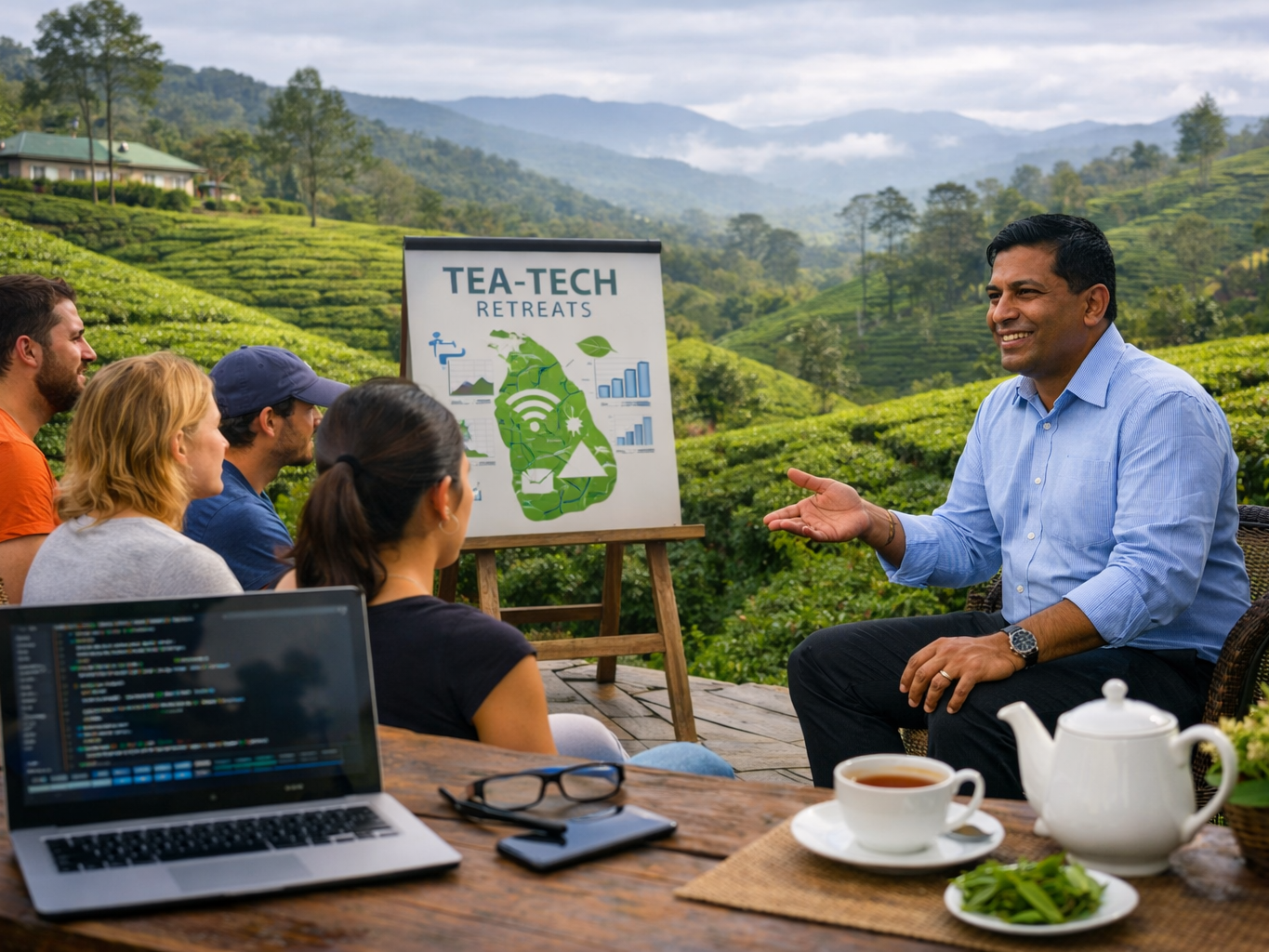
Developing Sri Lanka’s First API‑Driven Tourism Experiences for Remote Tech Teams
Combining technology, tea tourism, and corporate retreats into a globally differentiated offering
Introduction: Why Sri Lanka Must Rethink Tourism—Now
Sri Lanka’s tourism industry has always been rich in assets: landscapes, culture, biodiversity, heritage, and arguably the world’s most storied tea. Yet for decades, the industry has been constrained by an old question framed the wrong way: How do we bring more tourists?
The right question in 2026 and beyond is very different: What kind of tourists should Sri Lanka design for—and what problems can we uniquely solve for them?
A structural shift is underway in the global economy. Remote work is no longer a fringe privilege; it is a permanent operating model for technology firms, product teams, founders, and distributed enterprises. According to global labour market estimates, over 35–40% of knowledge workers now operate remotely at least part‑time, while more than 80 million professionals worldwide identify as location‑independent or semi‑mobile.
At the same time, burnout has become a defining corporate risk. The World Health Organization officially recognizes burnout as an occupational phenomenon, and enterprise surveys consistently show productivity losses exceeding USD 300 billion annually due to stress, disengagement, and mental fatigue.
Sri Lanka sits at a rare intersection of opportunity:
- A globally recognized tea economy built on geography, craftsmanship, and ritual
- Competitive costs compared to Western retreat destinations
- A time zone that overlaps Asia, Europe, and parts of Africa
- A hospitality culture rooted in warmth rather than transaction
This article proposes a Tea‑Tech Fusion Model—Sri Lanka’s first API‑driven tourism experience architecture designed specifically for remote technology teams, global startups, and innovation‑driven organizations.
This is not another retreat concept. It is a platform‑based tourism strategy.
Understanding the Tea‑Tech Fusion Concept
At its core, Tea‑Tech Fusion is the integration of three traditionally separate domains:
- Tea as a Cultural, Sensory, and Intellectual Asset
- Technology as an Experience Layer, Not Just Infrastructure
- Corporate Retreats Reimagined as Performance Recovery Systems
Unlike leisure tourism, this model does not sell rooms or itineraries. It sells outcomes:
- Cognitive clarity
- Team alignment
- Creative recovery
- Strategic thinking space
And it delivers these outcomes through API‑connected experiences—modular, programmable, data‑aware tourism components that enterprises can configure, measure, and repeat.
What Does “API‑Driven Tourism” Actually Mean?
In technology, an API (Application Programming Interface) allows systems to communicate seamlessly. Applied to tourism, APIs allow experiences to become:
- Modular
- Scalable
- Integrable with corporate systems
- Measurable
In a Tea‑Tech tourism ecosystem, APIs could connect:
- Booking engines
- Wellness schedules
- Team productivity metrics
- Learning modules
- Tea estate experiences
- Sustainability dashboards
For example, a global SaaS company could:
- Schedule a 10‑day Sri Lanka retreat
- Integrate it into HR wellness platforms
- Track anonymized engagement data
- Measure post‑retreat performance indicators
Sri Lanka moves from being a destination to becoming a service layer in the global remote‑work economy.
Why Tea Is the Perfect Anchor Asset
Tea is not merely a commodity. It is Sri Lanka’s most globally trusted cultural export.
Key facts:
- Sri Lanka exports tea to over 140 countries
- Tea contributes approximately USD 1.3–1.5 billion annually to export revenue
- Ceylon Tea carries one of the strongest geographical indications in global agri‑trade
Yet tourism has largely under‑utilized tea beyond factory visits and souvenir sales.
Tea‑Tech Fusion repositions tea as:
- A cognitive ritual (focus, calm, conversation)
- A leadership tool (ceremony, pacing, reflection)
- A sustainability narrative (soil, climate, labour dignity)
In tech culture, coffee dominates productivity spaces. Tea offers something different: slowness with clarity.
The Global Demand: Remote Teams Are Actively Searching for This
Enterprise and startup behavior reveals clear demand signals:
- Corporate retreat spending globally exceeds USD 45 billion annually
- Tech firms allocate 3–7% of payroll to wellness, learning, and off‑sites
- Asia‑based retreats cost 40–60% less than European equivalents
Yet most retreats suffer from the same problems:
- Over‑programming
- Generic wellness activities
- No measurable outcomes
- Zero cultural depth
Sri Lanka can outperform competitors by offering designed silence, nature‑embedded workspaces, and tea‑centric reflection rituals—all measurable, all configurable.
Case Studies: Where Tea‑Tech Logic Already Exists (But Not Yet Unified)
Case Study 1: Japanese Zen Retreats for Executives
Japanese firms have long integrated Zen practices into leadership retreats. The value lies not in luxury, but in mental reset and discipline. Tea‑Tech adopts this philosophy—without copying it.
Case Study 2: Estonia’s E‑Residency Ecosystem
Estonia turned digital infrastructure into a national export. Sri Lanka can do the same with experience infrastructure.
Case Study 3: Costa Rica’s Corporate Wellness Lodges
Costa Rica repositioned eco‑tourism toward corporate wellbeing, increasing per‑guest yield by over 70% within a decade.
Case Study 4: Bali’s Remote‑Work Villages
Bali successfully attracted digital nomads but struggled with congestion and cultural dilution. Sri Lanka can learn by designing controlled‑scale, high‑value retreats.
Case Study 5: Scandinavian Silent Retreat Models
Nordic countries monetize silence and nature for executive recovery programs, charging premium rates with minimal infrastructure.
Case Study 6: Indian Tea Estate Heritage Hotels
India’s tea bungalows demonstrate that tea tourism can command luxury pricing when storytelling is authentic.
Case Study 7: Silicon Valley Off‑Site Engineering Sprints
Tech companies already invest heavily in off‑sites for product alignment—yet rarely link them to cultural immersion or sustainability.
Economic Impact for Sri Lanka
A conservative model suggests:
- 200 retreats annually
- Average team size: 25 people
- Average spend per guest: USD 3,500
Annual revenue potential: USD 17.5 million from a single niche segment—without mass tourism pressures.
Indirect benefits include:
- Tea estate diversification
- Rural employment
- Knowledge transfer
- Brand repositioning of Sri Lanka as a thinking destination
Legal, Ethical, and Cultural Safeguards
Any Tea‑Tech Fusion model must:
- Respect artisan and plantation worker dignity
- Avoid cultural commodification
- Comply with Sri Lankan IP, labour, and data laws
- Ensure consent‑based data use
Technology must serve people—not extract from them.
Strategic Recommendation
Sri Lanka should pilot Tea‑Tech Fusion through:
- Public‑private partnerships
- Selected tea regions (Uva, Dimbula, Nuwara Eliya)
- Limited‑scale, high‑value pilots
This is not tourism policy. It is economic design.
Conclusion: From Island Destination to Cognitive Infrastructure
Sri Lanka does not need to compete on beaches or beds.
It can compete on clarity, calm, and consciousness.
Tea‑Tech Fusion positions the country as a place where the world’s builders come to think better.
That is a future worth designing.
Disclaimer
This article has been authored and published in good faith by Dr. Dharshana Weerakoon, DBA (USA), based on publicly available national and international data, decades of professional experience across multiple continents, and ongoing industry insight. It is intended solely for educational, journalistic, and public awareness purposes to stimulate discussion on sustainable tourism models. The author accepts no responsibility for any misinterpretation, adaptation, or misuse of the content. Views expressed are entirely personal and analytical and do not constitute legal, financial, or investment advice. This article and the proposed model are designed to comply fully with Sri Lankan law, including applicable intellectual property, human rights, data protection, and ethical standards. Authored independently and organically through lived professional expertise.
Further Reading: https://www.linkedin.com/newsletters/7046073343568977920/
Further Reading: https://dharshanaweerakoon.com/the-anti-algorithm-retreat/