Wellness Visa Pilots: Could Sri Lanka Lead South Asia in Offering a 12-Month “Digital Wellness Nomad” Permit?
Introduction: A New Wave of Wellness Migration
In a post-pandemic world defined by flexible work, mental health awareness, and lifestyle redesign, tourism is no longer about short holidays—it is about transformational living. Digital nomadism and wellness tourism, once distinct markets, are rapidly merging into a powerful new niche: the Digital Wellness Nomad. As nations across Europe, Asia, and the Pacific experiment with hybrid visa models to attract this segment, Sri Lanka now stands at a strategic crossroads.
With its Ayurveda legacy, yoga retreats, tea estate sanctuaries, coastal calm, and mountain serenity, Sri Lanka is uniquely positioned to pioneer South Asia’s first “Wellness Visa”—a 12-month digital residency permit designed for global professionals seeking healing, purpose, and productivity in paradise.
But could Sri Lanka become South Asia’s next global hub for long-term wellness migration? This article explores the opportunity, policy roadmap, case studies, and socio-economic implications of launching a “Digital Wellness Nomad Visa” pilot under a sustainable and inclusive tourism framework.
1. Global Context: From Digital Nomads to Digital Well-Being
The world counts more than 35 million digital nomads in 2024, contributing over USD 1 trillion annually to global economies through long-stay tourism, co-living, and lifestyle spending. Remote work has evolved beyond laptops in cafés—today, wellness has become the new productivity metric.
Countries like Portugal, Estonia, Croatia, Thailand, and Indonesia (Bali) have leveraged digital visas to attract skilled professionals seeking stability and well-being. In parallel, wellness tourism—valued at over USD 1.3 trillion globally—is growing twice as fast as traditional tourism.
The intersection of these two forces has created a new sub-market: Digital Wellness Nomadism—professionals who integrate work, rest, and holistic living while contributing to host economies sustainably.
2. Why Sri Lanka Is Perfectly Placed for a Wellness Nomad Visa
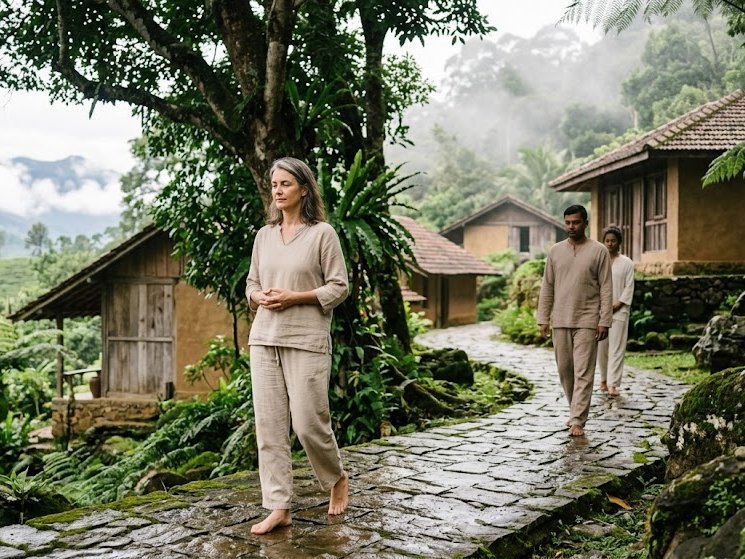
Sri Lanka’s natural diversity, cultural depth, and affordable lifestyle make it ideal for a long-stay wellness migration policy. The island offers everything that the new wellness traveler desires—Ayurveda retreats in Kandy, coastal yoga sanctuaries in Mirissa, meditation caves in Ella, organic tea trails in Haputale, and eco-lodges in Sigiriya.
Key Competitive Advantages:
- Cost Advantage: Sri Lanka’s cost of living is 45–55% lower than Thailand or Bali for comparable amenities.
- Wellness Legacy: More than 5,000 registered Ayurveda practitioners and 200 certified wellness resorts nationwide.
- Digital Infrastructure: Fiber internet penetration has expanded by 38% since 2020, supporting remote work.
- Visa Readiness: The country already manages long-term resident permits for investors and retirees, which can be adapted for wellness professionals.
When structured properly, a “Wellness Nomad Visa” could generate USD 400–600 million annually through accommodation, wellness services, health tourism, and local entrepreneurship—without the environmental burden of mass tourism.
3. Policy Framework: Designing a 12-Month Wellness Residency Permit
A 12-month renewable “Digital Wellness Nomad Visa” could merge the best of both worlds—Sri Lanka’s wellness heritage and the digital economy.
Proposed Features:
- Duration: 12 months, renewable upon meeting income and health criteria.
- Eligibility: Remote professionals or entrepreneurs earning at least USD 2,000/month.
- Wellness Commitment: Proof of enrolment in a recognized local wellness program (Ayurveda, meditation, yoga, or ecological volunteering).
- Sustainability Pledge: Mandatory contribution to a local community or conservation project.
- Insurance & Health Compliance: Valid international insurance and health screening.
- Tax Incentives: Simplified taxation with nominal flat fees for freelancers and wellness professionals.
This model blends economic productivity, wellness immersion, and environmental ethics, setting Sri Lanka apart as a global case study in regenerative tourism.
4. Learning from Global Case Studies
Case Study 1: Bali, Indonesia – “Second Home Visa”
Indonesia’s Second Home Visa offers 5–10-year stays for high-net-worth individuals and professionals. Bali’s wellness sector now accounts for USD 800 million annually. The “Canggu Nomad Belt” has become a wellness-digital hub, inspiring similar frameworks across Asia.
Case Study 2: Thailand – “Long-Term Resident (LTR) Visa”
Thailand offers a 10-year visa for digital professionals and wellness investors. In 2024 alone, over 35,000 applicants contributed an estimated USD 1.2 billion to the economy. Thailand combines wellness resorts with remote-work villages, enhancing community integration.
Case Study 3: Estonia – “Digital Nomad Visa”
Estonia was the first to legalize remote work visas (2020). It attracted over 20,000 long-stay digital professionals, boosting its tech ecosystem and small-town economies.
Case Study 4: Portugal – “Temporary Stay Visa for Remote Workers”
Portugal’s long-stay visa supports remote workers earning at least EUR 3,000/month. Beyond Lisbon, small towns benefited through wellness co-living retreats, yoga residencies, and community revitalization.
Case Study 5: Costa Rica – “Wellness-Powered Residency”
Costa Rica’s digital nomad policy is tightly aligned with Pura Vida wellness branding. In two years, arrivals under this scheme contributed USD 500 million, mostly in eco-lodges and wellness rentals.
Case Study 6: Japan – “Workcation Visa Pilots”
Japan’s Ministry of Tourism recently piloted workcation visas tied to cultural immersion. Participants in Nagano and Okinawa engage in meditation and green volunteering, boosting local wellness economies.
Case Study 7: Mauritius – “Premium Visa”
Mauritius’ 12-month visa attracted over 4,000 long-stay visitors, generating USD 250 million in 2023 through co-living spaces and wellness programs.
5. The Sri Lankan Opportunity: Economic, Social, and Environmental Impact
Economic Gains
- Long-stay visitors spend 4–6 times more than short-term tourists.
- A modest target of 10,000 wellness nomads per year could inject USD 500 million in annual foreign exchange.
- Expansion of Ayurveda training, eco-lodging, organic farming, and wellness exports could add 20,000 new jobs across rural areas.
Social Benefits
- Encourages global-local cultural exchange and knowledge transfer.
- Creates demand for ethical wellness certifications, uplifting local standards.
- Promotes youth entrepreneurship in eco-tourism, digital skills, and artisan crafts.
Environmental Gains
- Fosters low-impact, long-stay models instead of mass tourism.
- Enables funding for reforestation and biodiversity programs through visa-linked conservation fees.
6. Addressing Implementation Challenges
While promising, the wellness visa model requires multi-ministerial coordination and careful policy design to ensure integrity and inclusiveness.
Challenges & Solutions
- Regulatory Complexity – A streamlined single-window application through the Department of Immigration could simplify processing.
- Wellness Quality Assurance – Introduce an Ayurveda & Wellness Certification Board to accredit participating facilities.
- Community Integration – Require visa holders to engage in local wellness or sustainability projects for at least 10 hours per month.
- Digital Infrastructure – Prioritize Wi-Fi and co-working hubs in wellness zones like Kandy, Ella, Galle, and Kalpitiya.
- Taxation Clarity – Introduce a small flat fee model instead of complex taxation to avoid administrative friction.
7. Sri Lanka’s Strategic Position in South Asia
Among South Asian countries, Sri Lanka holds the highest Global Wellness Tourism Index ranking and has the most comprehensive Ayurveda policy framework. India’s e-tourist visa supports wellness visits but lacks long-term stay privileges. Maldives focuses on luxury short stays, and Nepal emphasizes spiritual retreats.
By integrating wellness and digital residency, Sri Lanka could position itself as South Asia’s first Wellness Nomad Nation, bridging culture, healing, and innovation.
8. A Roadmap for Implementation
Phase 1 (2025–2026): Policy Pilot
Launch a 1-year “Wellness Nomad Pilot Visa” for 1,000 applicants across five zones:
- Central Highlands (Kandy, Ella)
- Southern Coast (Galle, Mirissa)
- Cultural Triangle (Sigiriya, Dambulla)
- Tea Country (Haputale, Nuwara Eliya)
- East Coast (Arugam Bay, Pasikudah)
Phase 2 (2026–2028): National Expansion
Establish Wellness Clusters with digital co-living spaces, green transport, and Ayurvedic clinics. Encourage public-private partnerships for eco-construction and training.
Phase 3 (2028 onwards): Global Branding
Rebrand Sri Lanka globally as “The Island of Rejuvenation” under a single tourism narrative connecting wellness, nature, and creativity.
9. Sri Lanka’s Digital Wellness Ecosystem: Public and Private Collaboration
Collaboration is the cornerstone. The Sri Lanka Tourism Development Authority (SLTDA), Ministry of Tourism, Department of Immigration, BOI, and private wellness operators must co-create a unified visa and marketing platform.
Digital platforms like Airbnb and NomadList now feature “wellness-first” properties, and Sri Lankan entrepreneurs can capitalize on this by listing Ayurveda-certified co-living villas, eco-yoga homestays, and remote healing retreats targeting the digital-wellness diaspora.
10. A Vision for Regenerative Tourism
The “Wellness Nomad Visa” is not just an economic strategy—it is a philosophical shift toward regenerative tourism, where travel restores ecosystems, revives cultures, and rebalances the human spirit.
Sri Lanka’s mission should be to build a tourism model where visitors heal the island while the island heals them—a new form of sustainable coexistence that aligns perfectly with the nation’s post-crisis recovery and global positioning.
Conclusion: A Call for Policy Innovation
A 12-month “Digital Wellness Nomad Visa” could redefine Sri Lanka’s tourism identity—from short-term visitation to long-term transformation. It offers a policy path that bridges economic resilience, wellness diplomacy, and environmental stewardship.
As global citizens search for meaning, balance, and belonging, Sri Lanka can extend an invitation not just to visit—but to stay, heal, and grow together.
Disclaimer
This article has been authored and published in good faith by Dr. Dharshana Weerakoon, DBA (USA), based on publicly available data from cited national and international sources (e.g., Sri Lanka Tourism Development Authority, Central Bank of Sri Lanka, international tourism monitors, conservation bodies), decades of professional experience across multiple continents, and ongoing industry insight. It is intended solely for educational, journalistic, and public awareness purposes to stimulate discussion on sustainable tourism models. The author accepts no responsibility for any misinterpretation, adaptation, or misuse of the content. Views expressed are entirely personal and analytical and do not constitute legal, financial, or investment advice. This article and the proposed model are designed to comply fully with Sri Lankan law, including the Intellectual Property Act No. 52 of 1979 (regarding artisan rights and design ownership), the ICCPR Act No. 56 of 2007 (ensuring non-discrimination and dignity), and relevant data privacy and ethical standards.
✍ Authored independently and organically through lived professional expertise—not AI-generated.
Further Reading: https://www.linkedin.com/newsletters/7046073343568977920/
Additional Reading: https://dharshanaweerakoon.com/port-city-colombo/