Circular Spa: A Zero-Waste Revolution for Sri Lanka’s Wellness Future
Introduction
In the last few years, Sri Lanka’s tourism industry has demonstrated a remarkable revival, drawing renewed attention to sustainable and wellness-driven experiences. According to recent tourism data, wellness tourism now represents a small but fast-growing segment within Sri Lanka’s visitor portfolio—approximately 3.45 percent of German travelers listed wellness and rejuvenation as their primary motive for visiting the island. On the global front, the wellness economy has reached an estimated value of USD 6.3 trillion as of 2023, with wellness tourism expected to exceed USD 2.1 trillion by 2030, underscoring its immense potential.
Yet despite the visible growth, sustainability in the wellness sector often remains shallow. Many spas and resorts continue to rely on single-use plastics, imported products with heavy carbon footprints, and packaging that ends up in landfill. These practices contradict the very spirit of wellness. What if, instead, a spa could operate with no waste, sourcing all ingredients locally, reusing every container, and ensuring that every output—whether solid, liquid, or gaseous—returned beneficially to nature or community?
That vision is the Circular Spa: a regenerative, zero-waste wellness model rooted in the principles of the circular economy, tailored to Sri Lanka’s ecological diversity, cultural traditions, and regulatory environment. This concept transforms a spa from a consumer of resources into a producer of value and regeneration.
Drawing upon decades of global management experience across Asia, Africa, and the Middle East, I propose a roadmap for how Sri Lanka can pioneer this model. The Circular Spa integrates data, ethics, and operational practicality. This article aims to inspire industry leaders, policymakers, and communities to reimagine the spa as a living ecosystem—one that heals both people and planet.
What Is a Circular Spa?
A Circular Spa goes far beyond the conventional “eco” or “green” spa. It is a wellness enterprise designed to eliminate waste entirely, closing every loop of production and consumption. Its operations are guided by six core principles:
- Design for longevity and reuse – All equipment, containers, and furnishings are durable, repairable, and modular. Instead of replacing, they are restored.
- Local sourcing and biodegradability – Every oil, scrub, and herbal ingredient is cultivated and processed locally. All inputs return safely to the soil or water.
- Closed-loop waste cycles – Waste from treatments—such as herbal residue, water, and packaging—is composted or recycled into usable forms like biochar or fertilizer.
- Refill and reuse systems – Guests receive reusable containers for products. They can refill them on-site or return them for sanitization.
- Community and ecosystem integration – Local farmers, artisans, and healers are embedded in the value chain, ensuring economic inclusion and cultural respect.
- Transparency and reporting – Environmental metrics, from energy consumption to water reuse, are monitored and published to ensure accountability.
This concept redefines a spa from being a consumption-based service into a microcosm of circular living, where the flow of energy, materials, and human well-being is regenerative rather than extractive.
Why Sri Lanka Is Poised to Lead in Circular Spas
1. Natural and Cultural Assets
Sri Lanka’s ancient Ayurvedic heritage, abundant herbal flora, and sacred natural landscapes offer a rare foundation for circular wellness. Generations of indigenous practitioners have relied on plants such as gotukola, iramusu, neem, and sandalwood—resources that can be cultivated sustainably within rural and plantation regions. This not only preserves tradition but enhances traceability and authenticity.
Wellness tourists increasingly seek experiences that combine heritage, healing, and nature, all of which are integral to Sri Lankan identity. Circular Spas can therefore merge Ayurveda’s ethical and natural foundations with 21st-century design thinking.
2. Rising Demand and Premium Spending
Globally, wellness tourists spend 53 percent more than regular leisure travelers. In Sri Lanka, recent survey findings show average wellness visitor expenditure of USD 940 per trip, over roughly 4.8 days of stay—substantially higher than the typical tourist. Such guests value transparency, sustainability, and integrity in their wellness experiences, making them ideal patrons for a Circular Spa model.
3. Policy and Regulatory Alignment
Sri Lanka’s sustainability agenda already encourages green development, waste minimization, and rural entrepreneurship. A Circular Spa aligns perfectly with national tourism policy, biodiversity protection strategies, and community-based tourism frameworks. It also adheres to existing environmental and intellectual property laws, ensuring local producers benefit from the knowledge they contribute.
4. Strategic Differentiation
While neighboring destinations such as Thailand, Indonesia, and India have invested heavily in wellness tourism, none has yet pioneered a fully circular wellness operation. Sri Lanka can therefore leapfrog the competition by embedding circularity from inception—establishing itself as the first “zero-waste wellness destination” in the region.
How to Build a Circular Spa: The 10-Step Framework
| Step | Key Actions | Challenges & Mitigation | Indicators / KPIs |
| 1. Site & Ecosystem Assessment | Conduct ecological surveys, map water and biodiversity corridors, identify native medicinal plants | High survey cost → partner with universities or conservation NGOs | Water balance, biodiversity index |
| 2. Design & Materials | Build with locally sourced, recyclable materials—bamboo, clay, laterite, natural fibers | Ensure compliance with building codes | % of local materials, embodied carbon |
| 3. Herbal Supply Network | Partner with smallholders to grow herbs organically or regeneratively | Climate risk, training needs | # of farmers, pesticide-free certification |
| 4. Processing & Formulation | Establish micro-lab for oil extraction and natural scrubs | Quality testing & shelf-life management | Product safety metrics |
| 5. Reusable Packaging | Implement container-return deposit systems | Hygiene & guest compliance | Return rate %, waste reduction |
| 6. Water & Energy Loops | Install solar panels, greywater recycling, biogas composting | Initial investment | % water recycled, energy independence |
| 7. Waste Valorization | Convert organic waste to compost or biofuel | Need for permits | Waste diverted from landfill (%) |
| 8. Guest Journey & Behavior | Educate guests about reuse and refill systems | Cultural resistance | Guest satisfaction, participation rate |
| 9. Certification & Transparency | Adopt ISO 14001, Green Globe, or Global Wellness certification | Cost & audit workload | Certification obtained, LCA results |
| 10. Community Integration | Employ locally, co-own with cooperatives, share profits | Power imbalances | % of local employment, community revenue share |
This 10-step plan creates a self-sustaining loop where nature, community, and business reinforce each other.
Case Studies: Learning from the World and Home
Though few spas globally are entirely circular, many pioneering examples illustrate partial applications of these principles. Sri Lanka can learn and localize their lessons.
1. Parknasilla Resort & Spa, Ireland
This historic estate in County Kerry transitioned to renewable heating, energy efficiency, and biodiversity conservation across 500 acres. The takeaway: even older establishments can retrofit circular systems step by step, reducing fossil dependence while preserving guest comfort.
2. Medio Chiampo Circular Cluster, Italy
Within the Veneto region, industries collaborate to reuse waste chemical streams and close water cycles. The key insight is industrial symbiosis—different sectors sharing resources. Circular Spas can replicate this by linking with herbal growers, cosmetic manufacturers, and composters.
3. Eni’s Corporate Circular Strategy, Europe
The global energy firm restructured its production model to minimize raw material inputs and extend product life. Its approach underscores the need for systemic design—circularity cannot be a side project; it must be the core business DNA.
4. Santani Wellness Resort, Sri Lanka
Located near Kandy, Santani showcases architectural harmony with nature—open ventilation, renewable materials, and minimal energy use. Though not yet fully circular, it demonstrates how design philosophy can merge aesthetic minimalism with sustainability.
5. Sri Lanka Ecotourism Foundation Initiatives
Rural communities have developed eco-lodging and conservation programs under this foundation’s guidance. A Circular Spa embedded within such networks could use local herbs, employ villagers, and co-manage resources—ensuring benefits flow equitably.
6. Wellness Tourism Economic Studies, Sri Lanka
Empirical research from local universities indicates that wellness visitors are high-value, health-conscious travelers who respond strongly to authentic, ethical offerings. This validates the market opportunity for a premium-priced circular wellness brand.
7. Memorable Wellness Tourism Experience Framework
Recent studies highlight how multi-sensory, culturally rooted experiences enhance visitor satisfaction and loyalty. Circular Spas—by integrating nature walks, herb gardens, and refill stations—naturally align with this philosophy, offering a narrative of participation rather than consumption.
Each case contributes a facet of understanding—from design and community integration to operational discipline—proving that the Circular Spa is both viable and visionary.
Quantitative and Financial Projection (Hypothetical Example)
For a medium-scale spa with 20 treatment rooms and on-site herbal processing:
| Metric | Year 1 | Year 3 | Year 5 |
| Capital Investment | USD 1.2 million | – | – |
| Operating Costs | USD 350,000 | USD 380,000 | USD 420,000 |
| Service Revenue | USD 500,000 | USD 650,000 | USD 800,000 |
| Product Sales | USD 50,000 | USD 120,000 | USD 200,000 |
| Net Profit Margin | ~10% | 18% | 22% |
| Energy Self-Sufficiency | 30% | 60% | 90% |
| Water Recycling | 40% | 70% | 95% |
| Waste to Landfill | <5% | <2% | ~0% |
| Local Farmers Engaged | 20 | 50 | 100 |
| Guests Served Annually | 3,500 | 5,200 | 7,200 |
These numbers demonstrate that profitability and sustainability can coexist, and that returns improve as resource efficiency deepens.
Legal, Ethical, and Environmental Safeguards
- Intellectual Property and Indigenous Rights
Respect traditional Ayurvedic and indigenous knowledge under the Intellectual Property Act No. 52 of 1979. Secure written consent, royalties, and recognition for traditional practitioners and local communities. - Environmental Compliance
Follow the National Environmental Act and Central Environmental Authority regulations regarding waste management, composting, and water reuse. - Biodiversity Protection
Avoid wild harvesting in protected areas such as Sinharaja or Knuckles. Rely on cultivated sources, supporting biodiversity through propagation. - Labor and Non-Discrimination
Uphold ICCPR Act No. 56 of 2007, promoting fair wages, gender equity, and inclusivity in recruitment. - Consumer Health and Safety
Test all spa products for microbial contamination, allergens, and heavy metals under national health standards. Avoid unverified medical claims. - Data Privacy and Transparency
Collect guest data responsibly, ensuring consent and confidentiality. Publicly disclose sustainability metrics through verified audits. - Anti-Greenwashing Ethics
Verify all environmental claims through third-party certification to maintain credibility and trust.
By embedding these safeguards, the Circular Spa can achieve ethical integrity, legal protection, and public confidence.
Implementation Roadmap for Sri Lanka
- Feasibility and Stakeholder Mapping – Collaborate with local authorities, herbal cooperatives, and conservation experts to identify pilot regions.
- Pilot Core Modules – Begin small: one herbal lab, one refill system, and one waste-composting cycle to test viability.
- Phased Expansion – Reinvest profits to expand solar capacity, staff training, and community supply chains.
- Certification and Branding – Secure international eco-certification for credibility.
- Guest Education – Integrate storytelling, digital dashboards, and tours that explain circular systems.
- Networking and Partnerships – Engage with local universities, tourism alliances, and eco-foundations.
- Continuous Learning – Publish annual sustainability reports and case studies to refine best practices.
Projected Impacts and Benefits
- Environmental: Near-zero waste, reduced energy dependency, soil restoration, and biodiversity enhancement.
- Social: Empowerment of rural farmers, artisan income generation, and skill development for youth and women.
- Economic: Lower import costs, higher foreign exchange retention, and premium tourist spending.
- Marketing: Brand differentiation as a global leader in regenerative wellness.
- Knowledge Transfer: Development of a replicable model for other regions of the Global South.
A Guest’s Journey
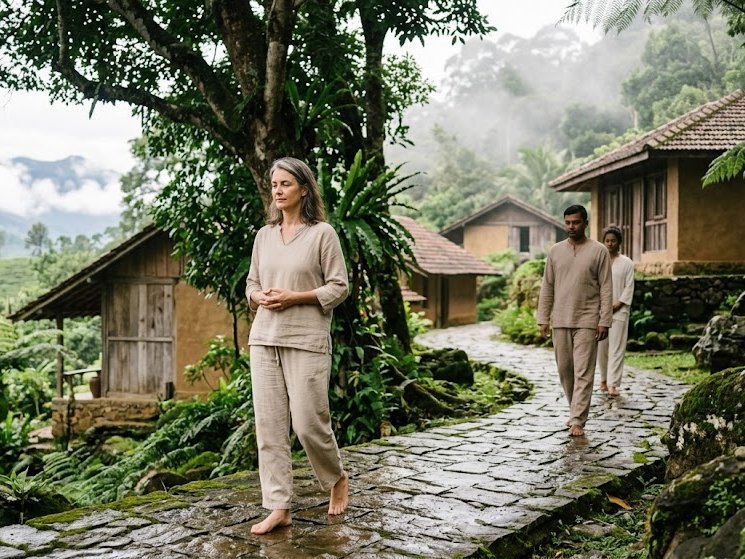
Picture a guest arriving in the misty foothills of central Sri Lanka. Instead of a disposable welcome towel, they receive a seed-paper card embedded with basil seeds. The air is scented not with imported aromatics, but with oils distilled on-site from lemongrass and cinnamon. The therapist greets them with a reusable ceramic jar, part of the spa’s refill program.
After a session of herbal massage and meditation, they visit a “Compost Café” serving probiotic teas brewed from the same herbs used in therapy. Waste from the kitchen is composted to fertilize the on-site herb garden. Before departure, the guest refills their ceramic jar with personalized oil, contributing to a 90 percent container return rate.
Their takeaway is more than relaxation—it is an encounter with regeneration and responsibility.
Challenges and Mitigation
- High Initial Costs: Offset through green financing, phased rollout, and partnerships with sustainability grants.
- Limited Technical Expertise: Collaborate with local universities, international consultants, and vocational training centers.
- Guest Perception: Use refined aesthetics and storytelling to make reuse systems feel luxurious, not frugal.
- Supply Variability: Diversify herbal crops, introduce hydroponic cultivation, and maintain buffer stocks.
- Regulatory Delays: Engage early with authorities; document compliance through transparent audits.
- Scaling Consistency: Use modular growth—each new unit replicates the tested circular model without overextension.
A Call to Action
- Government & Tourism Boards: Offer incentives such as tax relief and concessional loans for zero-waste wellness projects.
- Communities: Participate actively as suppliers and co-owners in the herbal value chain.
- Financial Institutions: Develop green credit facilities tailored to regenerative tourism ventures.
- Academic & Research Sectors: Support research into herbal processing, circular systems, and guest perception.
- Media & Public: Promote awareness of authentic sustainability and challenge greenwashing.
Conclusion
The Circular Spa is not a futuristic fantasy—it is an achievable transformation of Sri Lanka’s wellness industry. It represents a convergence of ancient Ayurvedic wisdom, modern sustainability science, and ethical business practice. Within the next decade, Sri Lanka can pioneer this model to become a global exemplar of circular wellness tourism.
Beyond luxury, this is about legacy—a regenerative system that heals land, uplifts communities, and renews the true spirit of wellness.
Let this be the next chapter in Sri Lanka’s story: from island of healing traditions to island of circular regeneration.
Disclaimer
This article has been authored and published in good faith by Dr. Dharshana Weerakoon, DBA (USA), based on publicly available data from national and international sources, including tourism authorities, central banking statistics, academic studies, and decades of professional experience across multiple continents. It is intended solely for educational, journalistic, and public awareness purposes to stimulate dialogue on sustainable tourism innovation. The author assumes no responsibility for any misinterpretation, adaptation, or misuse of the content. The views expressed are entirely personal and analytical and do not constitute legal, financial, or investment advice. The concepts presented are fully compliant with Sri Lankan law, including the Intellectual Property Act No. 52 of 1979 (regarding artisan rights and design ownership), the ICCPR Act No. 56 of 2007 (ensuring non-discrimination and dignity), and all relevant environmental and ethical standards.
Authored independently through lived professional expertise—organically written, not AI-generated.
Further Reading: https://dharshanaweerakoon.com/next-chapter-in-wellness/
Additional Reading: https://www.linkedin.com/newsletters/outside-of-education-7046073343568977920/