The Untold Reality of the Hospitality Industry: Leadership, Politics, Fear, and the Need for a Better Hotel Culture
Looking Beyond Luxury Hotels to Understand the Human Side of Hospitality
Introduction
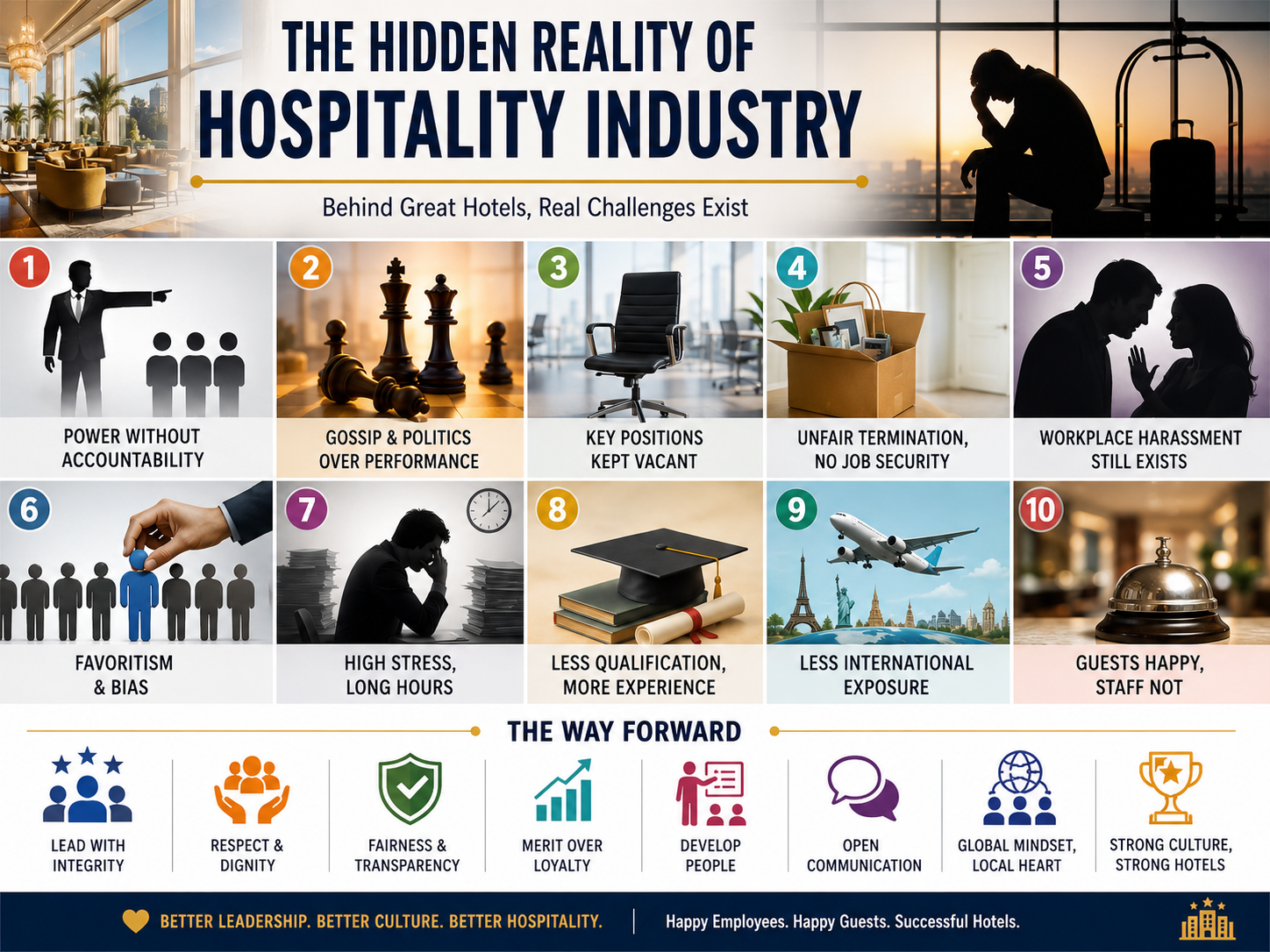
The hospitality industry is one of the world’s largest employers and among its most respected service industries. Every day millions of guests experience warm smiles, exceptional service, luxurious rooms and memorable dining experiences. Behind these beautiful hotel lobbies, however, there is another reality that very few people openly discuss.
This article is not intended to criticize the hotel industry. Quite the opposite.
Having worked across different countries, cultures and hotel environments for decades, I have had the privilege of meeting outstanding General Managers, inspiring hotel owners and remarkable colleagues who have dedicated their lives to developing people. They represent the very best of hospitality.
At the same time, I have also witnessed situations that deserve open professional discussion—not because every hotel operates this way, but because these issues continue to exist in parts of our industry.
Silence does not solve organizational problems.
Professional conversations do.
Hospitality contributes trillions of dollars to the global economy and supports hundreds of millions of jobs. The industry’s success depends not only on guest satisfaction but also on employee satisfaction. While hotels invest heavily in guest experience, investment in leadership culture often receives far less attention.
The industry talks frequently about RevPAR, ADR, GOP, occupancy, market share and guest reviews.
Far less attention is given to psychological safety, workplace fairness, leadership ethics, succession planning and employee trust.
Ironically, these are the very foundations that determine long-term hotel performance.
This article shares professional observations gathered over many years across multiple hospitality environments. None of these observations are intended to represent every hotel, every owner or every General Manager. Rather, they highlight organizational patterns that deserve thoughtful discussion if hospitality is to become an even stronger profession for future generations.
Hospitality is Built on People
Hotels are unlike factories.
Hotels do not manufacture products.
Hotels manufacture experiences.
Every experience depends entirely on people.
The receptionist who welcomes a guest.
The housekeeper preparing a room.
The chef creating memorable meals.
The engineer preventing operational failures.
The finance manager protecting profitability.
The sales team generating business.
The Human Resources department building culture.
When employees work with confidence, guests notice.
When employees work with fear, guests notice that too.
Many global studies have consistently shown that organizations with highly engaged employees achieve stronger productivity, lower staff turnover, better guest satisfaction and healthier financial performance than organizations where employees feel insecure or undervalued.
Unfortunately, hospitality remains one of the industries with relatively high employee turnover. In many countries annual staff turnover exceeds 30%, while some hotels experience significantly higher levels depending on market conditions.
Every resignation carries hidden costs.
Recruitment.
Training.
Loss of experience.
Reduced morale.
Operational disruption.
Guest dissatisfaction.
Yet many organizations continue treating employees as replaceable rather than investable.
The Extraordinary Power of a General Manager
The General Manager occupies one of the most influential positions in any hotel.
The GM influences virtually every department.
Finance.
Operations.
Food and Beverage.
Rooms Division.
Engineering.
Sales.
Human Resources.
Security.
Marketing.
Asset protection.
Guest experience.
The position demands exceptional leadership.
Most General Managers use this responsibility wisely.
Some unfortunately do not.
Like every industry, hospitality includes exceptional leaders, average leaders and poor leaders.
The challenge arises when organizational systems become overly dependent on one individual.
When excessive authority becomes concentrated in a single office without sufficient governance, organizational risks naturally increase.
Good leadership inspires confidence.
Poor leadership often creates fear.
Leadership Through Trust or Leadership Through Fear?
One experienced hotel executive once shared a story with me.
Soon after assuming leadership of a hotel, he decided to replace numerous long-serving senior managers.
His reasoning was not based on poor performance.
Instead, he believed they had developed close relationships with ownership over many years and feared they might influence management decisions or communicate internal information beyond his control.
Whether that perception was accurate or not is impossible to determine.
However, the story illustrates an important organizational lesson.
Leadership built primarily on insecurity often creates instability.
When experienced professionals are replaced without transparent performance reasons, remaining employees may begin asking themselves difficult questions.
“Will I be next?”
That single question can fundamentally change organizational culture.
Employees stop contributing ideas.
Innovation slows.
Honest feedback disappears.
Everyone becomes cautious.
Fear replaces creativity.
Eventually the organization loses exactly what made it successful—its people.
When Politics Replaces Performance
Every workplace contains some degree of office politics.
Hotels are no exception.
The concern begins when politics becomes more valuable than performance.
Employees quickly observe organizational behaviour.
Who receives promotions?
Who receives opportunities?
Who receives overseas training?
Who receives recognition?
Who receives difficult assignments?
If the answers consistently depend on relationships rather than competence, employees gradually lose motivation.
Eventually talented professionals begin leaving.
Ironically, organizations often lose their strongest people first because they have more employment alternatives.
Average performers remain.
The organization slowly weakens.
Job Security and Organizational Anxiety
Hospitality is naturally demanding.
Hotels operate twenty-four hours a day.
Weekends.
Public holidays.
Festive seasons.
Emergency situations.
Unexpected guest issues.
Operational pressure is part of the profession.
Constant fear should not be.
Many professionals privately admit they spend significant time worrying about organizational politics rather than improving guest experiences.
Anxiety affects decision-making.
Stress affects creativity.
Fear affects communication.
When employees feel psychologically unsafe, they become less willing to report operational risks, financial concerns or ethical issues.
In highly competitive hotel markets this silence can become extremely expensive.
The Hidden Cost of Leadership Insecurity
One of the least discussed organizational challenges is leadership insecurity.
Confident leaders usually recruit people smarter than themselves.
Insecure leaders sometimes do the opposite.
This phenomenon is not unique to hospitality.
It exists across many industries.
Organizations become stronger when leaders deliberately recruit specialists who complement their own capabilities.
Hotels today require experts in:
Digital marketing.
Artificial intelligence.
Revenue management.
Sustainability.
Cybersecurity.
Data analytics.
Financial modelling.
Luxury branding.
Customer psychology.
International sales.
No General Manager can master every discipline.
Modern leadership is therefore about assembling exceptional teams rather than becoming the smartest individual in every meeting.
Organizations led by confident leaders usually become learning organizations.
Organizations led by insecure leaders often become political organizations.
Recruitment Should Build Capability, Not Loyalty
One recurring concern occasionally discussed within hospitality is recruitment based primarily on personal loyalty.
Every leader understandably prefers trusted colleagues.
However, recruitment should ultimately prioritize competence, diversity of thinking and organizational fit.
Strong organizations encourage constructive disagreement.
Weak organizations encourage silent agreement.
Innovation rarely emerges from rooms where everyone thinks alike.
Healthy executive teams respectfully challenge ideas.
That challenge improves decisions.
Hotels serving increasingly sophisticated international travellers require precisely this diversity of thought.
Employee Wellbeing Matters More Than Ever
The hospitality industry has made significant progress in employee wellbeing over the past decade.
Nevertheless, challenges remain.
Long working hours.
Irregular shifts.
Work-life balance.
Mental health.
Burnout.
Career uncertainty.
These issues deserve greater attention.
Research consistently shows that employees who feel respected, supported and fairly treated deliver better guest experiences.
Hotels invest millions in physical infrastructure.
Perhaps equal investment should be directed toward organizational culture.
Sexual Harassment Has No Place in Hospitality
One difficult subject that cannot be ignored is workplace harassment.
Across many industries—including hospitality—employees may experience inappropriate behaviour, abuse of authority or sexual harassment.
These incidents should never be normalized.
They should never be hidden.
Equally important, allegations must always be investigated fairly, confidentially and through proper procedures.
Organizations that create respectful workplaces protect both employees and reputations.
Hospitality should remain synonymous with dignity—not fear.
Experience Matters. So Does Education.
Hospitality has traditionally rewarded experience.
Experience remains invaluable.
However, today’s hotel industry is changing rapidly.
Artificial intelligence.
Digital transformation.
Climate responsibility.
Global consumer behaviour.
Revenue science.
International law.
Cybersecurity.
Financial analytics.
Modern hospitality leadership increasingly requires continuous learning alongside operational experience.
The strongest future leaders will combine practical wisdom with academic knowledge.
Neither alone is sufficient.
Lessons From My Own Career
Like many hospitality professionals, my career has included both remarkable successes and difficult disappointments.
There were occasions when I lost positions for reasons I personally struggled to understand.
There were times when differences in leadership style, organizational culture or workplace relationships created professional challenges.
Looking back today, those experiences taught me resilience.
They taught me diplomacy.
They taught me emotional intelligence.
Most importantly, they reinforced my belief that every organization should strive for transparent leadership, respectful communication and merit-based decision-making.
No career is perfect.
No leader is perfect.
But every experience offers lessons that can improve the next generation of hospitality leadership.
Seven Practical Lessons for Hotel Owners
Case Study 1 – Fear-Based Leadership: Staff stop speaking openly, operational issues remain hidden and guest experience suffers.
Case Study 2 – Transparent Recruitment: Hotels introducing competency-based recruitment generally build stronger management teams than those relying solely on personal networks.
Case Study 3 – Leadership Development: Organizations investing in leadership coaching often reduce management conflict and improve retention.
Case Study 4 – Employee Voice: Hotels using anonymous engagement surveys frequently identify operational risks before they become crises.
Case Study 5 – Respectful Workplaces: Clear anti-harassment policies improve employee confidence and organizational reputation.
Case Study 6 – Merit-Based Promotion: Internal promotion based on measurable performance strengthens employee loyalty and succession planning.
Case Study 7 – Continuous Learning: Hotels encouraging executive education are generally better positioned to respond to technological and market disruption.
The Future Hospitality Industry
Tomorrow’s successful hotels will not compete only on luxury.
They will compete on leadership quality.
Guests increasingly evaluate authenticity.
Employees increasingly evaluate employers.
Investors increasingly evaluate governance.
The hotels that thrive over the next decade will likely be those that create environments where people feel trusted, respected, challenged and inspired.
Leadership is no longer about authority.
Leadership is about influence.
Final Thoughts
This article is not an attack on General Managers.
It is not an attack on hotel owners.
It is certainly not an attack on hospitality.
It is written because I deeply care about an industry that has shaped my professional life.
I have worked with extraordinary General Managers who mentored young professionals, protected their teams and built world-class organizations.
They deserve enormous respect.
At the same time, I believe every industry becomes stronger when difficult conversations are conducted professionally and constructively.
Hospitality is built by people.
People deserve fairness.
People deserve dignity.
People deserve opportunity.
If we improve leadership, we improve hotels.
If we improve hotels, we improve tourism.
If we improve tourism, we improve economies.
The future of hospitality will never be determined solely by beautiful buildings.
It will always be determined by the quality of leadership within them.
This article has been authored and published in good faith by Dr. Dharshana Weerakoon, DBA (USA), drawing upon publicly available industry research, global hospitality literature, professional observations accumulated over several decades across multiple countries, and personal experience within the international hospitality sector. The article is intended solely for educational, professional discussion, and public awareness purposes to encourage constructive dialogue on leadership, organizational culture, employee wellbeing, and the future of hospitality management.
The observations presented are general in nature and are not intended to refer to, identify, or make allegations against any specific individual, hotel, company, or organization. Examples and case studies are illustrative and have been anonymized or generalized to protect confidentiality. Views expressed are entirely personal and analytical and should not be interpreted as legal, employment, financial, or professional advice.
This publication is intended to comply with applicable laws relating to reputation, privacy, intellectual property, workplace dignity, and ethical communication.
© Dr. Dharshana Weerakoon, DBA (USA). All Rights Reserved.
Further Reading: https://dharshanaweerakoon.com/maldives-resort-investment-challenges/
Further Reading: https://www.linkedin.com/newsletters/outside-of-education-7046073343568977920/