Sri Lanka’s University Degree Revolution: What Should We Be Teaching for 2035?
Why China’s Higher Education Transformation Should Start an Important Conversation in Sri Lanka
Introduction: The Question Every Parent, Student and University Must Ask
Imagine a student enrolling in a university degree programme in 2026.
Four years later, after investing significant time, effort, and money, that student graduates.
However, what if the world that exists at graduation is completely different from the world that existed when the student first entered university?
What if Artificial Intelligence performs many of the routine tasks previously undertaken by graduates?
What if industries have changed?
What if employers are seeking entirely different skills?
Most importantly, what if the degree itself remains largely unchanged while the labour market has moved on?
These are no longer hypothetical questions.
Across the world, governments, universities, industries, and employers are rethinking the future of higher education.
Among the most significant examples is China’s recent restructuring of university degree programmes. Over recent years, thousands of academic programmes have reportedly been revised, merged, suspended, or replaced as part of a broader effort to align higher education with future economic priorities.
Whether one agrees with every aspect of China’s strategy is irrelevant.
What matters is the underlying message:
Education can no longer remain static in a rapidly changing world.
For Sri Lanka, this presents an important opportunity.
Instead of asking whether our universities are producing graduates, perhaps we should begin asking whether our universities are producing future-ready graduates.
The World of Work Has Changed Forever
Historically, education followed a predictable pattern.
Students completed school.
Students entered university.
Students graduated.
Students secured employment.
Students remained in similar career pathways for decades.
That model served previous generations well.
However, the Fourth Industrial Revolution has fundamentally altered the equation.
Today, technological advancements are accelerating at a pace never previously witnessed in human history.
Artificial Intelligence is transforming professional services.
Automation is changing manufacturing.
Data analytics is reshaping decision-making.
Digital platforms are disrupting traditional industries.
Renewable energy is creating new employment sectors.
Meanwhile, entirely new professions continue to emerge.
Ten years ago, many organisations had no requirement for:
- AI Specialists
- Prompt Engineers
- Data Scientists
- Digital Transformation Managers
- Sustainability Analysts
- ESG Specialists
- Smart Tourism Strategists
Today these professions are becoming increasingly valuable.
The challenge facing higher education is therefore obvious.
Universities cannot prepare students exclusively for the past.
They must prepare students for the future.
The Graduate Employability Challenge
This discussion is particularly relevant for Sri Lanka.
Every year, thousands of graduates enter the labour market from public universities, private universities, professional institutions, and international degree pathways.
Many are exceptionally talented.
Many possess strong academic capabilities.
Yet employers frequently identify a growing mismatch between academic qualifications and workplace expectations.
Several challenges continue to emerge.
Graduate Unemployment
Many graduates experience difficulty securing employment immediately after graduation.
Underemployment
Many highly qualified individuals accept positions that do not fully utilise their educational backgrounds.
Skills Mismatch
Employers increasingly seek practical skills, technological literacy, analytical thinking, and adaptability.
However, some curricula remain heavily focused on traditional knowledge frameworks.
Rapid Industry Transformation
The pace of industrial change frequently exceeds the pace of curriculum reform.
Consequently, universities often struggle to keep pace with evolving market demands.
This challenge is not unique to Sri Lanka.
However, Sri Lanka cannot afford to ignore it.
The Real Issue Is Not Which Degrees To Remove
Whenever discussions about educational reform emerge, many people immediately become defensive.
Some assume that discussions about modernisation mean certain disciplines should disappear.
That is not the argument.
Every academic discipline contributes value.
Arts develop creativity.
Humanities strengthen critical thinking.
Management develops leadership.
Social sciences improve societal understanding.
Tourism creates economic opportunity.
Engineering drives infrastructure.
Medicine protects human life.
The issue is not the existence of disciplines.
The issue is curriculum relevance.
The future belongs to graduates who combine domain expertise with technological capability.
A marketing graduate who understands AI will have advantages over one who does not.
A tourism graduate who understands data analytics will be more valuable than one who does not.
An accountant who understands automation will outperform one who ignores technological change.
Therefore, the future requires evolution rather than elimination.
What Should Sri Lanka Learn From Global Trends?
Several nations are already redesigning higher education around emerging economic priorities.
Singapore
Singapore continuously aligns education with future workforce requirements through lifelong learning initiatives and industry partnerships.
South Korea
South Korea invests heavily in technology, engineering, advanced manufacturing, and digital innovation.
Germany
Germany successfully integrates higher education with industry through practical training and apprenticeship systems.
Finland
Finland emphasises creativity, interdisciplinary learning, problem-solving, and adaptability.
China
China increasingly aligns university programmes with strategic sectors such as Artificial Intelligence, robotics, semiconductors, advanced manufacturing, renewable energy, and digital technologies.
Although these countries have different systems, they share a common principle.
Education must support future economic competitiveness.
Seven Industries That Will Shape Sri Lanka’s Future
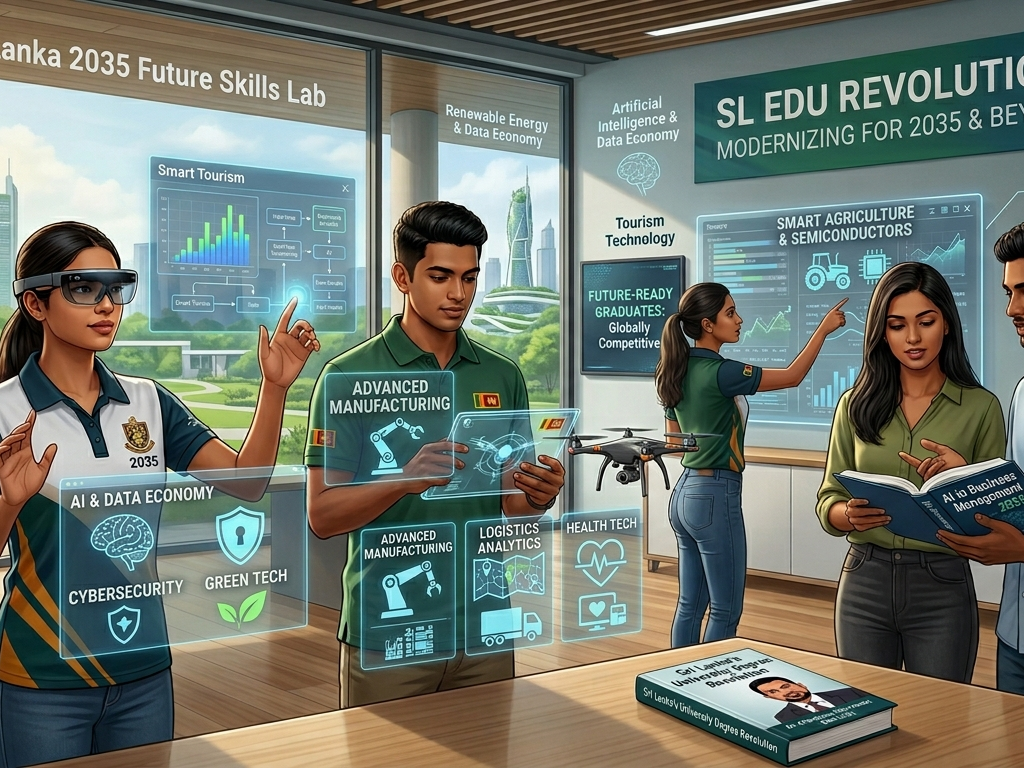
If Sri Lanka wishes to compete globally during the next decade, several sectors deserve particular attention.
1. Artificial Intelligence and Data Economy
AI is rapidly becoming a foundational technology.
Every industry will be affected.
Future graduates will require understanding of:
- Data analytics
- AI applications
- Machine learning concepts
- Digital decision making
AI literacy should become as important as computer literacy once was.
2. Tourism Technology and Smart Destinations
Having spent much of my career across Sri Lanka, Maldives, UAE, Saudi Arabia, Rwanda, and Zanzibar, I have witnessed tourism transformation first-hand.
The future tourist experience will increasingly involve:
- AI-assisted travel planning
- Digital guest journeys
- Smart destinations
- Predictive tourism analytics
- Sustainable tourism management
Sri Lanka possesses tremendous tourism potential.
However, future tourism leaders must combine hospitality expertise with technology and sustainability knowledge.
3. Cybersecurity
As economies become increasingly digital, cyber risks continue to grow.
Every sector requires protection.
Future demand for cybersecurity professionals is likely to increase significantly.
4. Renewable Energy and Sustainability
Climate change is reshaping global investment priorities.
Future opportunities will emerge in:
- Renewable energy
- Carbon management
- Sustainability reporting
- Environmental innovation
Universities must prepare graduates for these emerging sectors.
5. Advanced Manufacturing
Modern manufacturing increasingly relies upon:
- Robotics
- Automation
- Smart systems
- Digital production
Future industrial competitiveness will depend upon technological capability.
6. Health Technology
Healthcare is evolving rapidly.
Telemedicine, health informatics, AI-assisted diagnostics, and digital healthcare systems are becoming increasingly important.
7. Entrepreneurship and Innovation
Future economic growth will not come solely from employment.
It will also come from enterprise creation.
Universities should therefore focus more heavily on entrepreneurship, innovation, and commercialisation.
Degree Programmes That Need Reinvention
Rather than discussing which degrees should disappear, a better question is:
Which degrees require reinvention?
Several programmes may benefit from significant curriculum modernisation.
Examples include:
- Business Administration
- Marketing
- Human Resource Management
- Accounting
- Public Administration
- Information Management
- Tourism Management
- Communication Studies
- Design Programmes
- Language Studies
The objective is not replacement.
The objective is enhancement.
Every discipline should ask:
How will Artificial Intelligence, automation, sustainability, analytics, and digital transformation affect our graduates?
New Degrees Sri Lanka Should Consider Introducing
To remain globally competitive, Sri Lanka may consider expanding programmes in:
- Artificial Intelligence
- Data Science
- Machine Learning
- Cybersecurity
- Robotics Engineering
- Smart Manufacturing
- FinTech
- Climate Economics
- Renewable Energy Systems
- ESG Management
- Smart Tourism
- Tourism Analytics
- Regenerative Tourism
- Entrepreneurship
- Innovation Management
- Digital Governance
- Health Informatics
- Smart Agriculture
- Logistics Analytics
- Semiconductor Technologies
These programmes align more closely with future labour market developments and global investment trends.
The Future Graduate
The graduate of 2035 will look very different from the graduate of 2015.
Future graduates will require:
Technical Competence
Understanding emerging technologies.
Analytical Thinking
Interpreting data and making informed decisions.
Adaptability
Responding effectively to change.
Creativity
Generating innovative solutions.
Emotional Intelligence
Managing human relationships effectively.
Lifelong Learning
Continuously updating knowledge and skills.
Increasingly, success will not depend solely on what someone learned at university.
Success will depend on how quickly they continue learning after graduation.
My Recommendation for Sri Lanka
If I were advising policymakers, university leaders, and industry stakeholders, I would recommend five priorities.
First
Embed digital literacy across every degree programme.
Second
Introduce AI awareness across all disciplines.
Third
Strengthen university-industry partnerships.
Fourth
Expand entrepreneurship education.
Fifth
Create a national framework for future skills development.
The goal should not be producing more graduates.
The goal should be producing globally competitive graduates.
Conclusion: The Future Cannot Wait
The future of higher education is not a discussion for tomorrow.
It is a discussion for today.
Technology is advancing.
Industries are evolving.
Employment patterns are changing.
Student expectations are shifting.
Global competition is intensifying.
Consequently, Sri Lanka must ensure that its higher education system evolves alongside these realities.
The most successful nations of the future will not necessarily be those with the largest populations or the greatest natural resources.
They will be the nations that best develop human capital.
Sri Lanka possesses extraordinary talent.
The challenge is ensuring that talent is prepared for the opportunities and realities of the next decade.
The future belongs to those who prepare for it.
The time to begin is now.
Disclaimer
This article has been authored and published in good faith by Dr. Dharshana Weerakoon, DBA (USA), based on publicly available information, observable global higher education trends, workforce transformation patterns, professional experience across multiple international markets, and ongoing analysis of future skills requirements. The article is intended solely for educational, journalistic, research, and public awareness purposes to encourage constructive discussion regarding the future of higher education, graduate employability, workforce development, and national competitiveness in Sri Lanka. The views expressed are entirely personal, analytical, and forward-looking and do not constitute legal, educational policy, financial, employment, or investment advice. References to academic disciplines are intended exclusively to stimulate discussion on curriculum evolution and future readiness and should not be interpreted as criticism of any institution, university, faculty, profession, student, or graduate. The author accepts no responsibility for any interpretation, adaptation, or application of the content by third parties. This article has been independently authored based on professional expertise and informed analysis.
© Dr. Dharshana Weerakoon, DBA (USA). All Rights Reserved.
Further Reading: https://dharshanaweerakoon.com/are-we-solving-the-wrong-tourism-problem/
Further Reading: https://www.linkedin.com/newsletters/outside-of-education-7046073343568977920/