⚡ Batteries Not Included: The Coming Crisis of EV Tourism and Sri Lanka’s Unprepared Charging Corridors
Introduction: A Silent Disruption Approaching Sri Lanka Tourism
Tourism evolves faster than policy. Today, a silent but powerful shift is underway—electric mobility is redefining how global travelers move. Increasingly, tourists are not just choosing destinations; they are choosing how they travel within them.
Electric Vehicles (EVs) are no longer a futuristic concept. They are a present-day expectation.
However, Sri Lanka stands at a critical junction. While the island continues to promote itself as a sustainable tourism destination, a fundamental gap threatens its competitiveness: the absence of a reliable, island-wide EV charging network.
This is not merely an infrastructure issue. It is a strategic tourism risk.
If ignored, it could reshape traveler behavior, reduce destination appeal, and disrupt key tourism circuits such as Kandy – Ella – Arugam Bay.
The Global EV Tourism Shift: Numbers That Cannot Be Ignored
The global momentum behind EV adoption is undeniable:
- Over 18 million electric vehicles were sold globally in 2024, accounting for nearly 22% of total car sales.
- By 2030, EVs are expected to represent over 50% of new vehicle sales in developed markets.
- Major tourism markets—Europe, China, and North America—are aggressively transitioning to EV mobility.
- Rental giants are investing heavily:
- Hertz committed to 100,000 EVs in its fleet.
- Sixt and Europcar are rapidly electrifying their fleets across Europe.
Most importantly, eco-conscious travelers now prefer destinations aligned with sustainable mobility.
Sri Lanka markets itself as a green destination—yet lacks the infrastructure to support that claim in practical terms.
Understanding the Core Threat: “Range Anxiety Tourism”
“Range anxiety” is no longer just a driver’s concern—it is becoming a tourism behavior determinant.
Imagine this scenario:
A European traveler rents an EV in Colombo expecting a scenic journey through Sri Lanka’s hill country. However:
- Charging stations are concentrated in Colombo and suburbs.
- No reliable fast chargers exist between Kandy and Ella.
- Limited or no infrastructure towards Arugam Bay.
Result?
- Travel plans are altered.
- Destinations are skipped.
- Stays are shortened.
- Satisfaction declines.
This creates a new phenomenon:
👉 “Range Anxiety Tourism” — where travel decisions are dictated by charging availability rather than destination appeal.
Sri Lanka’s Current Reality: A Fragmented Charging Ecosystem
Despite early adoption of EV imports, Sri Lanka’s charging infrastructure remains:
- Urban-centric (primarily Colombo)
- Uncoordinated (multiple providers, no integrated network)
- Slow charging dominant (few fast chargers)
- Lacking route planning integration
Estimated figures suggest:
- Fewer than 300 public charging points nationwide
- Less than 15% are fast chargers
- Nearly 70% concentrated in Western Province
This creates a tourism bottleneck, particularly for long-distance travel routes.
High-Risk Tourism Corridors: The Kandy – Ella – Arugam Bay Route
This iconic route represents the essence of Sri Lankan tourism:
- Cultural heritage (Kandy)
- Scenic hill country (Ella)
- Coastal leisure and surfing (Arugam Bay)
Yet, it is also the most vulnerable to EV disruption.
Key challenges:
- Long distances between towns
- Mountain terrain increasing battery consumption
- Lack of mid-route fast charging
- Limited EV-ready accommodation
If not addressed, this route could become inaccessible to EV travelers within 3–5 years.
Case Studies: Lessons from Global EV Tourism Leaders
1. Norway: The Gold Standard
- Over 25,000 public chargers
- Fast chargers every 50 km on highways
- EV adoption exceeds 80% of new car sales
👉 Tourism benefit: Seamless nationwide travel with zero range anxiety.
2. Netherlands: Density Over Distance
- One of the highest charger densities globally
- Urban and rural parity
👉 Lesson: Infrastructure density drives traveler confidence.
3. Iceland: Tourism-Centric Charging
- Charging stations mapped along tourism routes
- Government-private partnerships
👉 Lesson: Charging must align with tourism circuits, not just cities.
4. United Kingdom: Destination Charging Model
- Hotels, attractions, and restaurants incentivized to install chargers
👉 Lesson: Charging becomes part of the hospitality experience.
5. United Arab Emirates: Strategic Corridor Development
- Fast chargers connecting Dubai to Abu Dhabi and beyond
👉 Lesson: Corridors matter more than isolated stations.
6. India: Emerging EV Tourism Infrastructure
- Highway charging networks expanding under national programs
- Focus on intercity travel
👉 Lesson: Even developing economies can scale rapidly with policy direction.
7. Australia: Long-Distance Charging Innovation
- Solar-powered remote charging stations
👉 Lesson: Renewable integration reduces operational costs and aligns with sustainability branding.
The Economic Risk: Lost Revenue and Reduced Stay Duration
Failure to adapt could lead to:
- Shortened itineraries → fewer nights per tourist
- Lower regional income distribution
- Decline in eco-tourism credibility
- Loss of high-value European travelers
Even a 5% drop in long-route tourism could translate into millions in lost revenue annually.
The Strategic Solution: “Charging Circuit Bond” Model
Sri Lanka does not lack vision—it lacks structured financing and execution alignment.
I propose a Public-Private Partnership Model:
🔋 Charging Circuit Bond (CCB)
A tourism-funded infrastructure financing mechanism.
How It Works
- Bond Issuance
- Government or tourism authority issues infrastructure bonds.
- Funding Sources
- Tourism levies
- Green financing funds
- ESG investors
- Development banks
- Private Sector Participation
- Hotels
- Fuel stations
- Retail chains
- EV providers
- Revenue Streams
- Charging fees
- Tourism tax allocations
- Advertising and partnerships
Strategic Deployment
Phase-based rollout:
Phase 1: Core Tourism Corridor
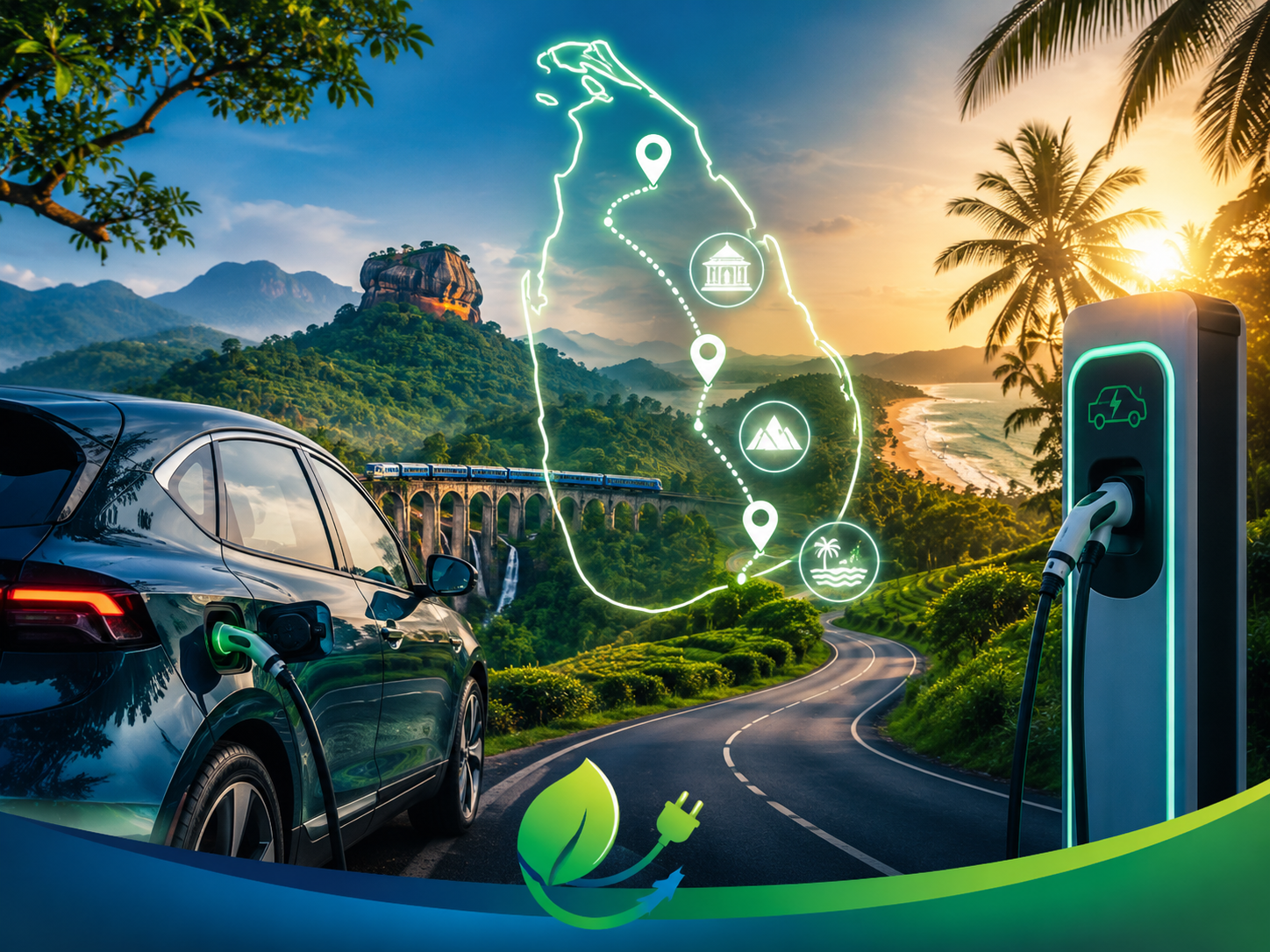
- Colombo → Kandy → Nuwara Eliya → Ella → Arugam Bay
- Fast chargers every 80–100 km
Phase 2: Secondary Routes
- Southern coast (Galle, Mirissa, Tangalle)
- Cultural triangle
Phase 3: Nationwide Integration
Integrating Tourism and Charging Infrastructure
Charging stations should not be standalone utilities. They must be experience nodes:
- Cafés and rest areas
- Local craft markets
- Wellness and Ayurveda stops
- Digital connectivity hubs
👉 This transforms charging time into economic activity time.
Policy Recommendations
To make this viable:
- Introduce tax incentives for EV charging investments
- Mandate charging points in new hotels
- Develop a national EV tourism map
- Standardize charging systems and pricing
- Encourage renewable energy integration
The Branding Opportunity: “Sri Lanka – The EV-Friendly Island”
This is more than infrastructure—it is a branding revolution.
Position Sri Lanka as:
- South Asia’s first EV Tourism Destination
- A leader in sustainable travel corridors
- A pioneer in green mobility tourism
Conclusion: A Strategic Crossroads
Sri Lanka’s tourism future will not be decided by marketing campaigns alone.
It will be decided by infrastructure readiness.
EV tourism is not coming—it has already arrived.
The question is simple:
👉 Will Sri Lanka lead, or will it lag behind?
The window for action is narrow—but the opportunity is enormous.
Disclaimer
This article has been authored and published in good faith by Dr. Dharshana Weerakoon, DBA (USA), based on publicly available data from national and international tourism trends, mobility transition patterns, sustainable infrastructure models, and extensive professional experience across global tourism and hospitality sectors.
It is intended solely for educational, analytical, and public awareness purposes to stimulate discussion on sustainable tourism development and infrastructure readiness in Sri Lanka.
The author accepts no responsibility for any misinterpretation, adaptation, or application of the content. The views expressed are entirely personal and analytical and do not constitute legal, financial, engineering, or investment advice.
All concepts, including the proposed “Charging Circuit Bond” model, are presented in alignment with Sri Lankan regulatory frameworks, sustainability principles, and ethical standards, and are intended for conceptual exploration and policy dialogue.
✍ Authored independently through professional expertise, industry exposure, and strategic analysis.
Further Reading: https://www.linkedin.com/newsletters/outside-of-education-7046073343568977920/
Further Reading: https://dharshanaweerakoon.com/invisible-excellence/