Reimagining Sri Lanka’s Tourism Future: A Holistic, Research-Driven Model Integrating Ayurveda, Agro, and Elderly Wellness Tourism
Introduction: A Strategic Inflection Point for Sri Lanka Tourism
Sri Lanka stands at a decisive crossroads. As a nation long celebrated for its biodiversity, cultural depth, and authentic hospitality, we have historically depended on conventional tourism models—sun, sand, and heritage. However, global tourism demand is shifting rapidly. Today’s traveler is not merely seeking destinations; they are seeking meaningful experiences, wellness, longevity, and purpose-driven travel.
According to global tourism estimates, wellness tourism alone has surpassed USD 800 billion, growing at nearly twice the rate of general tourism. Meanwhile, the global elderly population (aged 60+) is expected to reach 2.1 billion by 2050, creating an entirely new demand segment—elderly care tourism integrated with healthcare, spirituality, and sustainability.
Sri Lanka, with its Ayurveda heritage, spiritual traditions, and agricultural richness, is uniquely positioned to lead this transformation.
This article outlines a new integrated tourism development model, anchored by our upcoming venture—Global Agro Tech—and supported by academic, research, and industry collaborations.
The Vision: A 43-Acre Holistic Elderly Care Tourism Ecosystem
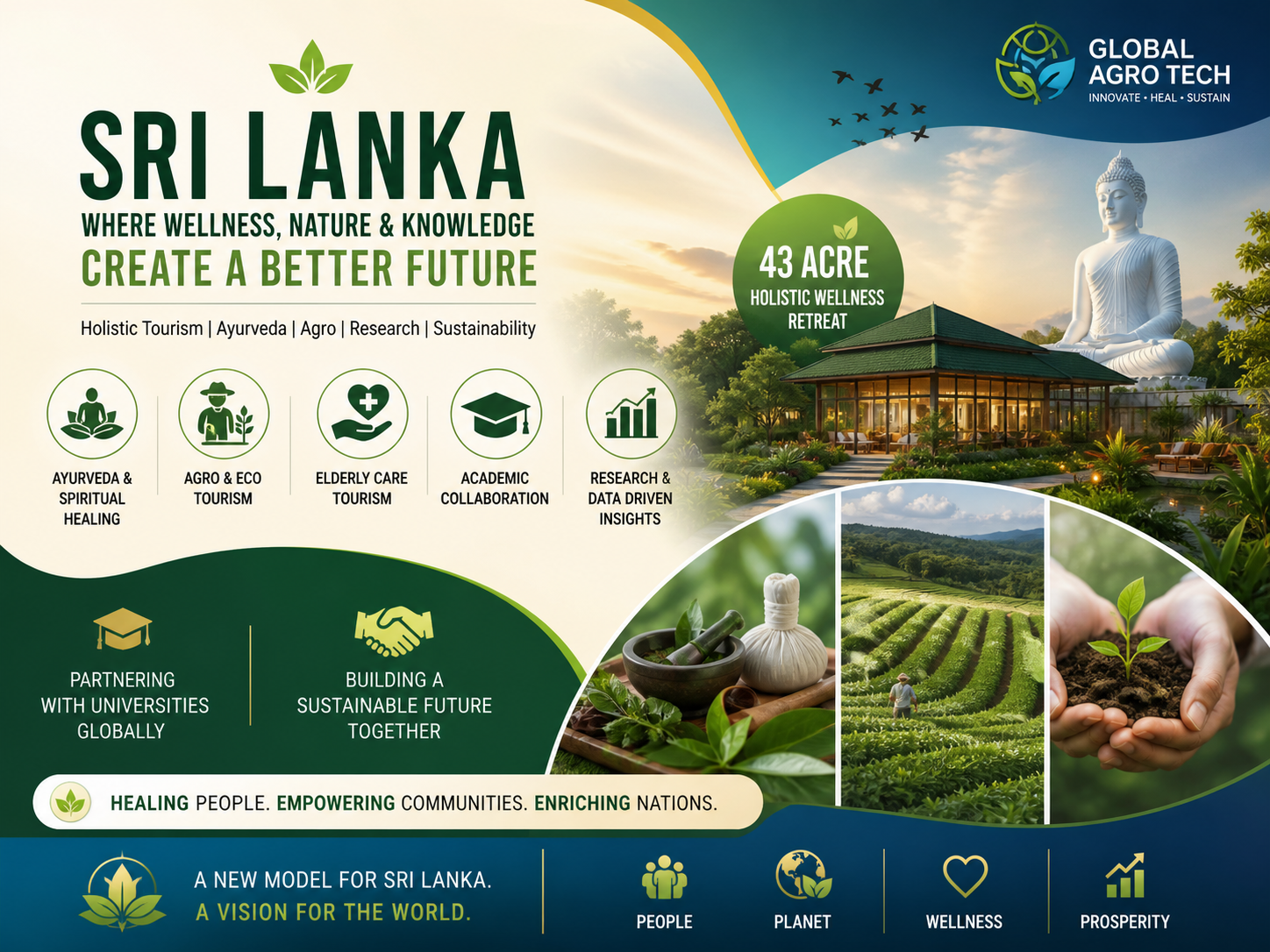
At the center of this initiative lies a 43-acre integrated development, designed not as a conventional hotel, but as a holistic ecosystem combining:
- Elderly Care Tourism
- Ayurveda Healing & Preventive Healthcare
- Spiritual and Mindfulness Retreats
- Agro Tourism (Cinnamon, Coconut, Organic Farming)
- Eco Tourism & Sustainability Practices
This model is built on a simple yet powerful premise:
Tourism should not only entertain—it should heal, educate, and sustain.
Unlike traditional hospitality developments, this concept aligns with long-stay, high-value tourism segments, increasing average tourist spending, length of stay, and knowledge exchange.
Academic Integration: The Missing Link in Sri Lanka Tourism
One of the fundamental gaps in Sri Lanka’s tourism sector is the limited integration between industry and academia. To address this, we have already taken concrete steps.
Our Memorandum of Understanding with University of Sri Jayewardenepura enables:
- Structured student internships
- Applied research in hospitality and agro-tourism
- Real-world exposure for undergraduates
- Knowledge transfer between academia and industry
This is not merely an internship pipeline—it is the foundation for a living laboratory.
Furthermore, our collaboration with Pepper Cube Consultants strengthens our capacity to:
- Conduct data-driven tourism analysis
- Understand evolving traveler behavior
- Develop evidence-based strategies
- Monetize tourism insights through structured data
Global Academic Collaborations: Positioning Sri Lanka as a Research Hub
With my academic background, including a Doctorate in Tourism and Hospitality Management and extensive international exposure, I see a powerful opportunity:
Position Sri Lanka as a global research destination.
Through strategic MOUs with leading international universities, we can:
- Facilitate joint research programs in:
- Tourism innovation
- Sustainable agriculture
- Wellness and longevity tourism
- Host international students and scholars
- Establish research residency programs
- Supervise postgraduate and doctoral research
This approach transforms tourism into an intellectual export industry, where knowledge, innovation, and global collaboration converge.
Why This Model Matters: Economic and Strategic Impact
Let us examine the broader implications.
1. Increasing Tourist Yield
Sri Lanka currently attracts millions of visitors, yet average spending per tourist remains relatively low compared to destinations like Maldives or Singapore.
Holistic elderly care tourism can:
- Increase average stay from 7 days to 21–60 days
- Boost per capita spending by 2–3x
- Attract high-value, long-term visitors
2. Employment Generation
This model creates multi-layered employment:
- Healthcare professionals (Ayurveda, therapy)
- Agricultural specialists
- Hospitality staff
- Research assistants
- Academic coordinators
A single 43-acre project can generate 200–400 direct jobs and significantly more indirect opportunities.
3. Rural Development
By integrating agro-tourism:
- Farmers become stakeholders in tourism
- Local produce gains premium value
- Supply chains become localized and sustainable
4. Foreign Exchange Earnings
Long-stay wellness tourists contribute significantly to foreign currency inflows, supporting macroeconomic stability.
Case Studies: Global Benchmarks and Lessons
To validate this model, let us examine relevant international examples.
Case Study 1: Thailand – Wellness Tourism Leadership
Thailand generates billions annually through medical and wellness tourism, combining modern healthcare with traditional therapies.
Lesson: Integrated wellness ecosystems drive repeat visitation and global reputation.
Case Study 2: Kerala, India – Ayurveda Tourism
Kerala successfully branded itself as the global hub for Ayurveda, attracting long-stay tourists.
Lesson: Authenticity and consistent branding create global trust.
Case Study 3: Japan – Elderly Care Innovation
Japan has developed advanced elderly care communities, integrating healthcare, technology, and lifestyle.
Lesson: Aging populations are not a challenge—they are an opportunity.
Case Study 4: Costa Rica – Eco Tourism Model
Costa Rica earns significant revenue by protecting biodiversity and promoting eco-tourism.
Lesson: Sustainability is a competitive advantage, not a limitation.
Case Study 5: Bali, Indonesia – Spiritual Tourism
Bali attracts global travelers seeking spiritual healing and mindfulness retreats.
Lesson: Cultural identity can be monetized ethically and sustainably.
Case Study 6: New Zealand – Agro Tourism Integration
New Zealand integrates agriculture into tourism, offering farm experiences.
Lesson: Agriculture can enhance tourism value chains.
Case Study 7: Switzerland – Research and Tourism Linkage
Switzerland combines tourism with academic excellence and innovation hubs.
Lesson: Research-driven tourism enhances global credibility.
Strategic Differentiation: Why Sri Lanka Can Lead
Sri Lanka possesses a rare combination:
- Authentic Ayurveda traditions
- Rich spiritual heritage (Buddhist philosophy, meditation)
- Diverse agriculture (cinnamon, coconut, spices)
- Compact geography with high biodiversity
However, the challenge lies not in resources—but in integration and positioning.
This model addresses that gap by combining:
- Tourism
- Healthcare
- Agriculture
- Education
- Research
- Sustainability
Technology and Data: The Role of Global Agro Tech
The establishment of Global Agro Tech is a strategic move to integrate:
- Smart agriculture
- Tourism analytics
- Sustainability metrics
- Digital visitor experiences
With data from partners like Pepper Cube, we can:
- Predict tourism trends
- Personalize guest experiences
- Optimize operational efficiency
- Support policy-level decision-making
Challenges and Risk Mitigation
No model is complete without acknowledging potential challenges:
Regulatory Compliance
All developments must align with:
- Tourism regulations
- Environmental laws
- Healthcare standards
Cultural Sensitivity
Spiritual and Ayurveda practices must be preserved authentically, avoiding commercialization risks.
Quality Assurance
International tourists demand consistent, high-quality service standards.
Talent Development
Continuous training is essential to maintain global competitiveness.
The Way Forward: A National Opportunity
This is not merely a private sector initiative—it is a national opportunity.
If scaled effectively, Sri Lanka can:
- Become Asia’s leading holistic wellness destination
- Attract global academic partnerships
- Generate high-value tourism revenue
- Build a knowledge-driven economy
Conclusion: From Destination to Transformation
Tourism is no longer about destinations—it is about transformation.
Through the integration of:
- Elderly care
- Ayurveda
- Agriculture
- Research
- Sustainability
Sri Lanka can redefine its global identity.
As a practitioner, academic, and entrepreneur, I see this not as a concept—but as a practical, scalable, and globally relevant model.
The world is searching for healing, meaning, and connection.
Sri Lanka is ready to provide it.
Disclaimer
This article has been authored and published in good faith by Dr. Dharshana Weerakoon, DBA (USA), based on publicly available insights from national institutions such as the Sri Lanka Tourism Development Authority, Central Bank of Sri Lanka, global tourism frameworks, and international wellness and sustainability benchmarks, combined with extensive professional experience across tourism, academia, and entrepreneurship.
It is intended solely for educational, analytical, and public awareness purposes to stimulate discussion on sustainable and integrated tourism development models in Sri Lanka. The views expressed are personal, research-driven, and do not constitute legal, financial, investment, or policy advice.
All concepts discussed are designed to align with Sri Lankan legal frameworks, including tourism regulations, environmental standards, intellectual property protections, and ethical research practices. The author assumes no responsibility for any interpretation, adaptation, or application of this content beyond its intended academic and strategic context.
This article reflects independent professional thought and lived expertise.
Further Reading: https://dharshanaweerakoon.com/api-driven-retreats/
Further Reading: https://www.linkedin.com/newsletters/outside-of-education-7046073343568977920/