
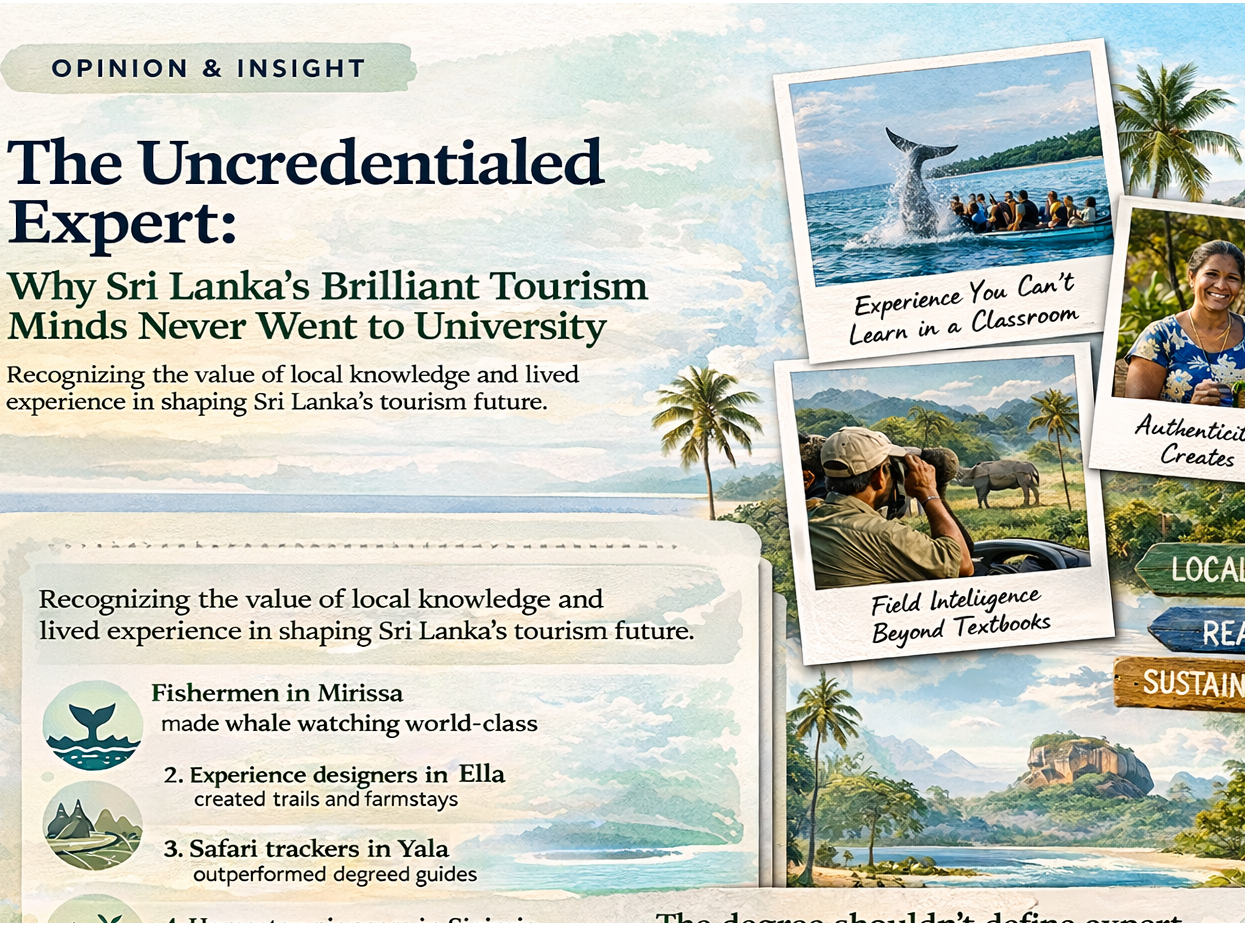
The Uncredentialed Expert: Why Sri Lanka’s Sharpest Tourism Minds Never Sat in a Lecture Hall
A Quiet Truth the Industry Avoids
There is an uncomfortable reality in Sri Lanka’s tourism sector that few policymakers openly acknowledge.
Some of the most insightful, commercially astute, and culturally authentic tourism minds in this country have never stepped inside a university lecture hall.
Yet, paradoxically, they are the very people excluded from national tourism planning.
Instead, policy frameworks are often shaped by credentialed experts—many of whom understand tourism in theory, but not always in lived reality.
This is not an argument against academia. It is, however, a challenge to a system that equates qualification with capability, while overlooking experience as intelligence.
Tourism in Sri Lanka: A System Built on Paper Credentials
Sri Lanka’s tourism industry contributes significantly to the national economy:
- Pre-crisis tourism earnings exceeded USD 4.4 billion annually
- The sector supports over 400,000 direct and indirect jobs
- Community-based tourism contributes an estimated 20–30% of experiential travel value
Yet, when it comes to structured decision-making—policy boards, advisory councils, and national tourism strategy—representation is heavily skewed toward:
- Academics
- Institutional administrators
- Corporate executives
What is missing?
The practitioner.
The fisherman who turned dolphin watching into a global attraction.
The villager who created immersive cultural stays before “experiential tourism” became a buzzword.
The self-taught hotelier who understands yield management without ever using that term.
The Knowledge Divide: Academic vs. Experiential Intelligence
Let’s be clear: academic knowledge and experiential knowledge are not substitutes—they are complements.
However, Sri Lanka has institutionalized a hierarchy where:
- Theory is seen as superior
- Practice is seen as informal
This imbalance creates three critical problems:
1. Policy Detachment from Ground Reality
Policies often fail because they are designed without understanding operational constraints at the grassroots level.
2. Missed Innovation Opportunities
Many grassroots tourism innovations never scale because their creators lack access to formal platforms.
3. Exclusion of Cultural Authenticity
Tourism loses its essence when those who live the culture are not part of shaping its narrative.
Case Studies: The Uncredentialed Experts Who Built Tourism Value
1. The Whale Whisperers of Mirissa
Local fishermen in Mirissa transitioned into whale-watching operators long before formal frameworks existed.
- Built a multi-million-dollar niche tourism segment
- Developed informal but effective tracking techniques
- Created global demand through consistency and authenticity
Yet, their voices remain largely absent in national marine tourism policy.
2. Ella’s Informal Experience Designers
Before boutique tourism brands arrived, locals in Ella were:
- Hosting hikers
- Designing trail experiences
- Offering farm-to-table meals
Today, Ella is one of Sri Lanka’s most visited inland destinations—largely built on grassroots initiative.
3. The Safari Trackers of Yala
Many of Yala’s most respected safari guides:
- Have no formal wildlife degrees
- Possess decades of field knowledge
- Can interpret animal behavior with remarkable accuracy
Their expertise often surpasses textbook learning—yet remains unrecognized institutionally.
4. Village Homestay Pioneers in Sigiriya
Long before Airbnb-style platforms:
- Rural families were hosting international travelers
- Offering authentic culinary and cultural immersion
- Generating sustainable micro-income streams
These pioneers defined community tourism without ever studying it.
5. Negombo’s Lagoon Experience Creators
Local boat operators developed:
- Lagoon tours
- Birdwatching experiences
- Cultural fishing demonstrations
These are now standard tourism products—but originated organically.
6. Self-Taught Hoteliers in the South Coast
Many boutique hotel owners:
- Started with no formal hospitality education
- Learned pricing, branding, and guest psychology through trial and error
- Built globally competitive products
Some now outperform internationally trained managers.
7. Indigenous Knowledge Holders in Cultural Tourism
Traditional healers, artisans, and cultural custodians:
- Offer experiences deeply rooted in heritage
- Preserve intangible cultural assets
- Attract high-value experiential travelers
Yet, they are rarely consulted in cultural tourism planning.
Why This Matters Now More Than Ever
The global tourism landscape is shifting:
- Travelers are seeking authentic, local experiences
- Experiential tourism is growing at ~15–20% annually
- Community-driven tourism models are outperforming standardized packages
Sri Lanka is uniquely positioned to lead in this space.
But only if it recognizes its greatest asset:
Its people—not just its professionals, but its practitioners.
The Structural Bias: Why Practitioners Are Excluded
The exclusion of grassroots experts is not accidental—it is systemic.
1. Credentialism
A belief that formal qualifications are the primary indicator of expertise.
2. Institutional Comfort Zones
Decision-makers tend to engage with individuals who speak the same “language” of reports, frameworks, and presentations.
3. Lack of Formal Recognition Mechanisms
There is no structured pathway for practitioners to enter policy conversations.
A Practical Solution: The National Practitioner Fellowship
It is time to formalize what has long been informal.
Introducing the National Practitioner Fellowship (NPF)
A structured, merit-based program designed to integrate lived experience into national tourism strategy.
How the National Practitioner Fellowship Would Work
1. Selection Criteria
- Minimum 10 years of hands-on experience
- Demonstrated impact on local tourism ecosystems
- Peer and community validation
2. Fellowship Structure
- Annual intake of 25–50 practitioners
- Representation across regions and tourism segments
- Fixed-term advisory roles (e.g., 2–3 years)
3. Roles and Responsibilities
- Participate in national tourism policy discussions
- Provide ground-level insights
- Co-design sustainable tourism frameworks
4. Integration with Academia
- Joint workshops with universities
- Knowledge exchange programs
- Case study documentation
The Economic Case for Inclusion
Integrating practitioners is not just ethical—it is economically strategic.
1. Improved Policy Effectiveness
Policies grounded in reality are more likely to succeed.
2. Enhanced Product Development
Authentic experiences command premium pricing.
3. Increased Community Participation
Inclusive models drive broader economic distribution.
The Risk of Inaction
If Sri Lanka continues to exclude its grassroots experts:
- Tourism risks becoming generic and commoditized
- Community participation may decline
- Competing destinations may outpace Sri Lanka in experiential tourism
Reframing Expertise
We must redefine what it means to be an expert.
An expert is not just someone who has studied tourism.
An expert is someone who has:
- Built tourism
- Sustained tourism
- Lived tourism
A Personal Reflection
Having worked across continents, I have observed a consistent pattern:
The most successful tourism ecosystems are not those with the most degrees—
They are those with the most inclusive intelligence systems.
Sri Lanka has the raw ingredients to lead globally.
But it must first correct a fundamental imbalance.
Conclusion: A Seat at the Table
This is not about replacing academics.
It is about balancing the table.
It is about recognizing that:
- A PhD and a fisherman can both be experts
- A professor and a village host can both shape policy
- A strategist and a safari tracker can both define the future
The question is not whether Sri Lanka has expertise.
The question is whether it is willing to recognize it.
Disclaimer
This article has been authored and published in good faith by Dr. Dharshana Weerakoon, DBA (USA), based on publicly available industry insights, national tourism data, and extensive professional experience across global tourism and hospitality markets. It is intended solely for educational, analytical, and public discourse purposes to encourage progressive thinking in tourism development.
The views expressed are personal, professional interpretations and do not constitute legal, financial, or investment advice. All examples are presented in a generalized and non-attributable manner to avoid misrepresentation or reputational impact.
This article and the proposed National Practitioner Fellowship concept are designed to align with Sri Lankan legal frameworks, including intellectual property protections, non-discrimination principles, and ethical standards in tourism and community engagement.
Authored independently through professional expertise and industry observation.
Further Reading: https://www.linkedin.com/newsletters/outside-of-education-7046073343568977920/
Further Reading: https://dharshanaweerakoon.com/shared-luxury-villa/