
Political Illiteracy & “Reputation Launderers”: The System That Quietly Undermines Sri Lanka’s Future
Introduction: The Problem We Pretend Not to See
Sri Lanka’s political crisis is not simply about bad leadership, poor policy, or economic mismanagement.
Those are symptoms.
The real problem runs deeper—and is far less discussed because it implicates not just politicians, but citizens themselves.
We are looking at a systemic failure built on three recurring patterns:
- Politicians mislead, overpromise, or underdeliver.
- Citizens eventually recognize it—but only after the damage is done.
- A powerful segment of supporters actively protects, justifies, and even glorifies failure.
This third group is the most dangerous.
I define them as “Reputation Launderers.”
Who Are “Reputation Launderers”?
Reputation Launderers are not ordinary supporters.
Support is a healthy part of democracy. It reflects choice, alignment, and belief.
However, this phenomenon goes far beyond support—it is about protecting power at the expense of truth.
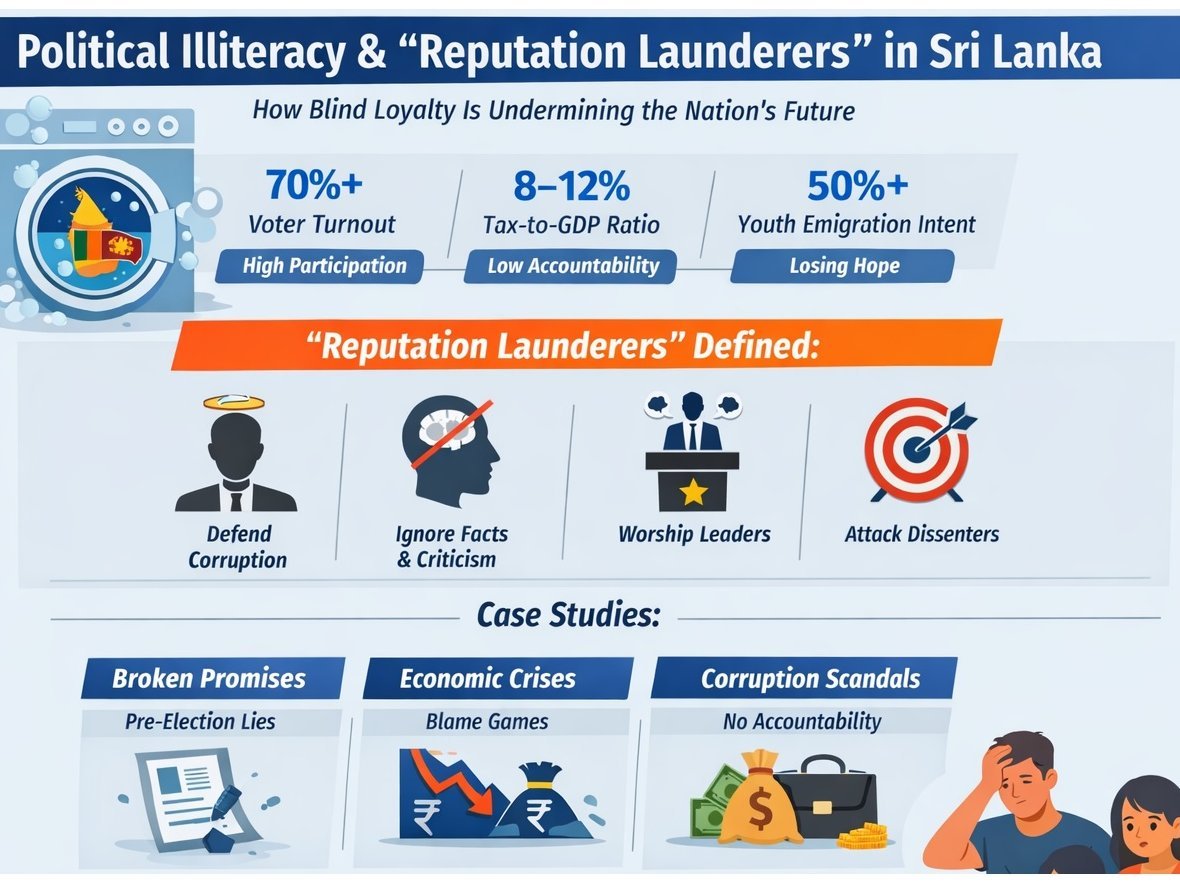
Reputation Launderers:
- Rationalize corruption, inefficiency, and policy failure
- Dismiss credible criticism without evaluation
- Reframe failure as strategy
- Attack individuals rather than engage with ideas
- Elevate political figures to near-infallible status
In effect, they perform a function similar to laundering:
They take damaged political credibility and return it to the public as “clean.”
This is not loyalty.
This is the removal of accountability from the system.
The Political Literacy Crisis: Education Without Understanding
One of the most uncomfortable truths in Sri Lanka is this:
Formal education does not translate into political literacy.
You will find:
- Degree holders defending unsustainable economic policies
- Professionals justifying fiscal irresponsibility
- Highly educated individuals unable to interpret basic governance outcomes
This is not an insult—it is a structural observation.
What Is Missing?
Political literacy is not about knowing party names or leaders.
It is about understanding:
- How government revenue is generated
- How public expenditure is allocated
- What debt sustainability means
- How policy decisions impact long-term economic stability
- What institutional accountability looks like
Without this, citizens become participants in democracy—but not informed decision-makers.
The Data Tells a Clear Story
Even without a formal political literacy index, national indicators reveal the reality:
- Tax-to-GDP ratio: Historically between 8%–12%
→ Indicates weak public engagement in fiscal responsibility - Public debt levels: Surpassed 120% of GDP during crisis periods
→ Reflects long-term policy failure and poor accountability - Voter turnout: Consistently above 70%
→ High participation, but not necessarily informed participation - Youth migration intent: Frequently exceeds 50% in surveys
→ A direct signal of declining confidence in governance
This is the paradox:
High democratic participation + Low political understanding = Systemic instability
Why Do Reputation Launderers Exist?
This behavior is not accidental—it is driven by deep psychological and social mechanisms.
1. Identity Over Evidence
Political alignment becomes tied to identity—family, region, history, or ideology.
Changing your political view feels like betraying your identity.
2. Cognitive Dissonance
Admitting failure creates discomfort.
It is easier to defend a bad decision than to accept being wrong.
3. Emotional Investment
Years of support create emotional attachment.
Leaders are no longer evaluated—they are protected.
4. Information Echo Chambers
Social media reinforces existing beliefs.
Opposing views are filtered out, not debated.
5. Absence of Accountability Culture
When institutions fail to enforce accountability, individuals compensate by justifying failure instead of challenging it.
The Role of Political Leadership: Exploiting the System
Let’s be clear.
This is not a one-sided issue.
Political leaders are not unaware of Reputation Launderers—they depend on them.
When leaders know:
- A segment will defend them regardless of performance
- Criticism can be reframed as “attacks”
- Narratives can override facts
…they are incentivized to:
- Overpromise without consequence
- Avoid structural reform
- Shift blame instead of delivering results
- Focus on perception rather than performance
This creates a dangerous equilibrium:
Leaders avoid accountability because supporters eliminate the need for it.
Case Studies: Repeating Patterns Across Political Cycles
These are not isolated incidents. They are recurring systemic patterns.
Case Study 1: The Promise-Reality Gap
Pre-election periods are filled with ambitious commitments:
- Tax reductions
- Subsidy expansions
- Rapid job creation
Post-election realities often force reversals.
Response from Reputation Launderers:
“It’s a strategic adjustment.”
Case Study 2: Crisis Blame Shifting
During economic crises:
- Previous governments are blamed
- External factors are emphasized
- Structural issues are minimized
Response:
“They inherited a difficult situation.”
Case Study 3: State-Owned Enterprise Losses
Persistent losses in state enterprises continue for decades.
Response:
“These are national assets, not profit-driven entities.”
Case Study 4: Infrastructure vs Economic Return
Large-scale infrastructure projects are showcased as development success.
However:
- Debt servicing increases
- Economic returns remain unclear
Response:
“This is long-term vision.”
Case Study 5: Corruption Allegations
Allegations emerge across political cycles.
Instead of consistent accountability:
- Narratives shift
- Investigations stall
- Public discourse polarizes
Response:
“This is politically motivated.”
Case Study 6: Policy Instability
Frequent changes in:
- Tax structures
- Trade policies
- Investment frameworks
Response:
“This is adaptive governance.”
Case Study 7: Youth Exit Strategy
A growing number of educated youth seek opportunities abroad.
Response:
“They are exploring global exposure.”
The Real Cost: A System Without Consequences
When Reputation Launderers dominate the narrative:
- Failure is normalized
- Performance becomes irrelevant
- Truth becomes negotiable
This leads to:
1. Policy Volatility
No consistency. No long-term planning.
2. Economic Fragility
Unsustainable decisions continue unchecked.
3. Talent Drain
The most capable individuals exit the system.
4. Institutional Decay
Trust in governance erodes over time.
The Generational Impact: A Future at Risk
The consequences are not immediate—they are cumulative.
Future generations inherit:
- High debt burdens
- Weak institutions
- Limited economic opportunity
- A culture of low accountability
This is not just a political issue.
It is a national sustainability issue.
The Hard Truth: The System Reflects the Voter
It is easy to blame politicians.
But systems evolve based on incentives.
If voters:
- Reward narratives over results
- Defend leaders over outcomes
- Reject accountability
…then the system will adapt accordingly.
In the long run, political outcomes reflect voter behavior—not just leadership quality.
What Needs to Change? (Beyond the Obvious)
This is not about replacing one leader with another.
It is about changing how the system functions.
1. Political Literacy Must Become Foundational
Understanding:
- Budgets
- Debt
- Policy impact
…should be basic civic knowledge.
2. Separate Identity from Governance
Vote based on:
- Performance
- Policy outcomes
- Measurable impact
—not emotional loyalty.
3. Normalize Accountability
Demand:
- Transparency
- Measurable results
- Institutional strength
4. Redefine “Support”
Support should mean:
Holding leaders accountable—not protecting them from scrutiny.
5. Encourage Constructive Disagreement
A healthy democracy requires:
- Debate
- Criticism
- Diverse perspectives
Not uniform thinking.
A Final Reflection: The Choice Is Collective
Sri Lanka does not lack intelligence.
It does not lack talent.
It does not lack opportunity.
What it lacks is a culture of informed political engagement.
Until that changes:
- Leaders will continue exploiting narrative control
- Reputation Launderers will continue defending failure
- And the country will continue cycling through avoidable crises
Conclusion: The Future Is Behavioral, Not Political
The future of Sri Lanka will not be decided in parliament alone.
It will be decided in:
- Conversations
- Mindsets
- Voting behavior
- Public expectations
If political literacy improves and accountability becomes non-negotiable:
Change is inevitable.
If not:
The cycle will continue—regardless of who is in power.
Disclaimer
This article has been authored and published in good faith by Dr. Dharshana Weerakoon, DBA (USA), based on publicly observable political patterns, widely recognized national economic indicators, and independent analytical interpretation developed through global professional experience.
It is intended solely for educational, analytical, and public discourse purposes to encourage critical thinking around political literacy, governance accountability, and civic responsibility.
The views expressed are personal, non-partisan, and do not target any individual, institution, or political entity. They do not constitute legal, financial, or political advisory.
This content is designed to remain fully compliant with applicable laws and ethical standards in Sri Lanka, including principles of responsible expression, non-discrimination, and public interest communication.
✍ Authored independently through professional expertise, observation, and original thought.
Further Reading: https://dharshanaweerakoon.com/a-time-for-strategic-reflection/
Further Reading: https://www.linkedin.com/newsletters/outside-of-education-7046073343568977920/