
Reframing Banking Oversight: Regulatory Responsibility in the Wake of Fraud Risk Signals
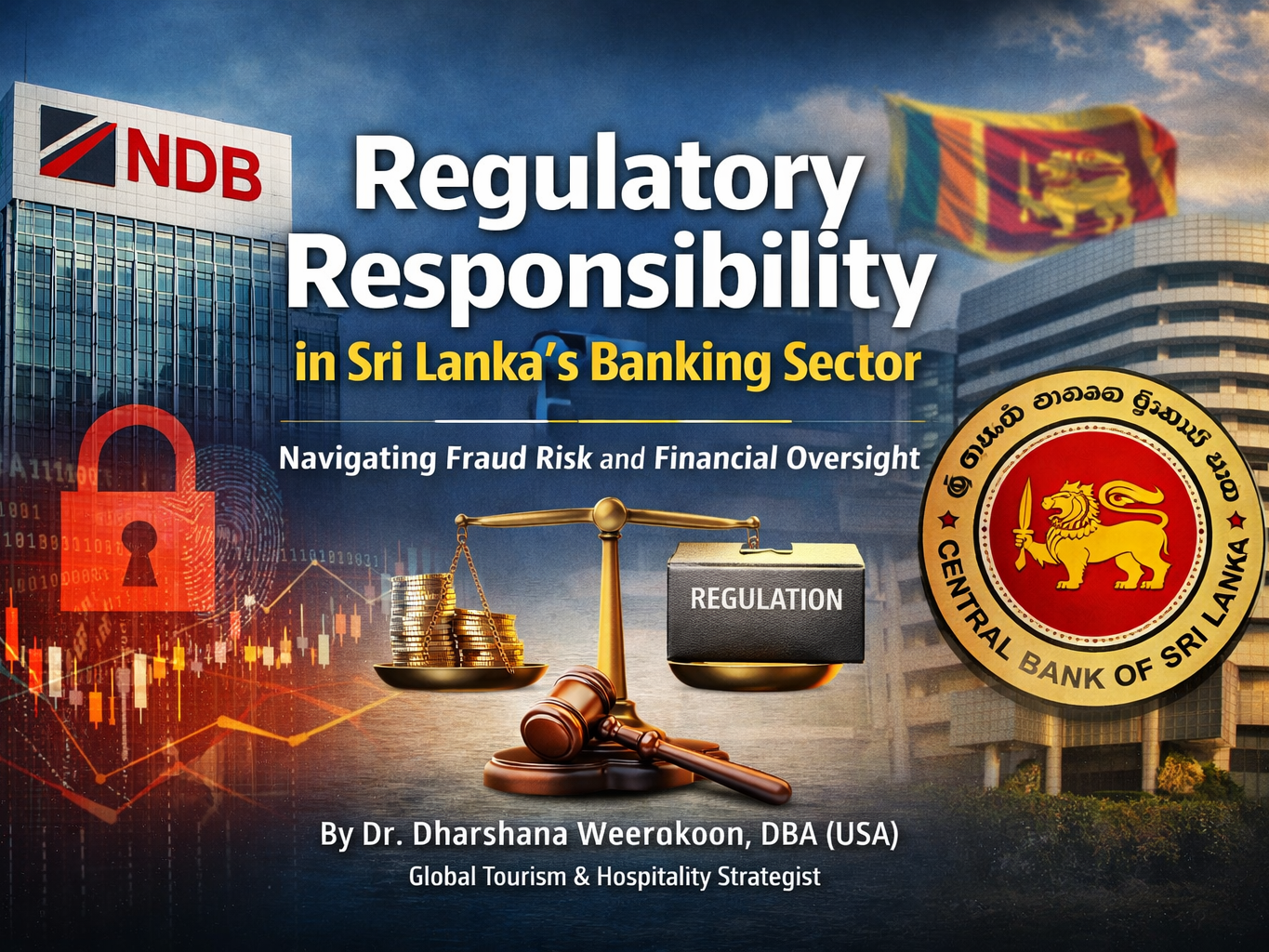
Introduction: A Moment for Reflection, Not Reaction
Recent developments involving NDB Bank have once again drawn public attention to the broader question of governance, oversight, and accountability within Sri Lanka’s financial system.
This article does not assert wrongdoing by any specific institution or individual. Instead, it uses recent developments as a contextual lens to examine the evolving nature of regulatory responsibility and systemic resilience—particularly the role of the Central Bank of Sri Lanka as the apex supervisory authority.
Because when isolated events emerge within regulated environments, the real question is not simply what happened, but rather:
👉 What can the system learn, strengthen, and future-proof?
Understanding the Sri Lankan Banking Landscape
Sri Lanka’s banking sector remains a critical pillar of economic stability, comprising:
- 24 Licensed Commercial Banks (LCBs)
- 6 Licensed Specialized Banks (LSBs)
- Total sector assets exceeding LKR 20 trillion
Over recent years, several structural shifts have shaped the sector:
- Digital banking transactions have increased by over 40% since 2020
- Non-performing loan (NPL) ratios have fluctuated between 3%–13%, reflecting macroeconomic pressures
- Reported operational irregularities and fraud-related concerns have shown a gradual increase of approximately 15–20% over five years
While these figures do not necessarily indicate systemic weakness, they do signal a need for continuous regulatory evolution.
Regulatory Responsibility: A Foundational Perspective
The Central Bank of Sri Lanka operates within a clearly defined mandate:
- Ensuring financial system stability
- Supervising licensed institutions
- Managing systemic risk
- Maintaining public confidence
Importantly, regulatory responsibility is not about eliminating all risk—that would be unrealistic.
Rather, it is about:
👉 Minimizing vulnerabilities, identifying emerging risks early, and ensuring timely corrective frameworks.
Three Layers of Financial Accountability
1. Institutional Responsibility (Primary Layer)
Banks themselves carry the first line of responsibility through:
- Internal controls
- Risk management systems
- Independent audit functions
- Ethical leadership and governance
However, even well-designed systems can face limitations if human, technological, or cultural factors intervene.
2. Regulatory Responsibility (Supervisory Layer)
The Central Bank’s supervisory approach typically includes:
- On-site examinations
- Off-site monitoring
- Risk-based supervision models
- Capital adequacy and stress testing
In modern financial systems, the emphasis is increasingly shifting from:
➡️ Compliance-based supervision
to
➡️ Risk-intelligent supervision
This evolution is critical because:
- Compliance confirms adherence
- Risk intelligence identifies emerging threats
3. Systemic Responsibility (Confidence Layer)
Financial systems operate fundamentally on trust.
Even limited irregularities can influence:
- Depositor confidence
- Investor sentiment
- International credit perception
Therefore, regulatory institutions play a dual role:
👉 Oversight authority
👉 Confidence stabilizer
Global Signals: What the Data Suggests
Across global banking systems:
- Approximately 60% of fraud cases involve internal actors or collusion
- Around 30–35% of fraud incidents remain undetected for extended periods
- Institutions operating under weak supervisory engagement frameworks show higher recurrence of control failures
These trends highlight an important reality:
👉 Fraud risk is evolving, adaptive, and increasingly complex.
Case Studies: Learning Without Attribution
To strengthen perspective, it is useful to examine global cases—not as comparisons, but as learning frameworks.
1. Barings Bank (United Kingdom)
A legacy institution collapsed due to unauthorized trading and control gaps.
Insight: Oversight systems must continuously adapt to operational realities.
2. Wells Fargo (United States)
Internal sales practices led to widespread irregular account creation.
Insight: Organizational culture can influence risk exposure significantly.
3. Punjab National Bank (India)
A large-scale fraud emerged through system-level vulnerabilities.
Insight: Integration gaps between systems can create blind spots.
4. 1MDB (Malaysia)
Complex financial flows highlighted the importance of cross-border regulatory cooperation.
Insight: Oversight must extend beyond domestic boundaries.
5. Danske Bank (Estonia operations)
Large volumes of suspicious transactions passed through undetected channels.
Insight: Scale can sometimes obscure risk visibility.
6. Wirecard (Germany)
Accounting inconsistencies led to one of Europe’s most notable financial collapses.
Insight: Timely verification and independent validation are essential.
7. Local Finance Sector Challenges (Sri Lanka)
Past issues in the non-bank financial sector demonstrate the importance of early regulatory intervention.
Insight: Preventive oversight is more effective than corrective action.
The Emerging Gap: Compliance vs. Predictive Oversight
A critical transition point in global regulation is the shift toward:
- Data-driven supervision
- Behavioral risk analytics
- Predictive anomaly detection
Traditional frameworks often focus on:
✔ What is reported
But modern systems must also consider:
❗ What may not yet be visible
The Human Factor in Financial Risk
Fraud risk is rarely purely technical. It often emerges through a combination of:
- Opportunity
- Pressure
- Rationalization
Therefore, forward-looking oversight may benefit from integrating:
- Organizational behavior analysis
- Incentive structure reviews
- Leadership pattern monitoring
Strengthening the Framework: A Forward-Looking Approach
To enhance resilience, several strategic directions can be considered:
1. Continuous Supervisory Models
Moving from periodic reviews to real-time monitoring environments.
2. Technology Integration
Leveraging AI and advanced analytics for early anomaly detection.
3. Enhanced Reporting Channels
Strengthening whistleblower frameworks with clear protections.
4. Independent Oversight Validation
Encouraging external reviews of supervisory methodologies.
5. Transparent Communication
Promoting clarity without compromising regulatory integrity.
Reframing the Narrative: From Incident to Insight
It is important to emphasize:
👉 Individual events do not define a system
👉 But they can inform how a system evolves
Constructive analysis should therefore focus on:
- Strengthening frameworks
- Enhancing preparedness
- Improving resilience
Conclusion: The Responsibility of Stewardship
Financial systems are built on an implicit social contract:
👉 Institutions operate
👉 Regulators oversee
👉 The public trusts
The Central Bank of Sri Lanka, as the apex regulator, plays a central role in maintaining this balance—not as a fault-finder, but as a system steward.
In an increasingly complex financial environment, the focus must remain on:
- Continuous improvement
- Adaptive regulation
- Proactive risk management
Because ultimately, effective oversight is not about preventing every incident—it is about ensuring that the system remains strong, responsive, and trusted.
Disclaimer
This article has been authored and published in good faith by Dr. Dharshana Weerakoon, DBA (USA), based on publicly available information, general industry knowledge, and professional experience across international financial and corporate environments. It is intended solely for educational, analytical, and public discussion purposes, focusing on regulatory frameworks, governance practices, and systemic risk considerations.
This content does not assert or imply wrongdoing by any specific institution, regulator, or individual. Any references to organizations are used strictly within a contextual and analytical framework. The views expressed are personal and do not constitute legal, financial, or investment advice.
The author assumes no responsibility for external interpretation or application of this content. This article is prepared in alignment with applicable Sri Lankan laws, regulatory standards, and principles of responsible and ethical communication.
✍ Authored independently through professional expertise, analytical insight, and industry experience.
Further Reading: https://www.linkedin.com/newsletters/outside-of-education-7046073343568977920/
Further Reading: https://dharshanaweerakoon.com/strengthening-institutional-integrity/