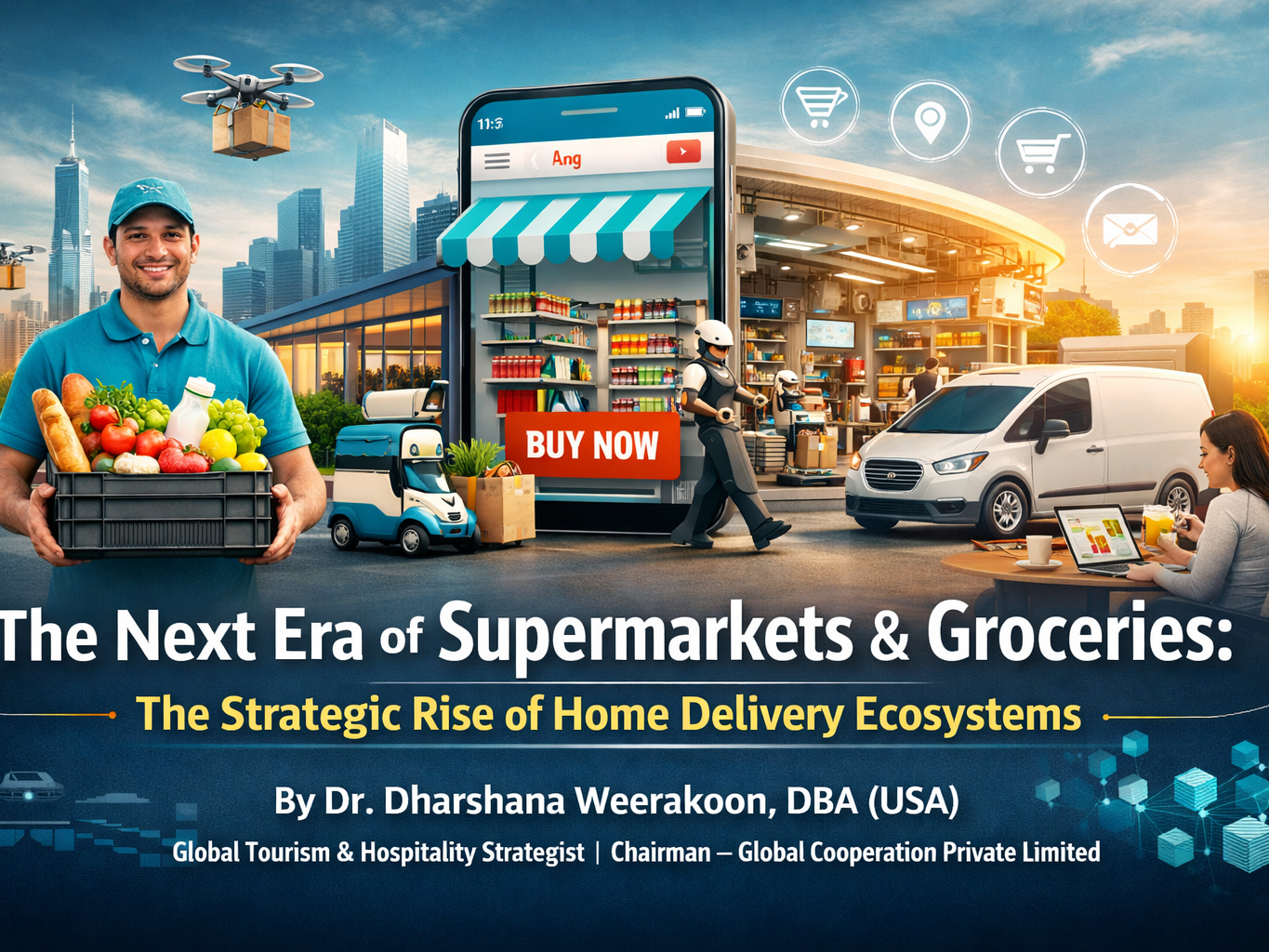
The Next Era of Supermarkets & Groceries: The Strategic Rise of Home Delivery Ecosystems
Introduction: The Quiet Revolution in Retail
A silent yet profound transformation is reshaping the global retail landscape. What was once a convenience—home delivery of groceries—has now become a defining pillar of modern consumer behavior. The supermarket, traditionally a physical destination, is evolving into a decentralized, technology-driven fulfillment ecosystem.
In Sri Lanka and across emerging markets, this transition is not merely about logistics—it is about redefining accessibility, customer expectations, and economic participation. The “next era” of supermarkets is not about bigger stores or wider aisles. It is about bringing the store to the consumer—intelligently, efficiently, and sustainably.
This article explores the structural shift toward home delivery services, supported by data, global benchmarks, and real-world case studies, while contextualizing opportunities for Sri Lanka’s retail and logistics sectors.
The Global Shift: Data-Driven Reality
The numbers clearly indicate that home delivery is no longer optional—it is strategic:
- Global online grocery sales surpassed USD 600 billion in 2025, representing nearly 12–15% of total grocery retail.
- In Asia-Pacific, online grocery penetration has grown by over 20% annually since 2020.
- Consumer surveys reveal that over 70% of urban households now prefer at least partial grocery delivery services.
- In emerging markets, mobile-first commerce accounts for more than 65% of grocery orders.
- The average delivery expectation has dropped from 48 hours (pre-2020) to under 2 hours in urban centers.
Sri Lanka, while still developing in this segment, is witnessing rapid adoption:
- Urban grocery delivery demand increased by an estimated 35–45% post-pandemic.
- Digital payment adoption in retail has grown by over 50% in the last three years.
- Colombo and suburban regions are emerging as micro-fulfillment hotspots.
Redefining the Supermarket: From Physical Store to Digital Fulfillment Hub
The traditional supermarket model is undergoing a structural transformation:
1. From Shelf Space to Screen Space
Consumers are no longer browsing aisles—they are scrolling apps. Product visibility is now governed by algorithms, not shelf positioning.
2. Inventory Becomes Dynamic
Real-time inventory systems now integrate supply chains, reducing wastage and improving demand forecasting.
3. Logistics as Core Competency
Delivery is no longer outsourced—it is a strategic differentiator. Speed, reliability, and transparency define brand loyalty.
4. Data is the New Currency
Consumer purchasing patterns allow hyper-personalization, predictive ordering, and targeted promotions.
The Sri Lankan Context: Opportunity Amid Constraints
Sri Lanka presents a unique environment:
Strengths:
- High mobile penetration
- Growing middle-class demand
- Strong informal retail networks
- Increasing digital literacy
Challenges:
- Infrastructure limitations
- Traffic congestion in urban zones
- Fragmented supply chains
- Price sensitivity among consumers
However, these challenges create opportunities for innovation-led disruption rather than traditional expansion.
Case Studies: Global and Regional Leaders in Home Delivery
1. Amazon Fresh Model (USA & Europe)
Amazon redefined grocery logistics through:
- AI-powered inventory
- Same-day delivery
- Subscription-based loyalty (Prime)
Insight: Integration of logistics + data creates dominance.
2. Tesco Online (UK)
Tesco leveraged its existing store network to build:
- Click-and-collect systems
- Scheduled delivery slots
- Hybrid retail models
Insight: Physical stores can become fulfillment centers.
3. BigBasket (India)
Operating in a similar socio-economic context:
- Focused on tier-2 and tier-3 cities
- Built strong supplier networks
- Introduced subscription models
Insight: Localization is critical in emerging markets.
4. JD.com (China)
JD.com invested heavily in:
- Automated warehouses
- Drone deliveries in rural areas
- Cold-chain logistics
Insight: Infrastructure investment ensures scalability.
5. Instacart (USA)
A platform-based model:
- Uses personal shoppers
- Integrates multiple supermarket brands
- Flexible delivery options
Insight: Platform aggregation can accelerate growth without owning inventory.
6. Keells & Cargills Online (Sri Lanka)
Local supermarket chains have:
- Introduced app-based ordering
- Expanded delivery coverage in Colombo
- Integrated loyalty programs
Insight: Early adopters are setting the foundation for national expansion.
7. Quick Commerce Startups (Global Trend)
Companies like rapid-delivery startups operate on:
- 10–30 minute delivery promises
- Dark stores (no walk-in customers)
- Hyper-local inventory
Insight: Speed is becoming the ultimate competitive advantage.
The Rise of Dark Stores and Micro-Fulfillment Centers
A critical innovation shaping the future:
- Dark Stores: Warehouses designed exclusively for online orders.
- Micro-Fulfillment Centers: Small, automated hubs located near residential zones.
Benefits include:
- Faster delivery times
- Lower operational costs
- Reduced congestion in retail stores
For Sri Lanka, adopting micro-fulfillment in urban clusters like Colombo, Negombo, and Kandy could significantly improve efficiency.
Technology as the Backbone
The next era of grocery delivery is powered by:
Artificial Intelligence
- Demand forecasting
- Route optimization
- Personalized recommendations
Internet of Things (IoT)
- Smart inventory tracking
- Temperature-controlled logistics
Mobile Applications
- Seamless user experience
- Payment integration
- Real-time tracking
Blockchain (Emerging)
- Supply chain transparency
- Food safety verification
Consumer Behavior: The Psychological Shift
Consumers are no longer buying products—they are buying:
- Convenience
- Time efficiency
- Reliability
- Trust
Interestingly, studies show:
- Customers are willing to pay 5–15% premium for faster delivery.
- Subscription models increase retention by over 60%.
- Personalized recommendations improve basket size by 20–30%.
Economic and Social Implications
1. Job Creation
Delivery networks, warehouse operations, and tech support roles are expanding rapidly.
2. SME Integration
Local farmers and small suppliers can directly integrate into digital supply chains.
3. Urban Decongestion
Reduced foot traffic in supermarkets leads to less congestion.
4. Environmental Concerns
However, increased delivery traffic may raise carbon footprints unless managed sustainably.
Sustainability: The Next Competitive Edge
Future-ready grocery systems must address:
- Electric delivery vehicles
- Optimized delivery routes
- Eco-friendly packaging
- Reduced food waste
Sustainability is no longer optional—it is a brand differentiator.
Strategic Recommendations for Sri Lanka
1. Invest in Logistics Infrastructure
Private-public partnerships can improve delivery networks.
2. Encourage Digital Payments
Financial inclusion will accelerate adoption.
3. Support SMEs
Integrate local suppliers into digital ecosystems.
4. Develop Smart Urban Hubs
Micro-fulfillment centers in key cities.
5. Build Consumer Trust
Consistency, transparency, and service quality are critical.
The Future: What Lies Ahead?
The next decade will witness:
- Autonomous delivery systems
- Drone-based logistics (in controlled zones)
- AI-driven predictive shopping (auto-replenishment)
- Fully integrated “smart kitchens” connected to grocery platforms
Ultimately, supermarkets will evolve into invisible infrastructures—present everywhere, yet physically minimal.
Conclusion: From Retail to Ecosystem
The transformation of supermarkets into home delivery ecosystems is not just a technological shift—it is a strategic redefinition of retail itself.
Sri Lanka stands at a pivotal moment. By embracing innovation, strengthening infrastructure, and fostering collaboration, the country can leapfrog traditional retail models and position itself as a regional leader in smart grocery ecosystems.
The question is no longer whether home delivery will dominate—it already is. The real question is:
Who will lead this transformation?
Disclaimer
This article has been authored and published in good faith by Dr. Dharshana Weerakoon, DBA (USA), based on publicly available data from national and international retail, logistics, and economic insights, combined with extensive professional experience across global markets and ongoing industry observation.
It is intended solely for educational, analytical, and public awareness purposes to stimulate discussion on the future of supermarket and grocery delivery ecosystems. The author accepts no responsibility for any misinterpretation, adaptation, or application of the content.
Views expressed are entirely personal and do not constitute legal, financial, operational, or investment advice. This article is designed to align with applicable Sri Lankan laws, including consumer protection regulations, data privacy standards, and ethical business practices.
✍ Authored independently and organically through lived professional expertise.
Further Reading: https://dharshanaweerakoon.com/from-farm-to-doorstep/
Further Reading: https://www.linkedin.com/newsletters/outside-of-education-7046073343568977920/