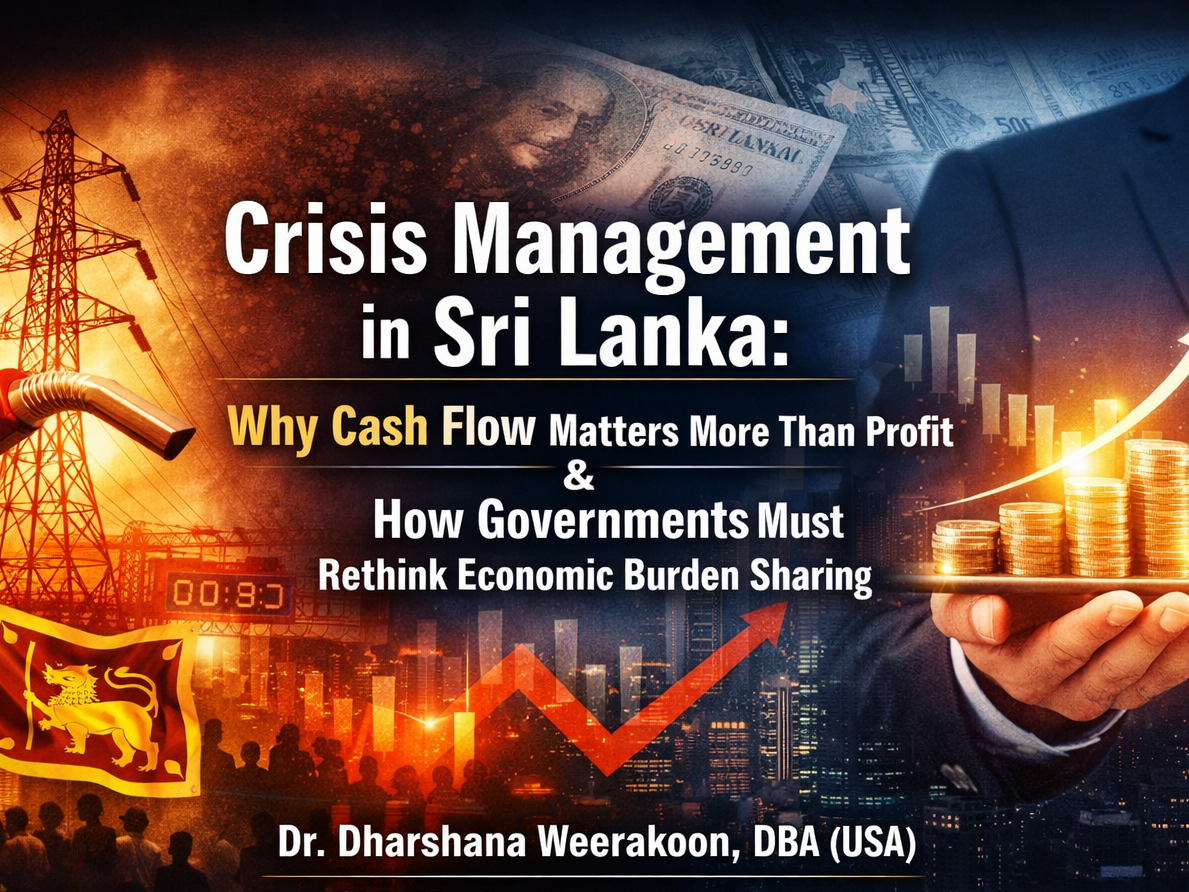
Crisis Management in Sri Lanka: Why Cash Flow Matters More Than Profit & How Governments Must Rethink Economic Burden Sharing
A Strategic Perspective on Economic Survival, Policy Innovation, and Responsible Governance
Introduction: The Reality We Must Accept
Sri Lanka is not unfamiliar with crisis. From foreign exchange shortages to fuel queues, from inflation shocks to debt restructuring, the country has been navigating one of the most complex economic environments in its modern history.
Yet, amid all these discussions—policy debates, fiscal corrections, and restructuring frameworks—one fundamental truth is often misunderstood or overlooked:
Cash flow is far more critical than profit (P&L) in times of crisis.
This is not just a corporate principle—it is a national survival strategy.
If individuals, businesses, and governments maintain positive cash flow, sustainability follows. Profitability is a longer-term outcome. However, without liquidity, even profitable systems collapse.
Therefore, this article aims to challenge conventional thinking and present practical, structured, and globally inspired crisis management mechanisms that Sri Lanka can consider—legally, ethically, and strategically.
Understanding the Core Principle: Cash Flow vs. Profit
In financial management:
- Profit (P&L) is an accounting measure.
- Cash Flow is the actual movement of money.
A country can show:
- Fiscal discipline on paper
- Controlled deficits
- Improved tax revenue
Yet still fail if:
- Citizens cannot afford essentials
- Businesses cannot operate due to liquidity shortages
- Consumption collapses
Sri Lanka’s Current Economic Indicators (Approximate Context)
- Inflation peaked above 70% in 2022, stabilizing later below 10%
- Fuel prices increased by over 200% during peak crisis periods
- Electricity tariffs rose by 75%–130% in phases
- Household real income declined by nearly 25%–40%
- Over 500,000 SMEs faced severe cash flow constraints
These numbers clearly highlight one reality:
The crisis is not just macroeconomic—it is deeply personal and liquidity-driven.
The Traditional Approach: Passing the Burden to the Public
Historically, governments—especially in developing economies—have relied on a predictable mechanism:
- Increase fuel prices
- Increase electricity tariffs
- Adjust taxes (VAT, import duties)
- Reduce subsidies
While economically justifiable under IMF programs, this approach creates:
- Immediate cash flow pressure on households
- Reduced consumer spending
- Lower business turnover
- Increased social dissatisfaction
In simple terms:
The burden flows downward—from government to people.
But the question is:
Can We Redistribute This Burden More Strategically?
A Proposed Alternative: Structured Burden Redistribution Model
Below is a structured framework that Sri Lanka can consider during crisis periods.
1. Quantifying the Population Impact
The starting point must be data-driven:
- Total population: ~22 million
- Estimated households: ~5.5 million
By calculating:
- Average monthly fuel usage per household
- Electricity consumption brackets
- Transportation dependency
The government can determine:
Exact financial impact per household due to price increases
2. Per Capita Crisis Burden Analysis
Let’s assume:
- Fuel + electricity burden increase per household = LKR 25,000/month
This results in:
- National monthly burden: LKR 137.5 billion
This is not just a statistic—it is a cash flow shock to the entire population.
3. Engaging Large Corporations & Multinationals
Sri Lanka hosts:
- Large listed companies
- Multinational corporations
- High-profit sectors (banking, telecom, FMCG, exports)
Estimated:
- Top 100 companies generate billions in post-tax profits annually
Proposal: Temporary Crisis Contribution Mechanism
Instead of increasing taxes broadly:
- Introduce a time-bound “Crisis Stabilization Contribution”
- Apply only to:
- Companies above a profit threshold
- Multinationals repatriating profits
Even a:
- 5%–10% temporary contribution
could generate:
Tens of billions in liquidity relief for the national system
4. Fuel & Electricity Cross-Subsidy Model
Instead of direct price hikes:
- Partially absorb increases using:
- Corporate contributions
- Windfall taxes (temporary)
This ensures:
- Household affordability
- Business continuity
- Economic stability
5. Learning from Developed Economies
Crisis management is not new. Several countries have implemented innovative solutions:
Case Study 1: United Kingdom (Energy Price Cap)
During the energy crisis:
- The government introduced price caps
- Provided energy subsidies to households
- Negotiated with energy companies
Outcome:
- Reduced immediate burden on citizens
- Maintained consumption levels
Case Study 2: France (Electricity Subsidy Model)
France:
- Limited electricity price increases to below 5% initially
- Absorbed cost through state intervention
Outcome:
- Controlled inflation
- Protected middle-class households
Case Study 3: India (Fuel Tax Adjustments)
India:
- Reduced excise duties on fuel during peak inflation
- Balanced revenue loss with economic activity growth
Outcome:
- Stabilized transport costs
- Supported SMEs
Case Study 4: Germany (Corporate Contribution Approach)
Germany introduced:
- Windfall taxes on energy companies
Outcome:
- Redistribution of excess profits
- Funding for public relief programs
Case Study 5: Japan (Consumption Stability Strategy)
Japan:
- Focused on maintaining consumer spending power
- Used targeted subsidies and corporate cooperation
Outcome:
- Prevented economic contraction
Case Study 6: South Korea (Public-Private Coordination)
South Korea:
- Engaged large corporations in national crisis strategy
- Encouraged voluntary contribution frameworks
Outcome:
- Stronger national resilience
Case Study 7: Singapore (Targeted Financial Support)
Singapore:
- Provided direct cash support
- Used reserves strategically
Outcome:
- High public confidence
- Stable economic recovery
6. Price Stabilization Through Retail Sector Collaboration
Another innovative approach:
Temporary Retail Price Reduction Agreements
Government can:
- Engage major supermarket chains
- Request controlled pricing for essential goods
In return:
- Offer tax incentives
- Reduce regulatory burdens
- Provide supply chain support
This is already practiced in some developed markets.
7. Redirecting CSR Funds for National Stability
Sri Lanka has:
- Active CSR culture across corporates
- Contributions from:
- Private companies
- Service organizations (Rotary, Lions, etc.)
Proposal: Temporary National CSR Pool
For a defined period:
- Redirect CSR funds into:
- Fuel subsidy support
- Electricity relief programs
This ensures:
CSR directly impacts national economic survival—not just branding exercises
Economic Logic Behind These Proposals
This approach is not about:
- Penalizing corporations
- Over-regulating markets
It is about:
Short-Term Stabilization for Long-Term Growth
When households:
- Retain spending power
- Avoid financial collapse
Businesses benefit through:
- Sustained demand
- Operational continuity
Government benefits through:
- Stable tax revenue
- Reduced social unrest
Challenges & Considerations
Of course, such models require careful execution:
Legal Framework
- Must comply with taxation laws
- Avoid discrimination
Investor Confidence
- Ensure measures are:
- Transparent
- Time-bound
- Predictable
Corporate Resistance
- Address through:
- Dialogue
- Incentives
- Policy clarity
The Bigger Issue: Leadership Mindset
One of the most critical observations is this:
Governments often focus on blame rather than solutions
While historical accountability is important, crisis management requires:
- Speed
- Innovation
- Courage
Sri Lanka needs:
- Action-driven governance
- Out-of-the-box thinking
- Public-private collaboration
Conclusion: A Call for Strategic Courage
Sri Lanka is at a defining moment.
The country does not lack:
- Talent
- Resources
- Global exposure
What is needed is:
A shift in thinking—from reactive governance to strategic crisis management
If we understand and implement:
- Cash flow prioritization
- Burden redistribution
- Corporate partnership
- Consumer protection
Sri Lanka can not only survive—but emerge stronger.
Final Thought
“In times of crisis, survival is not about who earns more—it is about who manages liquidity better.”
Disclaimer
This article has been authored and published in good faith by Dr. Dharshana Weerakoon, DBA (USA), based on publicly available macroeconomic indicators, general fiscal trends, and professional experience across international business, tourism, and economic environments.
It is intended solely for educational, analytical, and public discussion purposes, particularly in relation to crisis management frameworks and economic policy thinking in Sri Lanka.
The views expressed are entirely personal and do not constitute legal, financial, taxation, or investment advice. Any policy suggestions presented are conceptual in nature and must be evaluated within the framework of Sri Lankan law, regulatory requirements, and international obligations before implementation.
The author assumes no responsibility for any decisions made based on this content or for any misinterpretation thereof. All recommendations are designed to align with ethical governance principles, non-discriminatory practices, and applicable legal standards in Sri Lanka.
✍ Authored independently based on professional expertise, economic observation, and strategic insight.
Further Reading: https://www.linkedin.com/newsletters/7046073343568977920/
Further Reading: https://dharshanaweerakoon.com/sri-lanka-fuel-crisis/