Healing Beneath the Waves: Why “Scuba-for-Stress Tourism” Could Be the Next Global Tourism Revolution
Coral Reef Restoration as Therapy – A New Frontier for Sustainable Tourism
Introduction: Tourism Must Now Heal Both People and the Planet
Tourism has always evolved alongside human needs.
In earlier decades, travel was primarily about escape, entertainment, and leisure. Later, it expanded into luxury experiences and adventure tourism. Today, however, the expectations of travellers are changing rapidly. Increasingly, tourists are looking for something deeper — purpose, meaning, and personal transformation.
This shift has given rise to several new tourism concepts including wellness tourism, eco-tourism, and regenerative tourism. Yet one of the most innovative ideas now emerging globally lies at the intersection of marine conservation, mental wellness, and experiential travel.
This concept is commonly described as “Scuba-for-Stress Tourism.”
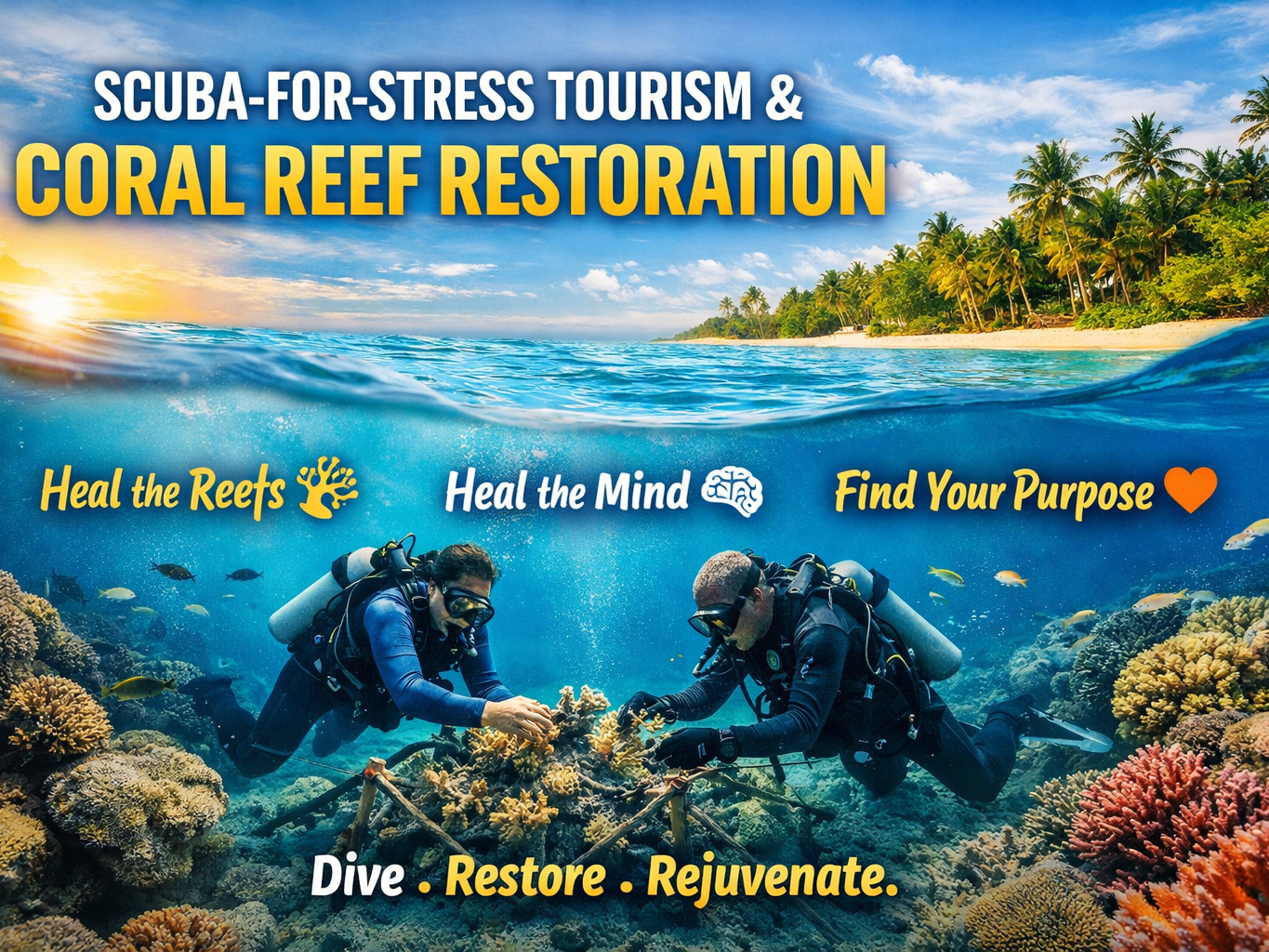
Under this model, travellers participate in coral reef restoration activities while engaging in guided scuba diving experiences designed to support psychological well-being. Rather than simply observing marine life, participants actively help restore damaged reefs while experiencing the therapeutic effects of the ocean.
The idea is powerful in its simplicity:
Restore the reef. Restore the mind.
For a nation like Sri Lanka, surrounded by the Indian Ocean and blessed with extraordinary marine biodiversity, this concept represents a remarkable opportunity to combine tourism innovation, environmental responsibility, and wellness experiences.
However, to fully appreciate the potential of Scuba-for-Stress Tourism, it is necessary to understand two parallel global challenges: the mental health crisis affecting modern societies and the ecological crisis facing coral reefs worldwide.
The Global Mental Health Crisis and the Rise of Wellness Tourism
Modern lifestyles have become increasingly stressful.
According to global health data, nearly one in eight people worldwide lives with some form of mental health condition, including anxiety disorders, depression, burnout, or chronic stress. Work-related pressure, digital overload, urban lifestyles, and post-pandemic social changes have significantly increased psychological strain across many populations.
Consequently, tourism behaviour is changing.
More travellers now prioritize experiences that promote mental balance, emotional well-being, and personal reflection. Activities such as yoga retreats, meditation programs, forest bathing, and digital detox holidays have grown significantly in popularity.
The global wellness tourism market has expanded rapidly and is estimated to exceed USD 900 billion, with strong growth projected over the next decade.
However, most wellness tourism experiences remain land-based.
Ironically, one of the most powerful environments for psychological restoration lies beneath the surface of the ocean.
The Therapeutic Power of the Ocean
Scientists increasingly recognize the mental health benefits associated with “blue environments,” which include oceans, lakes, and rivers.
The ocean environment stimulates a calming effect on the human brain through several mechanisms.
First, scuba diving requires slow, controlled breathing, which naturally reduces heart rate and stabilizes the nervous system. This breathing pattern is similar to meditation techniques used in stress-reduction therapy.
Second, the sensation of weightlessness underwater relieves physical tension in muscles and joints, creating a unique feeling of relaxation.
Third, the visual experience of observing coral reefs, fish, and marine landscapes stimulates feelings of wonder and fascination, which psychologists describe as a form of awe-based therapy.
These elements combine to create a deeply calming experience that many divers describe as mentally transformative.
However, when divers actively participate in coral reef restoration, the experience becomes even more meaningful.
Participants no longer feel like passive observers of nature. Instead, they become contributors to environmental recovery, which strengthens emotional engagement and creates a powerful sense of purpose.
Coral Reefs: One of Earth’s Most Valuable Ecosystems
Coral reefs are among the most important ecosystems on the planet.
Although reefs occupy less than one percent of the ocean floor, they support nearly 25 percent of all marine species. Coral reefs function as underwater cities that provide shelter, food, and breeding grounds for countless marine organisms.
Beyond biodiversity, reefs also play critical roles in:
• supporting fisheries
• protecting coastlines from storms
• sustaining marine tourism industries
• maintaining ecological balance
However, coral reefs worldwide are facing severe threats.
Climate change, ocean acidification, coastal pollution, destructive fishing practices, and uncontrolled tourism have contributed to the rapid degradation of reef ecosystems.
Current estimates indicate that approximately 50 percent of the world’s coral reefs have already been lost. Scientific projections suggest that up to 90 percent could disappear by 2050 if restoration efforts are not significantly expanded.
For island nations such as Sri Lanka, the loss of coral reefs would have serious consequences for marine biodiversity, coastal protection, fisheries, and tourism development.
Therefore, coral restoration is not simply an environmental concern. It is also a strategic economic priority.
The Emergence of “Scuba-for-Stress Tourism”
In response to these environmental and social challenges, innovative tourism programs have begun to emerge around the world.
These programs combine marine conservation activities with therapeutic diving experiences.
Participants typically engage in several structured activities including:
• coral nursery maintenance
• coral fragment transplantation
• reef monitoring and ecological observation
• marine conservation workshops
• guided mindfulness diving sessions
The combination of physical activity, environmental contribution, and emotional immersion in nature produces strong psychological benefits.
Participants frequently report increased levels of:
• relaxation
• personal fulfilment
• environmental awareness
• emotional resilience
In many cases, travellers describe these experiences as life-changing, because they reconnect individuals with nature in a direct and meaningful way.
Global Case Studies: Successful Models of Coral Restoration Tourism
Several international destinations have already demonstrated that coral restoration tourism can be both environmentally beneficial and economically viable.
The Great Barrier Reef – Australia
Australia has developed multiple tourism initiatives linked to the restoration of the Great Barrier Reef, the largest coral ecosystem on Earth.
Divers and tourists participate in coral propagation workshops, underwater planting programs, and reef monitoring activities supervised by marine scientists.
These experiences allow travellers to directly contribute to reef recovery while learning about marine ecosystems.
Coral Gardeners – French Polynesia
In Moorea, the Coral Gardeners initiative has gained global recognition for its innovative coral restoration program.
Tourists assist marine biologists in cultivating coral fragments in underwater nurseries before transplanting them onto degraded reefs. Educational workshops help participants understand reef ecology and conservation strategies.
Reef Check EcoDiver Program – Global
The Reef Check program trains divers worldwide to conduct reef health monitoring surveys.
Participants learn to identify coral species, measure reef conditions, and collect ecological data that supports marine research. This approach transforms recreational divers into citizen scientists.
Florida Keys Coral Restoration Foundation – USA
The Florida Keys host one of the largest coral restoration initiatives in the world.
Thousands of volunteer divers participate annually in coral nursery maintenance and reef transplantation programs. Tourism operators combine these activities with educational workshops and environmental awareness programs.
Bali Reef Rehabilitation – Indonesia
Indonesia has introduced innovative reef rehabilitation techniques using metal “reef star” structures that support coral growth.
Tourists assist in assembling these structures and attaching coral fragments, creating hands-on conservation experiences while supporting reef recovery.
Maldives Resort Coral Restoration Programs
Luxury resorts across the Maldives now offer coral restoration experiences for guests.
Visitors can build coral frames, assist marine biologists, and monitor reef development during their stay. These programs demonstrate that sustainability can coexist with luxury tourism.
Red Sea Marine Conservation Diving – Egypt
Several dive operators in the Red Sea region have introduced conservation diving programs that combine reef restoration activities with mindfulness-based diving practices.
These experiences attract international divers seeking both adventure and purpose.
Why Sri Lanka Has Extraordinary Potential for Scuba-for-Stress Tourism
Sri Lanka possesses several natural advantages that could support the development of Scuba-for-Stress Tourism.
Strategic Marine Biodiversity
Located within the Indian Ocean biodiversity corridor, Sri Lanka hosts diverse coral reef ecosystems that support rich marine life.
Established Diving Destinations
The country already offers world-class diving sites including:
• Hikkaduwa
• Unawatuna
• Kalpitiya
• Trincomalee
• Pigeon Island Marine National Park
These locations attract divers from Europe, Asia, and Australia.
Growing Wellness Tourism Reputation
Sri Lanka is globally recognized for its Ayurveda wellness tourism, meditation retreats, and holistic healing traditions.
Therefore, integrating ocean-based therapy experiences would be a natural extension of the country’s wellness tourism portfolio.
Demand for Purpose-Driven Travel
Modern travellers increasingly prefer experiences that create positive social and environmental impact.
Consequently, Scuba-for-Stress Tourism could position Sri Lanka as a global pioneer in ocean-based wellness and conservation tourism.
Economic Opportunities for Sri Lanka
If implemented responsibly, this tourism model could generate multiple economic benefits.
First, scuba divers typically spend three to five times more than average beach tourists due to equipment rentals, dive training, and specialized excursions.
Second, coral restoration programs usually require multi-day participation, encouraging longer tourist stays.
Third, such programs would create new employment opportunities including:
• dive instructors
• marine conservation guides
• environmental educators
• research assistants
• eco-tourism coordinators
Finally, Sri Lanka could differentiate itself globally as a destination offering purpose-driven ocean experiences rather than simply traditional beach tourism.
Building a Scuba-for-Stress Tourism Framework in Sri Lanka
For such programs to succeed, strong collaboration between multiple stakeholders would be essential.
These stakeholders include:
• Sri Lanka Tourism Development Authority
• marine conservation organizations
• universities and research institutions
• professional dive operators
• coastal communities
Key components of the framework could include:
• coral nurseries and restoration sites
• diver education and certification programs
• marine conservation workshops
• environmental monitoring systems
• underwater mindfulness and wellness experiences
However, strict environmental safeguards must guide the development of these programs.
Tourism should support marine ecosystems, not damage them.
Ethical and Environmental Responsibilities
While conservation tourism offers tremendous potential, it must be implemented responsibly.
Unregulated programs could unintentionally harm fragile reef environments.
Therefore, all activities must operate under the supervision of qualified marine scientists and conservation authorities.
Strict guidelines must govern diver training, reef interaction, and ecological monitoring.
The objective is not to commercialize conservation, but to strengthen it through responsible participation.
The Future of Tourism: Travel That Creates Impact
Tourism is entering a new era.
In the past, tourism focused primarily on consumption and entertainment. Today it increasingly focuses on experience and authenticity.
The next stage of tourism development will focus on positive impact.
Programs such as Scuba-for-Stress Tourism represent this emerging philosophy.
They demonstrate that tourism can simultaneously support:
• environmental restoration
• mental wellness
• community development
• sustainable economic growth
For Sri Lanka, embracing this vision could create a new global identity.
Instead of simply being known as a beach destination, the country could become recognized as the Indian Ocean’s leading destination for ocean-based wellness and conservation tourism.
Ultimately, when travellers help restore coral reefs, they are not only protecting marine ecosystems.
They are rediscovering something profoundly human — our connection with nature.
And perhaps that connection is the most powerful form of healing we can experience.
Disclaimer
This article has been authored and published in good faith by Dr. Dharshana Weerakoon, DBA (USA) based on publicly available tourism and environmental data, insights from international marine conservation initiatives, and the author’s professional experience in tourism strategy, hospitality development, and sustainable destination planning across multiple regions.
The content is intended solely for educational, journalistic, and public awareness purposes to encourage informed dialogue on innovative and sustainable tourism development models relevant to Sri Lanka and the wider global tourism industry.
The views expressed are entirely personal, analytical, and professional observations and do not constitute legal, scientific, financial, or investment advice.
All conceptual discussions related to Scuba-for-Stress Tourism and coral reef restoration participation models are presented in alignment with responsible tourism principles, marine conservation ethics, and applicable environmental protection standards.
The author accepts no responsibility for any misinterpretation, adaptation, or misuse of the ideas presented.
✍ Authored independently through professional expertise, analytical insight, and industry observation.
Further Reading: https://www.linkedin.com/newsletters/7046073343568977920/
Further Reading: https://dharshanaweerakoon.com/wellness-data-sovereignty-2/